
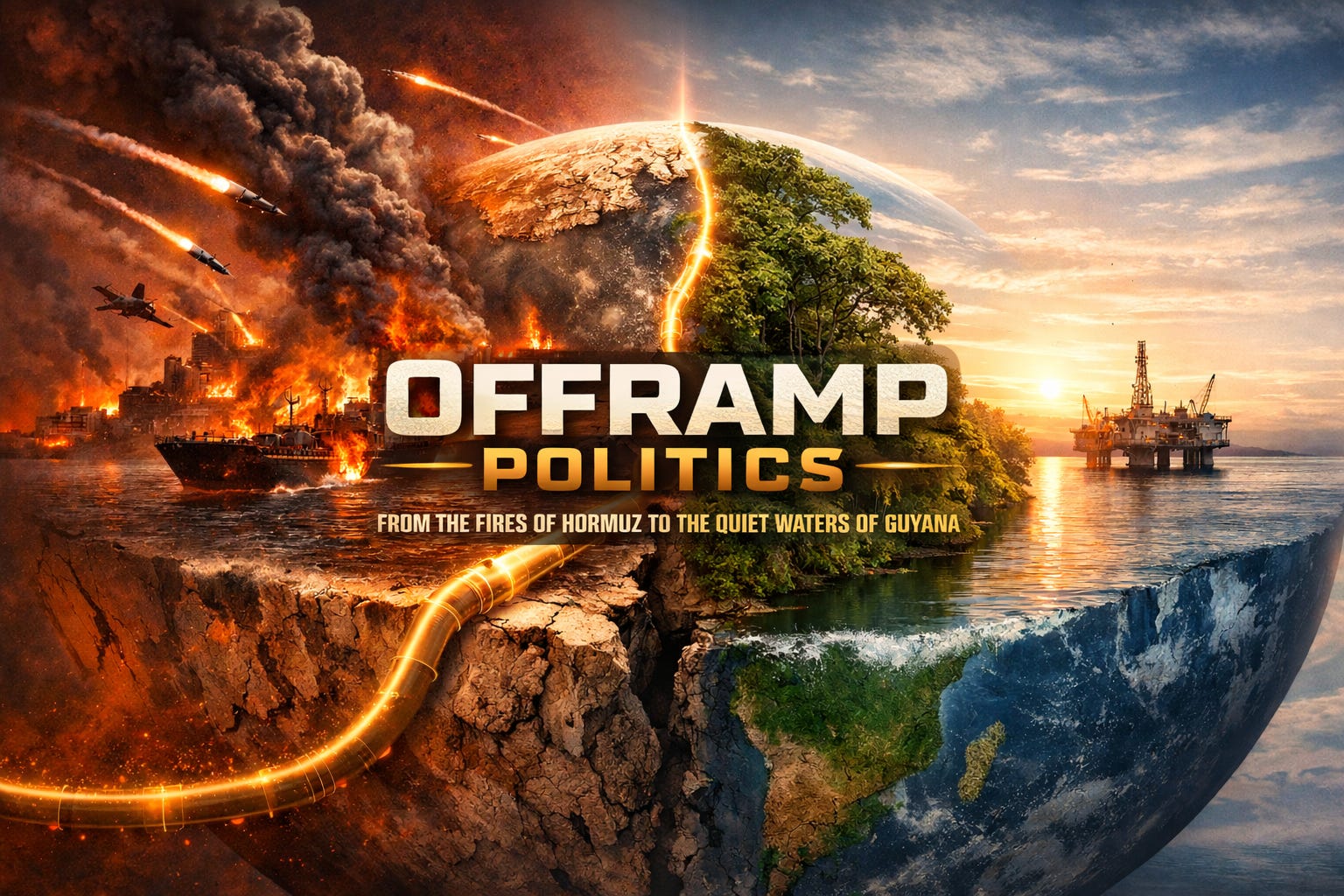
When War Raises the Value of Quiet Places
How the Iran conflict is quietly strengthening Guyana’s future
Most people looking at the current situation involving Iran are viewing it through a familiar political lens. The conversation quickly settles into the usual arguments. Who started it. Whether Israel is justified. Whether the United States should be involved. The debate becomes another geopolitical food fight played out across television and social media.
But very few people are stepping back and asking a different question.
What does this conflict mean for places that are nowhere near the Persian Gulf?
Because when missiles fly in the Middle East, the effects rarely stay there. They ripple outward through oil markets, alliances, and security arrangements across the world.
One of the places quietly feeling those ripples is Guyana.
Rising geopolitical risk in the Gulf pushes oil prices higher, which immediately increases the value of Guyana’s rapidly expanding offshore production in the Stabroek Block. But the impact may run deeper than prices alone. For years Venezuela, under Nicolás Maduro, has strengthened its relationship with Iran through oil cooperation and sanctions-evasion networks. That same Venezuelan government has repeatedly threatened to seize Guyana’s Essequibo region by force — a territory that sits adjacent to the massive offshore oil discoveries now transforming the country’s future.
Seen from Georgetown rather than Washington, the Iran conflict reveals something different.
It reveals how quickly global power shifts can change the strategic value of a small country sitting on a very large energy discovery.
And right now, those shifts appear to be tilting quietly in Guyana’s favor.
There is an old pattern in global energy markets.
War in one region rarely stays confined to that region. Its consequences ripple outward through shipping lanes, financial markets, and energy infrastructure.
When missiles fly in the Middle East, traders in London, Houston, and Singapore do not watch the battlefield. They watch oil prices.
The recent escalation involving Iran has already begun to send those signals.
Prices have moved upward, markets have priced in risk to shipping lanes, and analysts have begun discussing the vulnerability of the world’s most important oil chokepoint: the Strait of Hormuz.
Nearly a fifth of the world’s oil supply flows through that narrow corridor.
When tension rises there, the entire global energy system becomes more fragile.
And in those moments, the market begins looking for something it always seeks during instability:
reliable barrels.
That is where Guyana quietly enters the story.
The Geography of Stability
Energy markets are not simply about oil. They are about geography, security, and predictability.
The massive discoveries offshore Guyana in the Stabroek Block sit far from the geopolitical fault lines that dominate Middle Eastern production.
No regional proxy wars.
No strategic chokepoints controlling exports.
No militant groups targeting infrastructure.
Instead, Guyana’s oil moves through the open Atlantic.
In an era where instability can remove millions of barrels from the market overnight, that geographic reality matters.
It makes Guyana something the global energy system increasingly values:
a stable producer.
And stability commands a premium.
The Scale of the Discovery
When the first major discovery was announced in 2015, few people outside the energy industry grasped the scale of what had been found.
Today the ExxonMobil-led consortium — which includes Hess Corporation and CNOOC — has identified more than 11 billion barrels of recoverable oil equivalent offshore Guyana.
Production has already surged past 600,000 barrels per day.
Within the next several years, analysts expect output to exceed 1 million barrels per day.
For a nation of fewer than one million people, that is a transformation few countries in modern history have experienced.
The arithmetic is staggering.
At $80 oil, a million barrels per day represents roughly:
$80 million in daily revenue flowing from the basin.
But the real story is not the headline number.
It is the structure of the deal that governs how that revenue flows.
The Exxon Contract
Guyana’s oil development operates under a production sharing agreement covering the Stabroek Block.
Critics often focus on the 2 percent royalty, arguing it is lower than many producing countries.
That criticism is understandable, but it also misses an important structural reality.
The contract allows the consortium to recover up to 75 percent of production as cost oil.
The remaining production becomes profit oil, which is split evenly between Guyana and the consortium.
In the early years of a project, this means a large portion of production goes toward recovering the enormous capital investments required to build offshore infrastructure.
But over time something important happens.
Costs fall.
Infrastructure is paid for.
And a larger portion of production shifts into the profit-oil category.
That is when government revenue begins accelerating.
Volume Changes Everything
The second factor transforming Guyana’s outlook is simple scale.
Production in the Stabroek basin is expected to nearly double again within the next few years as additional floating production vessels come online.
That expansion alone could push government revenue into the billions of dollars annually.
For a country whose national budget was once measured in the low billions, the implications are enormous.
Oil does not simply increase revenue.
It changes the entire economic architecture of a nation.
Infrastructure becomes possible.
Education systems expand.
Regional influence grows.
But those benefits are never automatic.
The Global Energy Map Is Shifting
The Iran crisis highlights a broader trend already underway.
For decades, global oil markets have been heavily dependent on the Middle East.
But a new energy corridor is emerging across the Atlantic basin.
From Brazil to Guyana to Suriname, massive offshore discoveries are reshaping where future supply will come from.
These basins share a common advantage.
They sit far from many of the geopolitical conflicts that define the Persian Gulf.
As the world seeks diversification of supply, Atlantic producers are becoming strategically important.
Guyana now sits near the center of that shift.
The Only Real Risk
History offers many examples of countries blessed with extraordinary natural resources.
Not all of them prosper.
The greatest danger rarely comes from outside threats.
It comes from within.
Oil revenue introduces new political incentives, new financial pressures, and new opportunities for corruption.
Small states suddenly managing billions in energy revenue must develop institutions capable of handling wealth at a scale they have never encountered before.
This is where Guyana’s future will ultimately be decided.
Not in the oil fields.
But in its politics.
The global market may reward Guyana with rising demand for its oil. The discoveries offshore may place the country among the fastest-growing energy producers in the world. But none of those advantages matter if the political system tasked with governing that wealth remains fragile.
And there are signs that Guyana still has serious institutional work ahead.
One of the clearest examples emerged in the controversy surrounding Azruddin Mohamed, a prominent businessman whose family operates one of the country’s largest gold trading operations through Mohamed’s Enterprise.
U.S. authorities have accused the Mohamed network of participating in a massive gold smuggling scheme that allegedly moved billions of dollars in undeclared gold through international markets. According to the indictment and sanctions actions, the scheme involved falsifying export documentation and laundering gold through the United States financial system.
Gold has long been one of Guyana’s most important natural resources.
But the allegations surrounding the Mohamed network highlight a deeper problem: weak oversight in sectors where large volumes of natural wealth move through opaque financial channels.
In many ways the case serves as a warning sign.
If Guyana struggled to monitor and regulate its gold sector effectively, the challenge of managing a rapidly expanding oil economy will be exponentially larger.
And the Mohamed situation is not simply a criminal case. It is also a political one.
The businessman has deep political connections inside Guyana and has been publicly linked to senior figures in the government. Those relationships have fueled concerns among observers that political influence may have shielded powerful actors from scrutiny for years.
Whether those concerns ultimately prove justified is less important than what the episode reveals.
It reveals how easily natural resource wealth can become entangled with political patronage networks.
That is precisely the dynamic that has undermined resource-rich countries across the world.
Guyana cannot afford to fall into that pattern.
The stakes are simply too high.
At the same time, the country’s political environment has already shown signs of instability during its most recent elections.
The 2020 election became one of the most contentious political crises in modern Caribbean history. The vote count was disputed for months, accusations of fraud circulated widely, and the country endured an extended period of uncertainty before the results were finally resolved.
The dispute ultimately required international scrutiny, recounts, and intense diplomatic pressure before a final outcome was accepted.
For a country standing at the doorstep of an oil boom, that kind of electoral instability carries real risks.
Energy investors, international partners, and financial institutions all look for one thing above almost anything else:
predictable governance.
The more valuable Guyana’s oil sector becomes, the more important its political stability will be to the global energy system.
The next national election will therefore be watched closely — not only by Guyanese citizens, but by energy companies, foreign governments, and global markets that increasingly view Guyana as a critical emerging supplier.
None of this means Guyana is destined to fail.
Quite the opposite.
The country still has a rare opportunity.
The scale of the oil discoveries offshore gives Guyana the financial resources to build strong institutions, modern infrastructure, and long-term economic stability.
But those outcomes are not guaranteed.
Oil wealth does not automatically create prosperity.
It magnifies whatever political system already exists.
If that system is disciplined and transparent, the results can be transformative.
If it is captured by patronage networks and corruption, the results can be destructive.
That is the quiet tension now surrounding Guyana’s future.
The geology beneath the Atlantic seabed has already delivered extraordinary fortune.
What remains uncertain is whether the political system above it will prove worthy of the opportunity.
A Crossroads Moment
Guyana today stands at a crossroads that other resource-rich nations have faced before.
Some countries allowed oil wealth to distort their political systems.
Others used it to build institutions that lasted generations.
The difference was rarely geology.
It was governance.
If Guyana maintains political stability, strengthens its institutions, and manages its oil revenue with discipline, the nation could become one of the most remarkable economic success stories of the 21st century.
But if political conflict undermines those institutions, the opportunity could slip away just as quickly as it appeared.
The Quiet Future
Wars in distant regions often reveal the hidden value of stability.
As tensions rise in the Middle East and oil markets react, the importance of reliable producers becomes clearer.
Guyana’s emergence as an energy power was already underway.
The current geopolitical turbulence simply makes that reality harder to ignore.
In a world increasingly defined by uncertainty, quiet places with stable institutions and abundant resources tend to grow more important.
Guyana may soon find itself among them.


