


Something unusual is happening in the global economy.
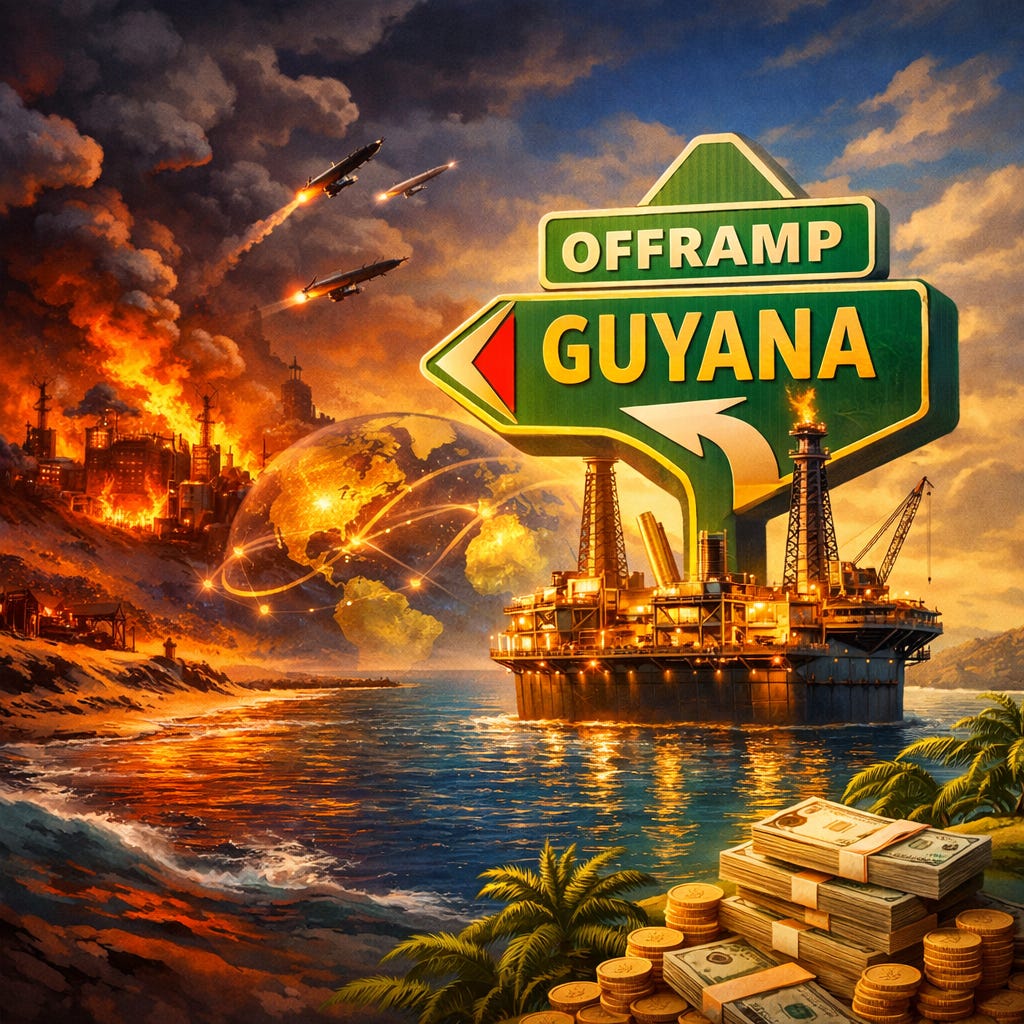
Missiles are flying across the Middle East. Tankers are being rerouted. Analysts are appearing on television warning about shipping lanes, escalation risks, and whether the Strait of Hormuz could become the next geopolitical choke point.
The focus, understandably, is on the region where the fighting is happening.
But oil markets do not operate on geography alone.
They operate on fear.
And when fear enters oil markets, prices rise everywhere.
Which means something quietly remarkable is happening thousands of miles away, off the northern coast of South America.
Guyana is getting richer.
Not slowly.
Not incrementally.
Rapidly.
And the reason has very little to do with anything Guyana itself has done in the past few weeks.
It has to do with the instability of the Middle East.
The Quiet Arithmetic of Global Conflict
Guyana’s offshore oil production has expanded rapidly over the past year.
Production is now approaching roughly 900,000 barrels per day from the Stabroek Block operated by ExxonMobil and its partners.
At the same time, geopolitical risk surrounding Iran has pushed oil prices toward the $100 per barrel range.
When you multiply those two numbers together, the scale becomes easier to understand.
900,000 barrels per day
× roughly $100 per barrel
That equals about $90 million worth of oil leaving Guyana’s waters every single day.
Under Guyana’s current production sharing agreement, the government receives revenue through a combination of royalties and profit oil that roughly equates to about 14 to 15 percent of the total value of production.
When you apply that percentage to the current market value of Guyana’s daily production, the government’s share works out to roughly:
$13 million per day.
Every day.
Just a year ago the math looked very different.
In early 2025, Guyana was producing closer to 630,000 barrels per day, and oil prices were hovering around $80 per barrel.
At those levels, the government’s daily revenue from oil was closer to $7 million per day.
In other words, Guyana’s oil revenue has nearly doubled in the span of a year.
And part of that increase is coming directly from geopolitical instability far from Guyana’s shores.
A Strange Global Incentive
This creates a curious reality.
The more unstable the Middle East becomes, the more valuable Guyana’s oil becomes.
Investors want supply that is politically stable.
Refiners want barrels that are not at risk of sanctions, blockades, or missile strikes.
And in a volatile world, Guyana increasingly looks like one of the safest sources of new oil supply anywhere on Earth.
That places the country in an unusual position.
Guyana is no longer simply an emerging oil producer.
It is becoming a stabilizing pillar in the global energy system.
When markets are nervous, Guyanese barrels calm them down.
And that means something important.
Guyana is now needed.
Not just by oil companies.
By the global economy.
Stability Has Value
But political stability is not automatic.
Guyana is a young democracy with deep historical divisions and real economic pressures. The oil boom has brought opportunity, but it has also brought expectations.
The people of Guyana have lived through decades where the country’s resources did not translate into broad prosperity.
Now they are watching billions of dollars of oil flow out of the seabed.
And they understandably want to see that prosperity reach their homes.
Last year, the government issued a national cash grant to citizens when oil revenues were significantly lower than they are today.
At the time, the policy made sense.
It was a signal.
A reminder that the oil wealth belonged not only to the state, but to the people.
Today the revenue environment has changed dramatically.
Guyana is earning millions more every single day than it was just a year ago.
Which raises a simple question.
Should the people share directly in that increase?
A Thank You to the Nation
One way to reinforce stability in a rapidly changing economy is to ensure that citizens see tangible benefits from national success.
Cash grants are not charity.
They are recognition.
Recognition that a nation’s stability is built not only by governments and corporations, but by ordinary citizens who continue to work, build families, and hold communities together while the country transforms around them.
Guyana’s oil sector depends heavily on something that cannot be drilled from the seabed.
Public trust.
Investors are pouring billions into offshore projects because they believe Guyana will remain politically stable.
That stability exists because the Guyanese people continue to show resilience, patience, and unity despite the enormous changes underway.
At moments like this, governments have an opportunity to reinforce that social contract.
A new cash grant could function not only as economic relief, but as a national statement.
A statement that the oil wealth flowing from Guyana’s waters belongs to the entire nation.
And a simple message of appreciation.
Thank you.
Thank you for maintaining unity.
Thank you for protecting stability.
Thank you for helping build a country that the global economy increasingly depends on.
The Strategic Moment
History shows that resource booms can divide nations just as easily as they enrich them.
Guyana has the opportunity to chart a different path.
A path where prosperity is visible.
Shared.
And felt immediately.
In a world where geopolitical shocks are sending oil prices upward, Guyana’s strategic importance is rising with them.
That makes stability inside the country more valuable than ever before.
And sometimes the most powerful way to strengthen stability is also the simplest.
Let the people share directly in the success they helped create.
Because when the world depends on Guyana’s stability, investing in the Guyanese people is not just generosity.
It is strategy.