
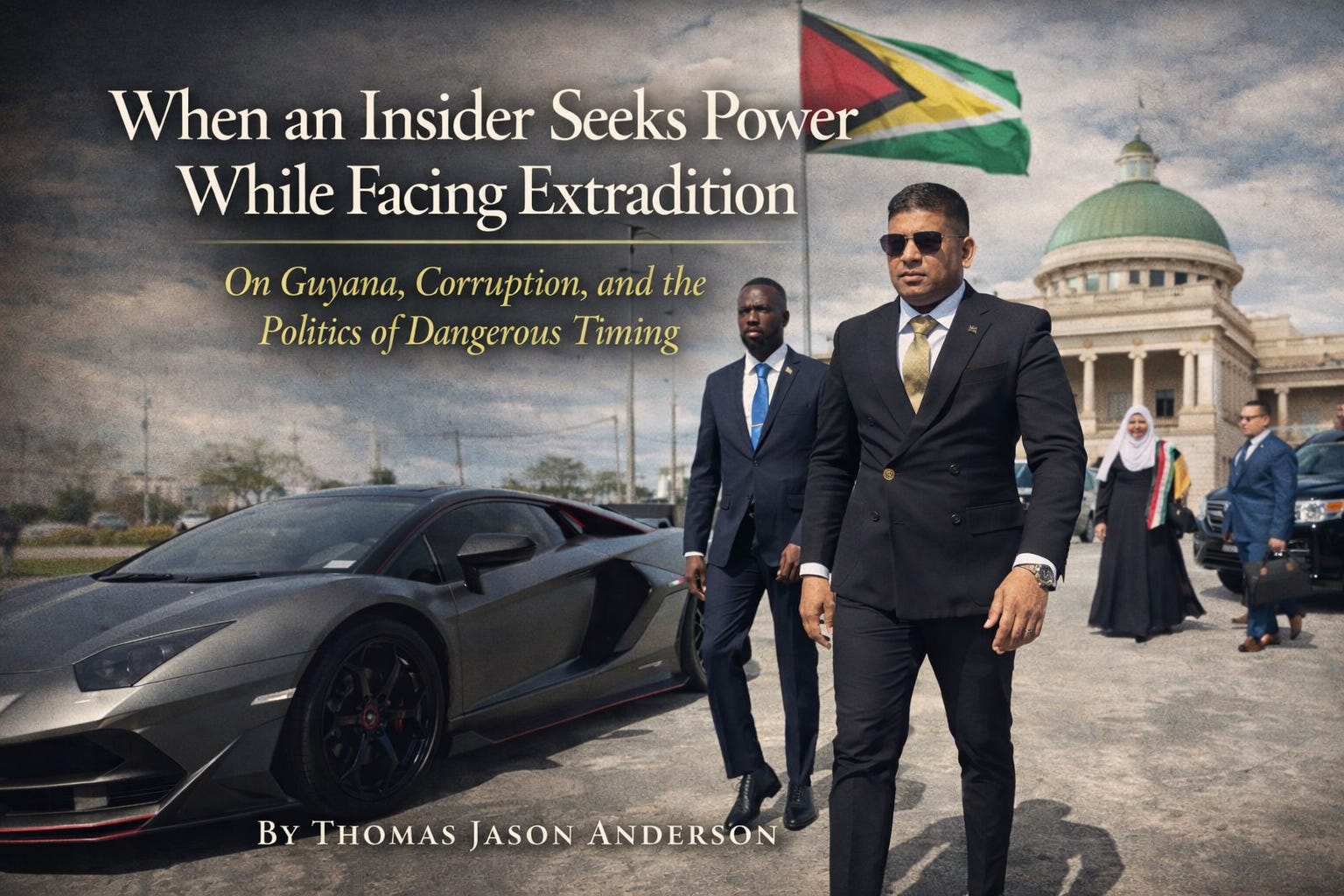
When an Insider Seeks Power While Facing Extradition
On Guyana, Corruption, and the Politics of Dangerous Timing
Most political crises do not announce themselves as crises.
They begin as narrow disputes that look procedural.
A delayed appointment.
A constitutional technicality.
A court filing that seems too small for headlines.
And then, much later, people look back and realize that the early signals were visible long before the story became unavoidable.
Something like that may now be forming in Guyana.
The Detail That Changes the Frame
On its surface, the story is simple.
Azruddin Mohamed, sanctioned by the United States in June 2024, is maneuvering to become the official Leader of the Opposition in Guyana while facing a potential U.S. extradition process.
The legal question people keep asking is straightforward:
Does becoming Leader of the Opposition protect someone from extradition?
The answer is no.
Not legally.
Not constitutionally.
But the legal answer is not the interesting part of this story.
The interesting part is what this timing creates.
The Corruption Context That Matters
Guyana is not a low-risk political environment.
It is a resource-rich state with:
Fragile institutions
Weak procurement controls
And a long-standing reputation for systemic corruption
This is reflected consistently in international corruption rankings and donor assessments.
And the governing People’s Progressive Party has been central to that history for decades.
That context matters for one reason.
Because this is not a case involving an outsider.
It is a case involving a former insider.
The Insider Variable
Azruddin Mohamed is former PPP.
He comes from inside the governing system.
And one of the individuals sanctioned with him in June 2024 was Mae Thomas, a senior PPP official.
That single fact should change how this story is understood.
Because when insiders fall out with corrupt systems, they do not fall empty-handed.
They fall with:
Institutional memory
Knowledge of how money moved
Records of who approved what
And a map of where pressure points actually are
This is not unusual in corruption cases.
It is one of the most predictable dynamics in them.
The most destabilizing figure in a corrupt system is not a reformer.
It is a former insider under legal pressure.
Why Timing Is the Real Story
From an analytical standpoint, the key variable here is not guilt or innocence.
It is sequence.
If damaging information about systemic corruption is released:
Before Mohamed holds office, it comes from a defendant.
After he becomes Leader of the Opposition, it comes from the official constitutional counterweight to the government.
Same information.
Completely different political effect.
Different international reaction.
Different diplomatic consequences.
Different pressure on institutions.
This is how narrow legal stories become national crises.
Not through leaks.
Through platforms combined with timing.
The Scenario That Creates Systemic Risk
There is a scenario here that is worth taking seriously.
Not because it will necessarily occur.
Because if it does, it unfolds quickly.
A sanctioned insider becomes Opposition Leader.
He gains formal legitimacy and international visibility.
He releases serious corruption allegations implicating senior officials.
Those disclosures trigger protests, foreign pressure, and institutional paralysis.
Not because of ideology.
Because of disclosure under maximum leverage.
This is how destabilization works in corruption politics.
Not through coups.
Through documents.
Why the Government’s Urgency Makes Sense
This lens also explains the unusual urgency surrounding efforts to remove the Mohameds through U.S. legal processes.
This may not be about political competition.
It may be about containment.
Because if Mohamed is extradited quietly, the problem disappears.
If Mohamed becomes Opposition Leader and then turns adversarial, the problem becomes international.
And internationalized corruption crises rarely remain manageable.
A Final Thought
I am not predicting what Azruddin Mohamed will do.
I am pointing out something simpler.
In corruption politics, the most dangerous asset is not money.
It is knowledge combined with timing and a platform.
And when a sanctioned insider seeks constitutional power
while facing removal by a foreign government,
what is forming is not just a legal case.
It is the early phase of a story that, in other countries, has often ended up reshaping governments.
Long before anyone was ready to say
that a crisis had begun.


