


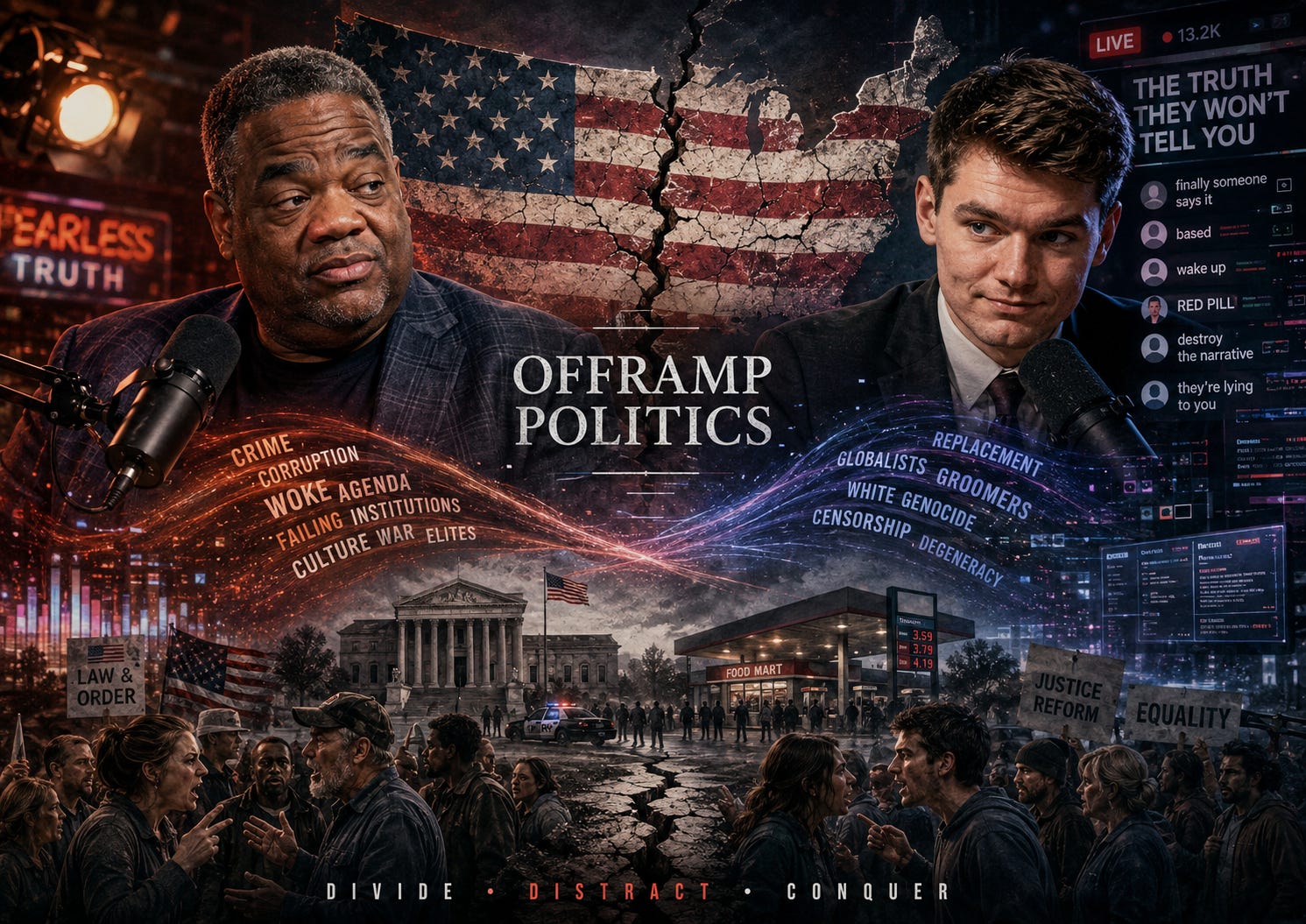
There is a dangerous thing that happens in America after certain local cases.
A jury hears the evidence. A family grieves. A community absorbs the shock. Local people gather outside courthouses, gas stations, churches, and living rooms trying to understand what just happened.
Then the national influencer class arrives.
They do not arrive as neighbors. They do not arrive as jurors. They do not arrive as people who sat through every hour of testimony, watched every witness, felt every tremor inside that local courthouse, or must live in the community after the verdict.
They arrive as content machines.
That is what I see happening with the South Carolina case involving Rick Chow, the convenience store owner found not guilty of murder in the killing of 14-year-old Cyrus Carmack-Belton.
This case is painful on its own terms. It does not need to be inflated into a national racial weapon. It does not need to be fed into the algorithmic furnace of “Black fatigue.” It does not need to become one more brick in someone else’s ideological cathedral.
According to the reporting, Chow suspected Cyrus, a Black teenager, of stealing bottled water. Prosecutors said that suspicion was false. Chow and his son chased Cyrus from the store. Chow shot him in the back. The defense argued that Cyrus had a gun and that Chow fired because he believed his son was in danger. A South Carolina jury heard the evidence and found Chow not guilty of murder.
That is the legal outcome.
But the legal outcome is not the same thing as the national meaning being manufactured around it.
A local case tried before local jurors should not automatically become national ammunition for influencers trying to push a preexisting racial narrative. This is where the Offramp Politics perspective matters.
The question is not simply whether someone agrees or disagrees with the verdict.
The question is: who is using the verdict, and for what purpose?
Jason Whitlock is already moving this case into the “Black fatigue” framework. His podcast listing frames the Rick Chow acquittal as pointing to the “consequence of Black Fatigue.” That is not neutral commentary. That is a decision to place a local South Carolina murder trial inside a national narrative about white exhaustion with Black people, Black behavior, Black protest, Black crime, Black grievance, and Black public presence.
That is the move.
It takes a case involving one store owner, one dead child, one jury, one set of disputed facts, one grieving family, and one local community, then stretches it across the national stage until it becomes a sermon about Black America.
That is not analysis. That is extraction.
It extracts pain from one community and converts it into ideological currency for another audience.
And once a case is fed into the “Black fatigue” machine, the details start to matter less than the emotional use of the case. The child becomes a symbol. The store owner becomes a symbol. The jury becomes a symbol. The Black community becomes a symbol. The whole thing becomes one more battlefield in a social media war that most ordinary Americans did not ask to fight.
This is exactly how divide-and-conquer politics works in 2026.
It no longer always comes from government. It does not always come from political parties. It increasingly comes from influencers who take real tragedies and turn them into tribal fuel.
The country becomes a chessboard made of grief.
The Local Case Must Remain Local First
A local jury is not a national referendum.
That should be obvious, but social media has trained Americans to forget it.
A jury in South Carolina is not “America.” It is not “white America.” It is not “Black America.” It is not “the system” in its entirety. It is a group of people selected under the rules of that jurisdiction to decide whether prosecutors proved a specific charge beyond a reasonable doubt.
That matters.
Juries can get things right. Juries can get things wrong. Prosecutors can overcharge. Defense lawyers can create reasonable doubt. Witness testimony can conflict. Local law can create outcomes that feel morally unbearable but legally explainable. A family can be devastated and still the verdict can reflect what the jury believed the law required.
That complexity is what national influencers flatten.
Because complexity does not trend.
A grieving father does not trend as powerfully as a racial slogan. A nuanced legal discussion does not move through the bloodstream of social media as quickly as anger. A careful distinction between moral outrage and legal burden of proof does not feed the algorithm.
But “Black fatigue” does.
That phrase now operates like a trapdoor. It sounds like analysis. It sounds like social diagnosis. But in the distorted form, it functions as a permission slip. It gives people language to say they are tired not simply of crime, not simply of disorder, not simply of bad behavior, but of Black people as a category.
That is why this phrase has become so dangerous.
It moves from “I am tired of destructive behavior” to “I am tired of them.”
And once the “them” becomes racial, we are no longer discussing accountability. We are discussing collective blame.
Whitlock and Fuentes: Different Roads, Same Terrain
This is where Jason Whitlock and Nick Fuentes become important to analyze together.
They are not the same person. They do not have the same biography. They do not speak to the same exact audience. Their public identities are different. Whitlock presents himself as a Christian cultural critic, a Black conservative voice, and a truth-teller against liberal race politics. Fuentes is widely identified by extremism researchers as a white nationalist and antisemitic influencer whose movement pushes white identity politics, anti-immigration politics, misogyny, anti-LGBTQ views, and hostility to DEI.
But overlap does not require sameness.
Two people can take different roads into the same valley.
Fuentes racializes the argument. Whitlock moralizes it.
Fuentes is more direct in the white grievance lane. He and the ecosystem around him treat “Black fatigue” as part of a broader claim that white people are tired of Black people, Jews, immigrants, and other groups they frame as threats to society. That is why watchdog groups have flagged the phrase as part of a coded hate vocabulary in extremist circles.
Whitlock’s approach is different. He does not generally argue in the same explicit white-nationalist grammar Fuentes uses. Instead, Whitlock frames the issue through moral collapse, family breakdown, anti-woke backlash, Black cultural dysfunction, liberal race politics, crime, fatherlessness, and what he sees as the consequences of Black Lives Matter-era discourse.
But look at the overlap in targets.
Both attack Black Lives Matter.
Both attack DEI.
Both attack liberal racial justice narratives.
Both argue that the post-George Floyd era produced a backlash.
Both speak to audiences frustrated with being told America is racist.
Both connect crime, disorder, and public behavior to race politics.
Both treat “wokeness” as a destructive social force.
Both position themselves against mainstream institutions.
Both use social media to intensify resentment toward liberal elites, racial justice activists, and progressive culture.
The difference is not the battlefield. The difference is the uniform.
Whitlock comes in carrying the language of faith, family, sports, masculinity, cultural accountability, and common sense.
Fuentes comes in carrying the language of white identity, demographic panic, antisemitic conspiracy, Christian nationalism, and racial hierarchy.
But when the topic is “Black fatigue,” they are walking through overlapping terrain.
This is not to say Whitlock is Fuentes. That would be too easy and too sloppy.
The sharper point is this: Whitlock’s rhetoric can create a socially acceptable doorway into a room where Fuentes is already waiting.
Whitlock can say, in effect, “America is tired of Black dysfunction.”
Fuentes can say, “Exactly, and here is the racial reason.”
Whitlock can say, “Black Lives Matter hardened hearts.”
Fuentes can say, “Those hearts should harden into white identity.”
Whitlock can say, “DEI and racial liberalism are corrupting America.”
Fuentes can say, “DEI is proof that nonwhite people are replacing white people.”
Whitlock can say, “The culture is broken.”
Fuentes can say, “The race is the problem.”
That is the pipeline danger.
It does not require coordination. It does not require friendship. It does not require direct partnership. It only requires issue overlap, emotional escalation, and an audience trained to move from cultural resentment to racial resentment.
This is how the social media machine works. It does not need everyone to say the same thing. It only needs them to push people in the same direction.
The “Black Fatigue” Agenda
The distorted “Black fatigue” narrative is not really about solving problems.
If it were about solving problems, it would sound very different.
It would ask why teenagers have guns. It would ask why local stores become flashpoints between merchants and residents. It would ask why some communities do not trust police, prosecutors, courts, or shop owners. It would ask why so many Americans, across race, live in fear of one another. It would ask what families, churches, schools, business owners, local officials, and law enforcement can do together to prevent the next tragedy.
But that is not the energy of “Black fatigue.”
The energy of “Black fatigue” is not repair. It is resentment.
It does not say, “Let us build something better.”
It says, “Aren’t you tired of them?”
That question is poison.
Because once people are tired of “them,” they stop looking for solutions. They stop seeing citizens. They stop seeing children. They stop seeing families. They stop seeing neighbors. They stop seeing the possibility of shared responsibility.
They only see a category.
That is the oldest trick in American politics.
Take a local failure. Turn it into a racial indictment. Use the racial indictment to build an audience. Use the audience to gain influence. Use the influence to harden the divide.
Divide and conquer does not always wear a government badge. Sometimes it wears a podcast mic.
The Public Should Be Coming Together
America is already under enough pressure.
The public is dealing with inflation, housing stress, political exhaustion, distrust in institutions, crime fears, online radicalization, family breakdown, foreign conflict, and the quiet spiritual fatigue of trying to live decently in a country that feels like it is being pulled apart by invisible machinery.
We do not need influencers pouring gasoline on every local tragedy.
We do not need national figures turning one jury verdict into a racial weapon.
We do not need Black people told that every acquittal means their children do not matter.
We do not need white people told that every case involving a Black teenager proves some larger racial pathology.
We do not need Asian store owners turned into symbols.
We do not need grieving families turned into content.
We do not need America sliced into smaller and smaller emotional tribes until every courthouse becomes a battlefield and every tragedy becomes someone else’s monetization strategy.
America is stronger together.
That does not mean ignoring crime. It does not mean ignoring race. It does not mean pretending every community problem is someone else’s fault. It does not mean refusing accountability. It does not mean flattening the truth to protect feelings.
It means refusing to let influencers turn us against each other for profit, attention, or ideological conquest.
A stronger America can hold multiple truths at once.
A 14-year-old boy should not be dead.
A jury verdict should be analyzed carefully.
A family’s grief should not be mocked or minimized.
A community’s pain should not be dismissed.
Youth gun possession is a real issue.
Local business owners should not live in fear.
Race can matter without becoming the only thing that matters.
Accountability can exist without collective racial blame.
And public debate should lead toward repair, not national emotional arson.
That is the Offramp.
The Offramp is not denial. It is discernment.
It is the decision to slow down before the algorithm turns a local case into a national weapon. It is the refusal to let people who were not in the courtroom, who do not live in the community, and who will not help heal the damage use the dead as fuel for their brand.
Rick Chow’s acquittal is a South Carolina case first.
Cyrus Carmack-Belton was a child first.
His family’s grief is human first.
The local community’s reaction is local first.
Everything after that should be handled with care.
Because the national influencer machine does not heal communities. It harvests them.
And America cannot survive forever as a country where every wound becomes content, every verdict becomes propaganda, and every tragedy becomes a new reason for Americans to hate each other.
We need a different path.
We need the courage to say that local justice matters, national analysis matters, race matters, accountability matters, grief matters, and unity matters.
We need to reject the people who profit from division while pretending they are simply telling hard truths.
And we need to remember something simple that has become almost radical in the current media environment:
The American people are not each other’s enemy.
The people trying to convince us that we are may be the real danger.
Black fatigue might also be called hate fatigue. All tribes are tiring under the multiple spins of divide and conquer racism/ hate.
The Whitlock like characters are agents of the puppet masters you regularly identify.
The primary agenda is aimed at distracting the masses from the venality/hate- exploitation agenda of the oligarchs.