


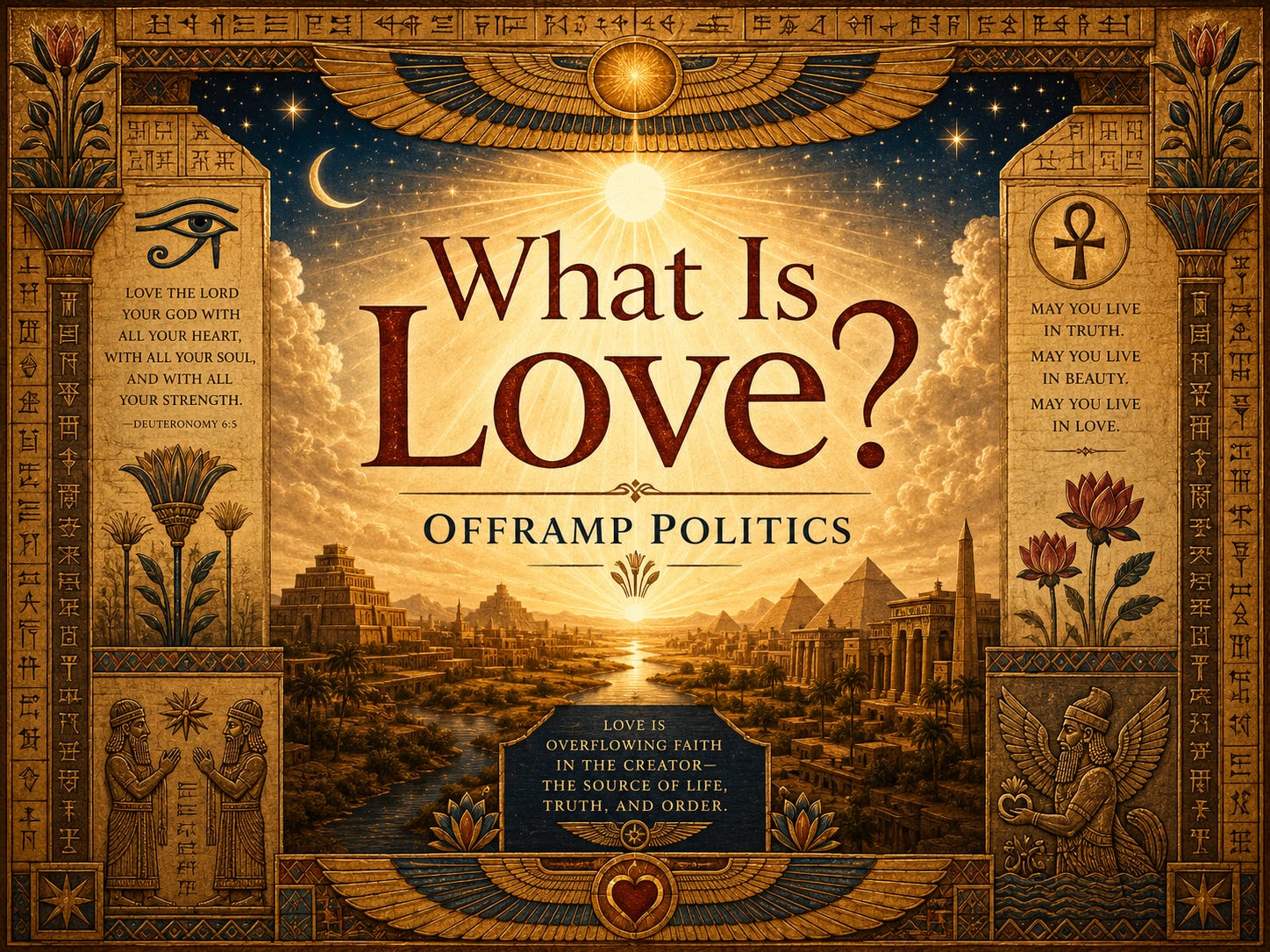
What is love?
That question has been turned into a song, a poem, a wedding vow, a wound, a weapon, a memory, a mystery, and in some cases, a marketing campaign.
But I want to put the question on the table in a deeper way.
Not what does the world call love?
Not what does romance call love?
Not what does fear dress up as love?
But what is love when you strip it down to its spiritual foundation?
I believe true love is faith in the Creator.
Not casual faith. Not decorative faith. Not the kind of faith people place on a shelf and take down only when life starts shaking.
I mean all-encompassing faith.
Faith so complete that it cannot stay contained inside one person.
Faith that overflows.
Faith that becomes mercy.
Faith that becomes courage.
Faith that becomes protection.
Faith that becomes truth.
Faith that becomes service.
Faith that becomes a river moving through the world.
That, to me, is love.
Love is faith after it has become water.
Love Begins With the Creator
In the biblical tradition, love does not begin with human emotion. It begins with God.
The command in Deuteronomy is not small. It is not soft. It is not sentimental. It says to love the Lord with all your heart, all your soul, and all your strength. This is total devotion, not partial affection. It is the whole person turned toward the Creator.
That means love, at its root, is alignment.
It is the human spirit saying: I trust the Source of life.
I trust the One who made me.
I trust the One who made the person standing across from me.
I trust the One who formed the world before I had language for it.
And if I truly trust the Creator, then I cannot despise creation.
That is where love becomes more than a feeling.
If God created the world, then love for God must eventually become care for what God created. You cannot claim to love the artist while hating the canvas. You cannot praise the architect while burning down the house. You cannot worship the Creator while holding contempt for the creation.
That is why the Bible does not leave love floating in the clouds. Jesus joins love of God with love of neighbor. The vertical relationship with God must become horizontal responsibility toward people.
That is the test.
Faith that never becomes love is still locked in the vault.
God Is Love, But Love Is Not Whatever We Want It To Be
First John gives one of the clearest statements in Scripture: God is love. But that does not mean love is whatever we decide it is. It means real love must be measured against the nature of God.
Love is not possession.
Love is not control.
Love is not fear wearing perfume.
Love is not the hunger to dominate another person and call that hunger devotion.
First John also says perfect love casts out fear. That line matters because so much of what the world calls love is actually fear. Fear of being alone. Fear of losing control. Fear of abandonment. Fear of punishment. Fear of not being enough.
But mature love does not grow from fear.
It grows from trust.
That is why I come back to faith.
Faith in the Creator frees a person from the panic of scarcity. If the Creator is the Source, then love does not have to hoard. Love does not have to manipulate. Love does not have to tighten its fist around another human being.
True love can pour out because it knows the Source is not empty.
That is the difference between love and attachment.
Attachment says: I need you to complete me.
Love says: I am rooted in God, and from that place I can bless you without trying to own you.
That is a very different kind of power.
Love As Overflow
When I say love is faith in the Creator, I do not mean faith as a private belief only.
I mean faith as a force.
Faith that overflows so much it has to be shared with the entire world.
That is the part we often miss.
Love is not just something we feel toward people who are easy to love. Love is the overflow of divine trust into the broken places of the world.
It is the reason someone feeds the hungry.
It is the reason someone protects the vulnerable.
It is the reason someone tells the truth when silence would be safer.
It is the reason someone refuses to reduce another human being to a label, a party, a race, a class, a mistake, or a wound.
Love is the spiritual evidence that faith has become active.
A person can say they believe in God. But love asks: does that belief make you more merciful? More truthful? More courageous? More just? More willing to see the image of God in people you do not understand?
That is where the question gets uncomfortable.
Because love is not just a doctrine.
Love is an audit.
Egypt: Love As Order, Truth, And Balance
When we look outside the biblical texts into ancient Egypt, we find another important piece of the puzzle.
The Egyptians had the concept of Ma’at, often understood as truth, justice, balance, and cosmic order. Britannica describes Ma’at as the personification of truth, justice, and cosmic order in ancient Egyptian religion.
That may not sound like “love” at first. But look closer.
If love is faith in the Creator, and if the Creator brings order out of chaos, then love must participate in divine order.
Love cannot be chaos.
Love cannot be deception.
Love cannot be exploitation.
Love cannot be cruelty.
Love cannot be imbalance disguised as passion.
In the Egyptian imagination, a righteous life was a life aligned with the order that sustained the world. That means truth was not merely intellectual. Justice was not merely legal. Balance was not merely social. These were sacred realities.
From that angle, love is not just affection. Love is the act of living in a way that does not tear the world apart.
That speaks loudly into our time.
Because we live in an age where people confuse intensity with truth. They think because they feel something strongly, it must be sacred. But ancient wisdom would challenge that.
Is it balanced?
Is it truthful?
Does it bring life?
Does it protect the vulnerable?
Does it restore order, or does it create chaos?
Ma’at gives us a hard but necessary lens: love must be in harmony with truth.
A lie cannot be love.
A manipulation cannot be love.
A system that crushes the weak cannot be love.
Love, if it is real, helps restore the moral architecture of the world.
The Aten Hymn And Universal Care
There is also something powerful in ancient Egyptian hymns that describe divine care as something that reaches across creation. The Great Hymn to the Aten presents the divine as a life-giving force whose care extends to peoples, lands, animals, and the created world. Scholars have often compared themes in that hymn with biblical creation praise such as Psalm 104.
That matters because it pushes us beyond narrow love.
If the Creator gives life broadly, then love cannot remain tribal.
If the sun rises on nations we do not belong to, then love cannot stop at our border.
If the breath of life moves through people we disagree with, then love cannot be reduced to political convenience.
This is where faith in the Creator becomes world-embracing.
The more deeply someone believes in the Creator, the harder it becomes to see creation as disposable.
That does not mean we abandon discernment. It does not mean we pretend evil does not exist. It does not mean we confuse love with weakness.
It means we understand that love is not the absence of judgment.
Love is judgment purified by mercy.
Love is truth without hatred.
Love is strength without cruelty.
Love is correction without dehumanization.
Sumer: Love As Sacred Life-Force
When we move into ancient Sumer, love appears in another form. The Sumerian love songs connected to Inanna and Dumuzi are often tied to fertility, sacred marriage, abundance, kingship, and the renewal of life. The Penn Museum notes that the Dumuzi-Inanna cult and its sacred marriage ceremony were central to this tradition.
This is a different world from biblical covenant theology. We should not flatten the differences.
But we can still observe the pattern.
In Sumerian sacred love poetry, love is not merely private emotion. It is connected to fertility, land, kingship, and the flourishing of the community. Love is a force that renews the world.
That is important.
Because true love should produce fruit.
Not always biological fruit. Not always romantic fruit. But spiritual fruit. Social fruit. Moral fruit. Creative fruit.
Love should make something live.
If what we call love constantly destroys, drains, humiliates, consumes, and leaves people spiritually smaller, then maybe we are not looking at love. Maybe we are looking at appetite.
The Sumerian material reminds us that ancient people often saw love as connected to abundance. The field. The womb. The season. The city. The future.
In my language, I would say it this way:
Love is faith in the Creator becoming fruitful in creation.
It should leave evidence.
It should leave a harvest.
Love Is Not Weakness
One mistake modern people make is thinking love means softness.
But biblical love is not weak.
Egyptian Ma’at is not weak.
Sumerian sacred fertility is not weak.
Love is one of the strongest forces in the ancient imagination because love is tied to life itself.
Love builds.
Love restores.
Love confronts.
Love protects.
Love tells the truth.
Love stands between the vulnerable and the devourer.
When love is rooted in faith in the Creator, it does not become passive. It becomes brave.
Because the person who truly trusts God does not have to be ruled by fear.
That is why perfect love casts out fear.
Fear makes people cruel.
Fear makes people tribal.
Fear makes people suspicious of mercy.
Fear makes people confuse domination with safety.
But love rooted in God says: I do not have to destroy another person to prove I exist.
That is a revolutionary idea.
Especially now.
The Political And Spiritual Meaning Of Love
At Offramp, I often write about power, corruption, fear, division, propaganda, and the systems that push people into corners.
So why write about love?
Because love may be the one force that corrupt systems cannot fully manufacture.
They can manufacture outrage.
They can manufacture suspicion.
They can manufacture narratives.
They can manufacture enemies.
They can manufacture identity battles.
They can manufacture distractions by the truckload.
But love rooted in faith is harder to counterfeit.
Because it requires surrender to something higher than ego.
It requires faith in the Creator.
It requires the belief that truth matters even when lies are profitable.
It requires the belief that people matter even when systems treat them as disposable.
It requires the belief that justice matters even when power tells us to move along.
This is why love is not just personal. It is public.
A society without love becomes a machine.
A politics without love becomes domination.
A religion without love becomes performance.
A truth without love becomes a blade.
A love without truth becomes fog.
But faith in the Creator brings the pieces back together.
Truth.
Mercy.
Justice.
Courage.
Order.
Fruitfulness.
Overflow.
That is love.
What Is Love?
So let me answer the question plainly.
Love is not merely romance.
Love is not merely kindness.
Love is not merely attraction.
Love is not merely loyalty to the people who already belong to us.
Love is all-encompassing faith in the Creator that overflows into the world.
It is faith so full that it becomes mercy.
Faith so steady that it becomes courage.
Faith so alive that it becomes service.
Faith so rooted that it becomes justice.
Faith so abundant that it becomes protection.
Faith so fearless that it becomes truth.
The Bible tells us to love God with the whole self. It tells us God is love. It tells us perfect love casts out fear.
Egypt points us toward love as harmony with truth, justice, balance, and sacred order through Ma’at.
Sumer reminds us that love, in the ancient imagination, was tied to life, fertility, renewal, and the flourishing of the community.
And when I gather those streams together, I come back to this:
True love is faith in the Creator made visible.
It is not trapped inside the heart.
It does not stop at words.
It does not end at belief.
It overflows.
It moves.
It feeds.
It forgives.
It protects.
It builds.
It restores.
Love is what happens when faith becomes larger than the self.
And maybe that is what the world needs now.
Not the cheap version of love.
Not the slogan version.
Not the sentimental version.
But the ancient kind.
The Creator-rooted kind.
The kind that casts out fear.
The kind that restores order.
The kind that makes life fruitful.
The kind that looks at a broken world and still says:
I have faith.
And because I have faith, I will love.