


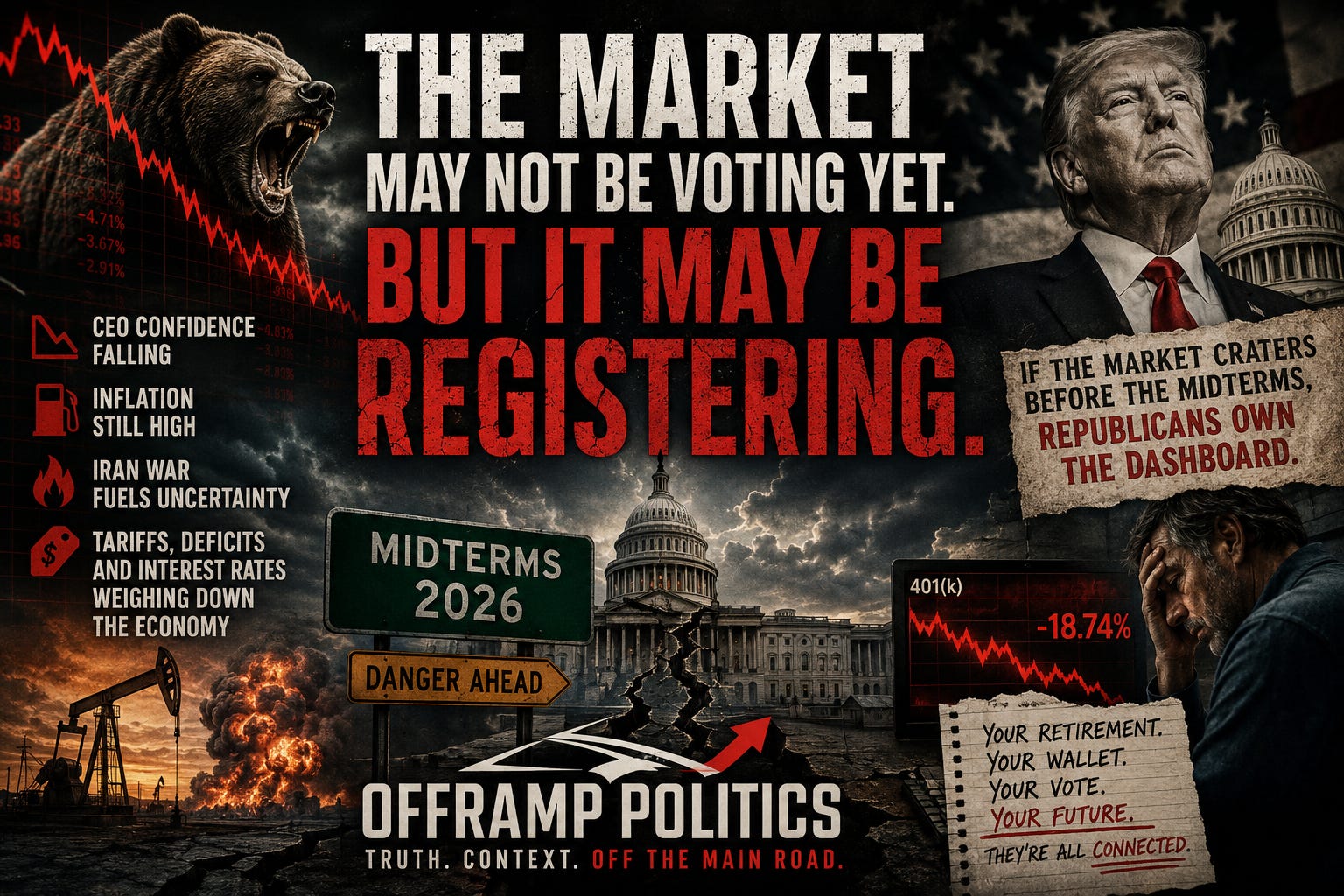
There are moments when the economy does not announce itself with a crash.
It announces itself with a change in behavior.
The market keeps climbing, but the climb feels narrower. CEOs keep talking, but their tone changes. Consumers keep spending, but the spending starts to look more like endurance than confidence. Politicians keep celebrating the headline numbers, but the households underneath those numbers begin to feel something different.
That is the place where politics becomes dangerous.
Not when the economy officially enters recession. Not when Wall Street finally panics. Not when the headlines finally admit what people have been feeling for months.
The danger comes earlier.
It comes when the system begins to lose its internal belief.
That may be where America is now.
Axios recently reported a sharp drop in CEO confidence, with executives turning increasingly gloomy on the prospects for the overall economy. That kind of survey does not prove a market crash is coming. It does not prove a recession is guaranteed. But it does show something important: the people sitting closest to the machinery are beginning to hear a different sound coming from the engine.
And when CEOs lose confidence, they do not always make dramatic public announcements. They trim. They delay. They slow hiring. They pull back from expansion. They preserve cash. They become cautious before the public sees why caution was necessary.
That is how weakness travels through an economy before it becomes visible.
The stock market may not have cratered yet. But the ground underneath it is carrying more stress than the political class wants to admit. Inflation is still alive. Tariffs have raised costs. Deficits are expanding. Interest rates remain trapped by inflation pressure. The Iran war is feeding energy uncertainty. Consumers are tired. Businesses are losing confidence. And the Republican Party, now fully responsible for the federal government, is heading into a midterm election cycle with ownership of the dashboard.
That may become the real political problem.
The GOP does not need the economy to enter a depression to suffer. It does not even need a full-blown crash. A serious stock market decline heading into the midterms could be enough to change the entire political conversation.
Because once voters open their retirement accounts and see red, the stock market stops being an abstraction.
It becomes a precinct.
The Market Is Not Just a Market Anymore
For most Americans, the stock market is not Wall Street.
It is their retirement account. It is their 401(k). It is the college fund. It is the sense that tomorrow may be slightly more secure than today. Even for people who do not own much stock directly, the market operates as a national mood board. When the market rises, politicians talk about confidence. When the market falls, voters begin to wonder what else is breaking.
This is why Donald Trump spent so much of his political career treating the stock market like a scoreboard.
When it went up, he claimed credit. When indexes hit records, he pointed to them as proof that his policies were working. When investor optimism followed tax cuts, deregulation, or promises of strength, the GOP took the victory lap.
But the market is a dangerous altar.
If a party worships at it when the numbers are green, it cannot pretend the altar is meaningless when the numbers turn red.
That is the box Republicans may now be building around themselves.
If the market takes a serious hit before November, Democrats will not need to craft a complicated economic argument. They will point to the obvious. Republicans had the White House. Republicans had Congress. Republicans had the policy levers. Republicans had the tax bill, the tariffs, the war posture, the spending priorities, and the economic messaging machine.
They will say the GOP promised stability and delivered volatility.
They will say Republicans promised strength and delivered stress.
They will say America needs to turn the page.
That message becomes more powerful if voters are already frightened.
The Economy Is Carrying Too Many Stress Fractures
The question is not whether a stock market crater is inevitable.
That word, inevitable, is too clean for something as strange as markets. Markets can ignore bad news for months. They can float above obvious risks. They can rally on hope, liquidity, speculation, momentum, or the belief that somebody else will buy higher tomorrow. Markets do not move like morality plays. They move like crowds inside a theater where someone may or may not have smelled smoke.
So the better question is this:
How many things now have to go right for the market to avoid a serious decline?
Inflation has to cool.
Oil prices have to behave.
The Iran war has to avoid widening.
The Federal Reserve has to maintain credibility while facing political pressure.
Corporate earnings have to justify high valuations.
The AI boom has to keep carrying the market without becoming a speculative bubble.
Tariff-related price pressures have to stop feeding into consumer costs.
The bond market has to absorb expanding deficits without demanding higher yields.
Consumers have to keep spending despite falling real pressure.
Businesses have to keep investing despite declining confidence.
That is a lot of spinning plates in a room full of tripwires.
One problem can be absorbed. Two problems can be explained. Three problems can be messaged around. But when inflation, war, deficits, tariffs, interest rates, and market valuation risk begin to overlap, the economy starts to look less like a machine and more like a bridge taking pressure from every direction.
The bridge may hold.
But the creaking matters.
CEO Gloom Is Not Just a Mood
The Axios report on CEO confidence is important because it gives us a view into executive psychology.
That does not mean CEOs are prophets. They are not. They can be wrong. They can be self-interested. They can misread politics, overreact to uncertainty, or use pessimism to pressure Washington.
But CEO confidence still matters because executives make the decisions that determine whether workers get hired, factories get expanded, projects get launched, and capital gets deployed.
When CEO confidence falls, it is not just a survey result. It can become a self-reinforcing force.
A CEO who expects conditions to worsen may postpone hiring.
A company that postpones hiring contributes to slower job growth.
Slower job growth weakens consumer confidence.
Weaker consumer confidence slows spending.
Slower spending pressures revenue.
Pressured revenue confirms the original caution.
That is how pessimism becomes policy without Congress passing a bill.
This is why the economic mood matters. The economy is not only numbers. It is trust. It is expectation. It is confidence in the next quarter, the next invoice, the next customer, the next shipment, the next payroll cycle.
Once that trust begins to crack, politicians often find themselves behind the event. They are still arguing about yesterday’s data while the people making tomorrow’s decisions have already changed their posture.
That is why the CEO survey should matter to Republicans.
It may be showing the first stage of a broader economic pullback.
Inflation Is Still the Beast Under the Floorboards
The central political problem for Republicans is that inflation has not disappeared.
It may not look like the 2021 or 2022 inflation crisis. But voters do not experience inflation as a statistical comparison to prior peaks. They experience it as the cumulative exhaustion of prices that went up and never came back down.
That is the part Washington often misses.
A family does not say, “Good news, inflation is lower than it was three years ago.”
A family says, “Why is this still so expensive?”
That is why inflation remains politically explosive even when the rate of increase slows. The damage compounds. Grocery prices, insurance, rent, utilities, car payments, credit card interest, and energy costs all become part of one lived reality.
Now add the Iran war.
War has a way of turning foreign policy into household economics. It affects oil markets. It affects shipping. It affects insurance costs. It affects military spending. It affects inflation expectations. It affects investor psychology. It affects the Federal Reserve’s room to maneuver.
If energy prices rise because of the war, inflation becomes harder to tame. If inflation becomes harder to tame, the Fed has less room to cut rates. If the Fed has less room to cut rates, the market loses one of its favorite safety blankets. If the market loses that blanket while valuations are stretched, investors may begin to reassess risk very quickly.
That is the chain Republicans should fear.
Not because every link is guaranteed.
But because every link is plausible.
The Iran War Is an Economic Issue Now
Republicans may want to frame the Iran war as a national security issue. And it is one.
But wars do not stay inside the foreign policy box.
The longer the war continues, the more it enters the domestic economy. It becomes part of fuel prices, supply chains, shipping routes, defense spending, deficit politics, and voter anxiety. The war does not have to become unpopular in moral terms to become dangerous in economic terms.
A voter may support stopping Iran from obtaining nuclear weapons and still resent paying more for gas.
A voter may believe in American strength and still wonder why their household budget is weaker.
A voter may support the troops and still punish the party in power if the war appears to be making life more expensive.
This is the problem with governing through force while promising prosperity. The two can coexist, but only if the public believes the cost is controlled, the strategy is clear, and the benefit is real.
If the Iran war begins to feel like another open-ended pressure on the American household, Republicans will have a problem that cannot be solved with patriotic language alone.
The economy translates everything.
It translates war into oil.
It translates oil into inflation.
It translates inflation into interest rates.
It translates interest rates into market stress.
It translates market stress into voter anger.
By the time that translation reaches the ballot box, the original policy argument may not matter anymore.
Tariffs Are Not Free Strength
The GOP has also built part of its economic identity around tariffs.
Tariffs sound powerful. They sound like punishment for foreign competitors. They sound like leverage. They sound like America standing up for itself.
But inside the economy, tariffs can function like a hidden tax.
They can raise costs for importers, retailers, manufacturers, and consumers. They can complicate supply chains. They can force businesses to make decisions under uncertainty. They can create price pressure at the exact moment the Federal Reserve is trying to contain inflation.
This is where political convenience runs into economic reality.
It is convenient to sell tariffs as toughness.
It is harder to admit that toughness may raise prices for the very voters being told they are protected.
The GOP’s tariff strategy may have given Republicans a rhetorical weapon, but it also gave Democrats an economic opening. If prices remain elevated, Democrats can argue that Republicans made inflation worse. If businesses slow investment, Democrats can argue that tariff uncertainty weakened confidence. If markets fall, Democrats can argue that Trump’s economic nationalism became instability dressed as strength.
That argument may not convince every voter.
But it does not have to.
It only has to convince the voters already tired of paying more.
Deficits Matter Again When Markets Decide They Matter
For years, deficits have been treated like a political prop. Both parties use them when convenient and ignore them when power requires spending.
Republicans are especially vulnerable here because they have long claimed the mantle of fiscal discipline. But under Trump, the GOP has often operated from a different formula: cut taxes, increase defense spending, use tariffs as a revenue and political weapon, and assume growth will make the math work later.
That may be politically useful.
But markets eventually ask uglier questions.
Who buys the debt?
At what interest rate?
How much does servicing that debt cost?
What happens if inflation remains sticky?
What happens if investors demand a higher premium for lending to a government that keeps expanding deficits?
The federal deficit is not always an immediate market problem. But in a high-rate, high-inflation, high-uncertainty environment, it becomes part of the background stress.
This is where the GOP’s governing contradictions become dangerous.
Republicans want to be the party of tax cuts.
They want to be the party of military strength.
They want to be the party of tariffs.
They want to be the party of lower inflation.
They want to be the party of market growth.
They want to be the party of fiscal sanity.
The problem is that all of those positions do not automatically fit together. At some point, the economy begins to reject the campaign brochure.
That rejection may show up in bond yields before it shows up in polls.
Then it may show up in stocks.
Then it may show up in retirement accounts.
Then it may show up in turnout.
Midterms Are Built for Punishment
Midterm elections are rarely generous to the party in power.
They are not built as ceremonies of gratitude. They are built as correction mechanisms. Voters use them to rebalance Washington, to express frustration, to slow a president down, or to punish a governing party for overreach, incompetence, arrogance, or bad luck.
That is already the natural terrain Republicans face.
Now add economic stress.
History does not give us a perfect formula, but it does provide warning signals. In 1974, Republicans were punished after Watergate, inflation, recession pressure, and the oil shock. The political system was exhausted. Trust had collapsed. Economic pain gave voters a practical reason to punish a party already damaged by scandal.
In 2006, Republicans lost badly under George W. Bush as the Iraq War, Hurricane Katrina, corruption scandals, and public fatigue converged. The economy was not yet in the 2008 crisis, but the governing brand had been damaged.
In 2018, Democrats took the House under Trump despite a relatively strong economy by conventional measures. Anti-Trump energy, health care concerns, suburban backlash, and the trade-war atmosphere all contributed to a national correction.
The lesson is not that 2026 will repeat any of those elections.
The lesson is that midterms punish accumulated stress.
If voters are angry about prices, worried about war, tired of Trump, uncertain about the market, and skeptical of Republican governance, then the GOP does not face one problem. It faces a convergence.
That is when political weather becomes political climate.
The GOP Owns the Dashboard
The biggest Republican vulnerability is ownership.
They cannot run as outsiders while controlling the government. They cannot blame the system while operating the system. They cannot treat Trump as the center of the political universe and then detach him from the economy when the economy becomes inconvenient.
That may be the defining midterm trap.
Trump remains powerful. MAGA remains powerful. Republican primary victories still show his grip on the party. His endorsement still moves voters. His presence still shapes the Republican coalition. But that strength comes with responsibility.
If Trump is the sun around which the GOP revolves, then the heat from the economy burns the whole party.
Republicans cannot say Trump is responsible for market highs but not market lows.
They cannot say his tariffs are strength but not price pressure.
They cannot say the Iran war is leadership but not economic risk.
They cannot say tax cuts are growth but deficits are someone else’s problem.
They cannot say the GOP restored confidence if CEOs are turning gloomy.
At some point, the dashboard belongs to the driver.
And right now, Republicans are driving.
Democrats Still Need a Simple Message
None of this automatically saves Democrats.
The Democratic Party has its own problem: it often turns opportunity into a committee meeting. It can take a clear political opening and bury it under too many themes, too many slogans, too many issue lanes, and too many competing factions trying to make the election about their priority.
If the market drops, Democrats cannot afford to sound like an economics panel.
They need a simple message.
Republicans got power. They made life more expensive. They brought more chaos. America needs a change.
That is the frame.
Everything else should plug into it.
Tariffs? They made life more expensive.
Iran? They brought more chaos.
Deficits? They weakened America’s foundation.
Inflation? They failed to control costs.
Stock market losses? Their economy hit your retirement.
CEO gloom? Even business leaders are losing confidence.
This is why the “turn the page” frame matters. It gives Democrats a container big enough to hold inflation, war, tariffs, deficits, market stress, and Trump fatigue without sounding scattered.
The GOP has Trump as its singular organizing force.
Democrats need change as theirs.
Not change as a vague slogan.
Change as a verdict.
The Crash Is Not the Only Threat
A crash would be dramatic. It would dominate headlines. It would change the midterms overnight.
But the GOP should also fear something less cinematic and more politically corrosive: a grinding market decline combined with persistent inflation and war fatigue.
That might be even harder to message against.
A crash creates panic, but it can also create the possibility of rebound. A slow decline creates dread. It makes voters feel trapped. It turns every paycheck, every grocery trip, every investment statement, every gas fill-up into evidence that the country is moving in the wrong direction.
That kind of economic mood is poison for the party in power.
The market does not have to collapse in one week to become politically lethal.
It only has to weaken at the wrong time.
And for Republicans, the wrong time is coming.
The midterms are not far away. The economy is already under pressure. The war is already part of the inflation story. CEOs are already showing concern. Consumers are already uneasy. The deficit picture is already ugly. Tariffs have already added cost pressure.
The political fuse is not imaginary.
It is sitting in public view.
Political Courage vs. Political Convenience
This is where the deeper issue appears.
The Republican Party has chosen political convenience over political courage.
It was convenient to run on tariffs as strength without fully admitting the cost.
It was convenient to promise tax cuts without a serious deficit framework.
It was convenient to treat Trump’s market highs as proof of genius.
It was convenient to turn economic nationalism into a rally line.
It was convenient to frame war as strength while treating the economic consequences as secondary.
It was convenient to promise lower prices while adopting policies that could make prices harder to control.
Political courage would have required telling voters the truth.
Tariffs have costs.
War has costs.
Tax cuts have costs.
Deficits have costs.
Inflation has costs.
And when all of those costs arrive together, the bill does not go to a think tank.
It goes to the household.
That is what makes this moment dangerous. The GOP has built a politics of force, but the economy is asking questions of structure. Strength without structure becomes volatility. Volatility becomes anxiety. Anxiety becomes political punishment.
Republicans may still believe Trump can overpower this. They may believe his movement is strong enough to survive economic stress. They may believe Democrats are too fractured to take advantage. They may believe voters will blame the Fed, global events, Iran, China, Biden, the media, or anyone else placed in the line of fire.
Maybe they are right.
But if voters see their retirement accounts bleeding, their grocery bills rising, their gas prices climbing, and their president insisting everything is under control, the blame game may not work.
Reality has a way of breaking through the talking points.
The Market May Become the Midterm Messenger
The stock market is not destiny.
It is not morality.
It is not always rational.
But it is a powerful political signal. It tells voters whether confidence is rising or falling. It tells businesses whether risk is being rewarded or punished. It tells campaigns whether the economic story is helping or hurting the party in power.
If the market holds, Republicans may survive the economic argument.
If the market falls hard, the entire midterm map may change.
Because a stock market decline would not arrive alone. It would arrive with inflation anxiety, CEO gloom, consumer fatigue, tariff backlash, deficit concerns, interest-rate pressure, and the Iran war sitting behind it.
That is the difference between a market correction and a political event.
A correction hits portfolios.
A political event hits power.
And if the market becomes a voter in 2026, Republicans may find themselves facing a constituency they cannot primary, threaten, flatter, or distract.
They may face the coldest voter in American politics:
The household balance sheet.
That voter does not care about slogans.
That voter does not care about rally applause.
That voter does not care about cable news spin.
That voter asks one question:
Is this working?
If the answer is no, the midterms may become something larger than a referendum on Trump.
They may become a referendum on Republican control of the economy itself.
The stock market may not be voting yet.
But it may be registering.
And if it walks into November bleeding red, the GOP may discover that Wall Street, Main Street, and the ballot box were never separate roads.
They were always connected.
The only question was when America would see the offramp.