War, Positioning, and the Television Candidate Trap
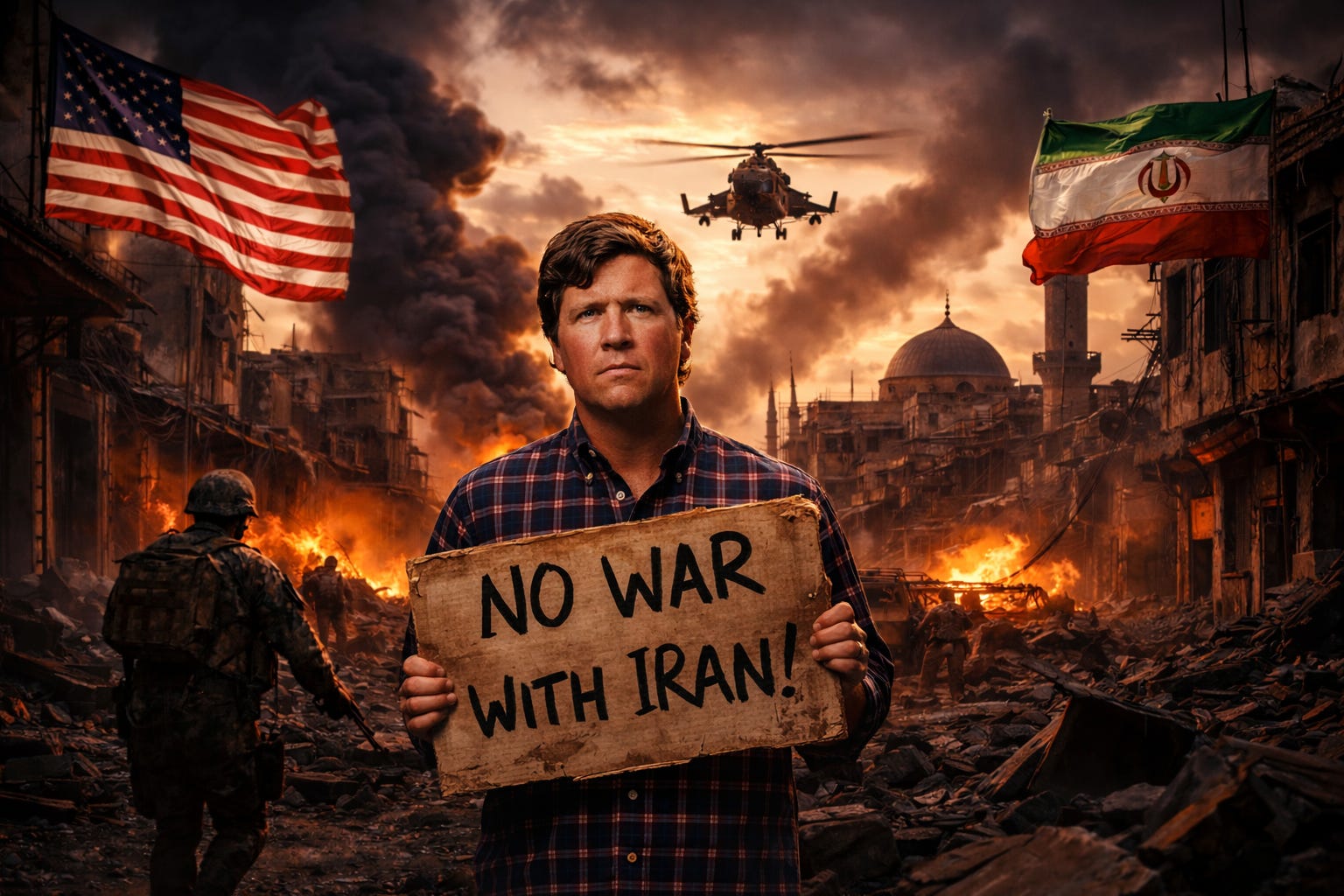
This Is Why Tucker Carlson Is Taking a Peace Position With Iran — Positioning Himself Ahead of a Potential Geopolitical Fault Line
There is a pattern forming.
Not a headline.
Not a viral moment.
A pattern.
When a media figure begins speaking consistently on a single geopolitical fault line, when that messaging becomes sharper, more disciplined, more repeatable, when it differentiates them from both parties, and when it carries long-term consequence — that is no longer commentary.
That is positioning.
A potential war with Iran is not just a foreign policy question.
It is an electoral accelerant.
And Tucker Carlson’s current posture toward it carries the fingerprints of someone building optionality.
Let’s slow this down and examine why.
1. He Is Separating Himself From the GOP’s Traditional Foreign Policy Core
For decades, Republican presidential contenders operated within a hawkish framework:
• Strong alignment with Israeli military priorities
• Regime-change tolerance
• Hard-line rhetoric toward Iran
• Sanctions escalation
• Projection of force as deterrence
Carlson is deliberately breaking from that.
Not quietly.
Not incidentally.
He is criticizing senators in his own ideological orbit. He is framing escalation as reckless. He is questioning motives. He is shifting from “strength” rhetoric to “strategic restraint” rhetoric.
That is not safe positioning inside traditional donor circles.
It is, however, very attractive positioning inside a populist base fatigued by 20 years of Middle Eastern intervention.
Presidential positioning often begins by identifying the fracture inside your own coalition.
The post-Iraq Republican voter is not the 2003 Republican voter.
Carlson appears to understand that.
2. He Is Choosing a High-Impact Issue With Asymmetrical Payoff
War with Iran is a binary escalation issue.
If it does not happen, he simply remains a commentator who urged caution.
If it happens and goes smoothly, his critique fades.
But if it happens and goes poorly — economically, militarily, politically — he inherits credibility.
That is asymmetric leverage.
There is very little downside to being early on “don’t escalate,” but enormous upside if escalation fails.
Presidential aspirants look for issues like that.
Issues where foresight can be banked.
3. He Is Framing It in Moral, Not Technical, Terms
He is not debating missile ranges or enrichment percentages.
He is framing war as:
• Insane
• Self-interested
• Elite-driven
• Not aligned with American interest
That language is accessible to voters.
It bypasses policy complexity and moves directly into character judgment.
Modern presidential campaigns are not built on white papers.
They are built on moral framing.
Carlson’s rhetoric is morally framed.
That is campaign language.
4. He Is Building the “I Warned You” Narrative
The most powerful debate stage sentence in modern politics is:
“I told you this would happen.”
Reagan had it with inflation.
Trump had it with trade.
Obama had it with Iraq.
The electorate rewards perceived foresight.
If oil spikes.
If recession follows escalation.
If casualties mount.
If Middle East instability widens.
The candidate who opposed escalation gains instant gravity.
Carlson is positioning to own that lane.
Not as a senator.
Not as a governor.
But as the outsider who saw clearly.
5. He Already Has the Infrastructure
Unlike most potential candidates, he does not need traditional media.
He has:
• Distribution
• A loyal audience
• A narrative ecosystem
• Cultural reach
• Fundraising potential
The barrier to entry is low.
Stephen A. Smith floating presidential ambition normalizes something else: the full arrival of the television candidate 2.0.
Not celebrity outsider as novelty.
Celebrity outsider as political architecture.
Carlson understands television psychology.
He understands conflict framing.
He understands emotional pacing.
Those are campaign skills.
But here is where your warning becomes important.
Because there is also a trap here.
The One-Issue Television Trap
If war with Iran becomes the central fault line of 2026–2028, the electorate could fall into a familiar pattern:
Choose the person who was most right on one issue.
That is seductive.
It feels rational.
But it is incomplete.
Being correct about escalation does not automatically translate into:
• Executive competence
• Legislative coalition-building
• Economic stewardship
• Institutional stability
• Crisis management breadth
Television creates amplification of clarity.
Governance requires navigation of complexity.
A commentator can be right about war and still be untested in:
• Budget negotiation
• Bureaucratic management
• International treaty architecture
• Domestic compromise
The electorate has fallen for this before.
Charisma over capacity.
Message over mechanism.
Confidence over coalition-building.
The danger is not that Carlson is wrong about Iran.
The danger is that voters could elevate someone to the presidency based primarily on being right about a single geopolitical escalation.
War is emotionally catalytic.
It compresses decision-making.
It magnifies voices.
But presidential leadership is multidimensional.
And here is the deeper structural risk.
If Americans become economically strained because of conflict, they will look for a corrective figure. The loudest early critic becomes psychologically attractive.
But the presidency is not a debate show.
It is an operational role.
I have often framed politics as Political Courage versus Political Convenience.
There is a third category here.
Political Clarity versus Political Competence.
Clarity wins microphones.
Competence runs governments.
If a war unfolds badly, Tucker Carlson could absolutely emerge as a serious contender — because he will have narrative equity.
But the electorate must ask a harder question:
Is foresight on one issue enough?
Or is it simply the beginning of the vetting process?
The Structural Reality
War with Iran would not just reshape foreign policy.
It would reorder the 2028 field.
It would fracture the Republican coalition.
It would pressure Democratic leadership.
It would shift donor alignments.
It would harden populist sentiment.
Carlson’s positioning suggests he understands that.
He is building optionality.
If no war comes, he remains a dominant media figure.
If war comes and falters, he becomes the man who warned against it.
That is not accidental commentary.
That is strategic preservation of future viability.
The real question is not whether Tucker is positioning.
The real question is whether voters, exhausted by conflict, will confuse narrative foresight with executive readiness.
History shows that in moments of crisis, electorates often do.
And that is where the real caution lies.
Because being right about war is important.
But running a country requires far more than being right once.


