
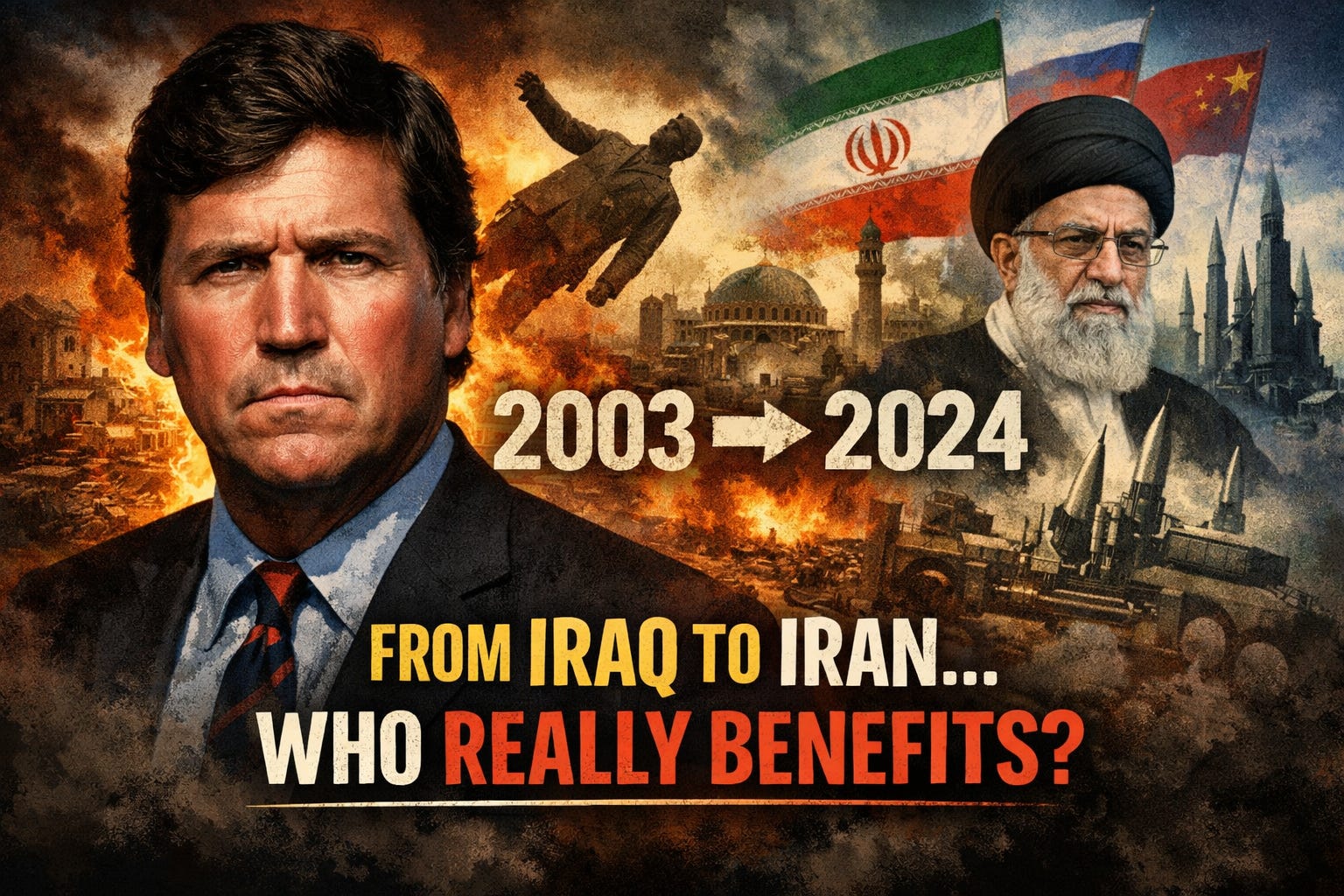
Tucker Carlson and the Iran Amnesia Problem
There is a lesson the American media class was supposed to learn from the Iraq War.
Accountability.
In 2003, a large portion of the American information system helped push the country toward war in Iraq. Commentators, television hosts, columnists, and political analysts created an atmosphere of certainty around a policy that would later unravel into one of the greatest strategic miscalculations in modern American history.
The war removed Saddam Hussein.
But it also removed the single most powerful regional counterweight to Iran.
Iran did not defeat Saddam.
The American media environment helped remove him.
And in the vacuum that followed, Tehran’s influence spread across Iraq and throughout much of the Middle East.
Many commentators later admitted they had been wrong.
One of those commentators was Tucker Carlson.
Carlson has acknowledged that he supported the Iraq War and that doing so was a mistake. That admission is now often presented as a sign of humility, a lesson learned from the failures of the early 2000s.
But admitting the mistake after the damage is done is not the same thing as learning from it.
Because Carlson now finds himself playing a remarkably similar role in another geopolitical debate involving the same country that benefited from the Iraq War.
Iran.
Today Carlson is one of the most influential voices in American media arguing against confronting Iran. His reasoning is rooted in the lesson of Iraq: foreign wars in the Middle East create chaos, drain American power, and produce unintended consequences.
But here is the problem.
That argument completely ignores who benefited from the last great media-driven mistake.
Iran.
The Iraq War was sold to the American public as a way to make the Middle East safer. Instead it destroyed Iran’s greatest regional rival and dramatically expanded Tehran’s influence across the region.
Now the American media environment is swinging hard in the opposite direction.
Where once there was certainty about intervention, there is now certainty about restraint.
And once again, Iran stands to benefit.
Iran today is not the Iran of 2003.
It operates inside a growing geopolitical alignment with Russia and China, built around sanctions resistance, energy trade, military cooperation, and a shared interest in weakening American influence.
China depends on global energy flows that increasingly move through networks connected to Iran.
Russia and Iran have strengthened military ties and strategic coordination.
This is not a small regional issue anymore.
This is part of a much larger geopolitical contest.
Yet large segments of American media treat the question of confronting Iran as if the only relevant lesson is Iraq.
The result is a narrative environment that strongly discourages any serious discussion of confrontation with Tehran.
That narrative environment benefits Iran just as surely as the Iraq War did.
Which brings us back to Tucker Carlson.
Carlson today operates largely outside the traditional television networks, but he remains one of the most influential agenda-setting figures in American media. His commentary reaches millions and shapes the boundaries of debate across the political right.
That influence carries responsibility.
Because this is not the first time Carlson has been on the wrong side of a major geopolitical decision involving Iran.
The last time the American media system rallied around a flawed narrative about the Middle East, Iran emerged as the strategic winner.
If the current wave of media commentary once again produces a strategic outcome that strengthens Tehran’s position in the world, the consequences could be even larger.
Iran today is more powerful.
Its partnerships with Russia and China are deeper.
And the global balance of power is far more contested than it was in 2003.
Which means the margin for error is smaller.
Much smaller.
The real problem here is not simply that commentators sometimes get things wrong.
The problem is that the American media system rarely holds its most influential voices accountable when those errors carry enormous geopolitical consequences.
After the Iraq War, many commentators simply moved on.
Some apologized.
Most continued to shape the national conversation as if the mistake had never happened.
But history does not forget strategic errors that easily.
If Tucker Carlson and the broader American media environment are once again helping create a narrative climate that benefits Iran and its geopolitical partners, the country may be watching the early stages of a second mistake.
The first one reshaped the Middle East.
The second one could reshape the balance of power between the United States and the emerging alignment of Russia, China, and Iran.
And if that happens, the question will not simply be who was wrong.
The question will be why the American media system allowed the same pattern to repeat itself.


