
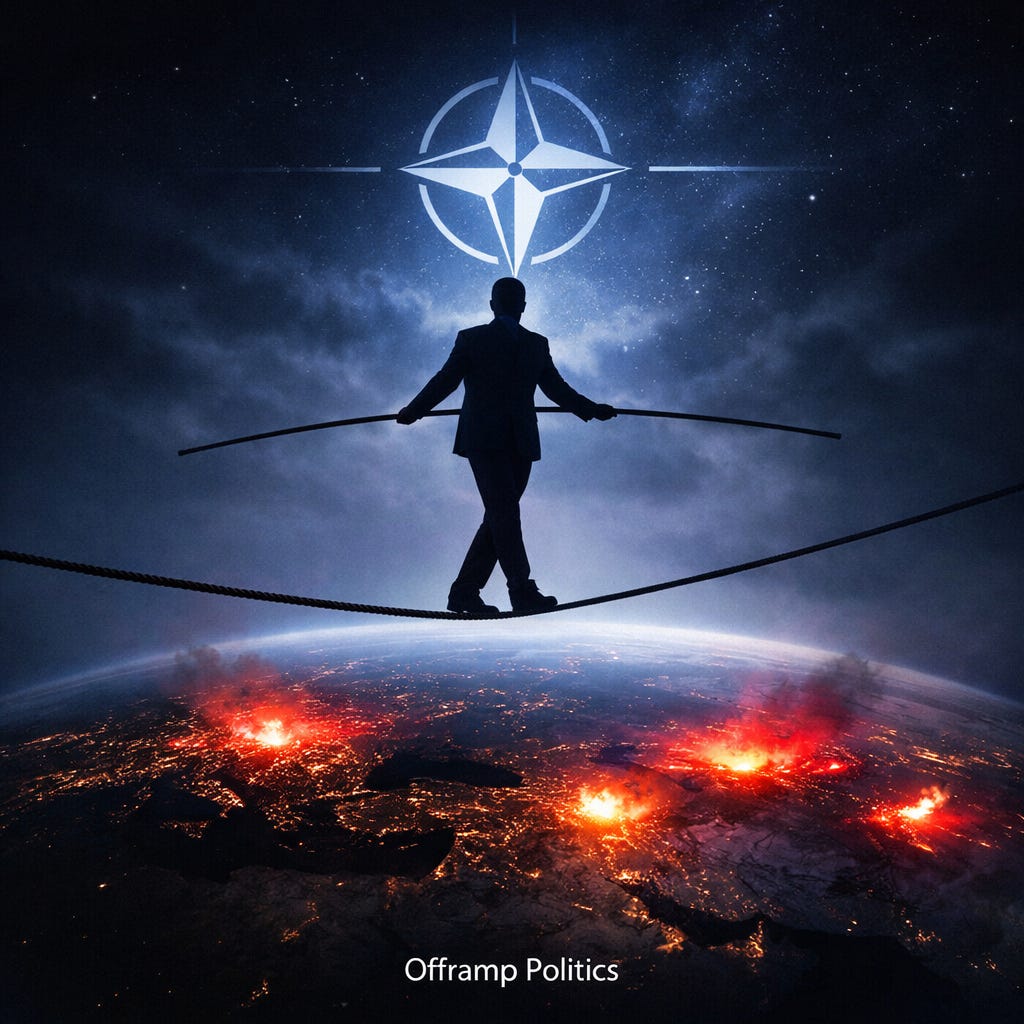
Trump’s Next Test: Can NATO Fight Three Wars Without Fighting One?
For the last several weeks the commentary around the Iran conflict has been predictable.
Trump is reckless.
Trump is reckless.
Trump is reckless.
That is the chorus.
But something else quietly happened in the Middle East that deserves attention.
The math changed.
The Trump administration proved something very specific: it can change the battlefield calculus kinetically. When Washington decided to act, the equation shifted quickly. Oil markets reacted, military balances shifted, and suddenly every capital from Moscow to Beijing began recalculating.
Changing the math through force is one thing.
Changing the math through diplomacy is something entirely different.
And that is where the real test for the Trump administration begins.
Because the strategic map right now looks less like one crisis and more like three overlapping fault lines stretching across the globe.
Russia in Ukraine.
China circling Taiwan.
Iran disrupting the Middle East and global energy routes.
Each of these theaters pulls on the same military resources. The same navies. The same missiles. The same intelligence infrastructure. The same political attention.
And every NATO planner knows the uncomfortable truth.
The Western alliance does not want to fight a three-front geopolitical war.
Europe understands this instinctively.
Their first priority remains Russia. Ukraine is not simply a distant conflict for them. It sits on Europe’s doorstep. If Russia breaks Ukraine, the pressure shifts directly onto NATO’s eastern flank.
Meanwhile in Asia, the Taiwan question looms like a storm cloud over global trade. Japan, South Korea, and increasingly the United Kingdom are quietly preparing for a scenario in which China tests the limits of Western deterrence.
Now the Middle East enters the equation.
Iran threatens the Strait of Hormuz, a narrow artery through which roughly a fifth of the world’s oil flows. Energy markets begin to wobble. Insurance costs for shipping spike. And suddenly the conflict becomes global whether anyone intended it to be or not.
This is the strategic triangle the Trump administration now faces.
Russia.
China.
Iran.
Three different actors, three different theaters, but one shared pressure point: Western capacity.
The administration has already shown it can change the math militarily in the Middle East. But the larger challenge now lies elsewhere.
Can Washington convince its allies to change the math with it?
That is where diplomacy becomes the battlefield.
Europe’s hesitation about joining the Iran fight is not simply political caution. It is strategic triage. European governments are already sending weapons, money, and intelligence into Ukraine. Their defense industries are ramping up, but slowly. Their militaries are rebuilding after decades of post-Cold War downsizing.
Opening another major military commitment in the Middle East risks stretching those systems to the breaking point.
And then there is Asia.
If China moves on Taiwan, the United States will need help. Not symbolic help, but real naval power, real logistics, real allied participation. Japan, South Korea, Australia, and even European naval forces would likely be pulled into the Pacific.
This is why the idea now floating in European capitals is so interesting.
Some leaders are quietly suggesting a strategic trade.
Europe could help stabilize the Middle East if the United States guarantees continued support for Ukraine.
In other words: alliance burden-sharing across theaters.
This is the kind of complex diplomatic puzzle that does not resolve itself through military strikes. It requires something else entirely.
It requires alignment.
Enter Marco Rubio.
For years Rubio has been one of Washington’s most vocal voices on foreign policy. He understands Latin America deeply, and few people in Washington know the political terrain of America’s own hemisphere better than he does.
But the challenge now sitting on his desk stretches far beyond the Americas.
It spans Brussels, Tokyo, Seoul, and London.
Rubio’s task is not simply to defend American interests. It is to orchestrate allied confidence across three geopolitical fault lines at once.
That is not an easy assignment.
Europe must believe that supporting the Middle East will not weaken Ukraine.
Asian allies must believe that American attention to Iran will not weaken deterrence against China.
And Washington itself must maintain the ability to manage all three theaters without appearing overextended.
If that sounds difficult, it is because historically it is.
Great powers tend to stumble when multiple fronts open simultaneously. The strategic bandwidth required to manage several crises at once has broken alliances before.
Which is why the coming months may represent one of the most important diplomatic tests of the Trump presidency.
The administration has demonstrated it can act decisively when it chooses to use force. That question appears settled.
The next question is far more complicated.
Can the United States persuade its allies to move with it?
Can NATO adapt to a world where the major geopolitical fault lines are no longer confined to one continent?
And can Marco Rubio extend American diplomatic reach far enough into Europe and Asia to keep the alliance system aligned?
These are the questions quietly shaping the next phase of the conflict.
Military action may change the numbers on the battlefield.
But diplomacy determines whether alliances can carry the weight of those numbers over time.
And right now the weight is enormous.


