


For years the migration crisis in Europe was discussed in almost entirely apocalyptic terms.
You could feel the panic in the language.
Hungary’s Prime Minister Viktor Orbán warned that Europe faced a civilizational threat. Britain’s Prime Minister David Cameron described the wave as destabilizing for the continent. Commentators across Europe argued that the migration surge from the Middle East and North Africa represented a problem with no upside.
The images burned into public memory: train stations overflowing, families walking along highways, camps expanding on the edges of European cities.
The consensus was simple.
Nothing good could come from this.
But geopolitics often moves in ways that only become visible years later.
And now, a decade after the migration wave reached its peak, something unusual is beginning to take shape in the sky.
Strange stars are aligning.
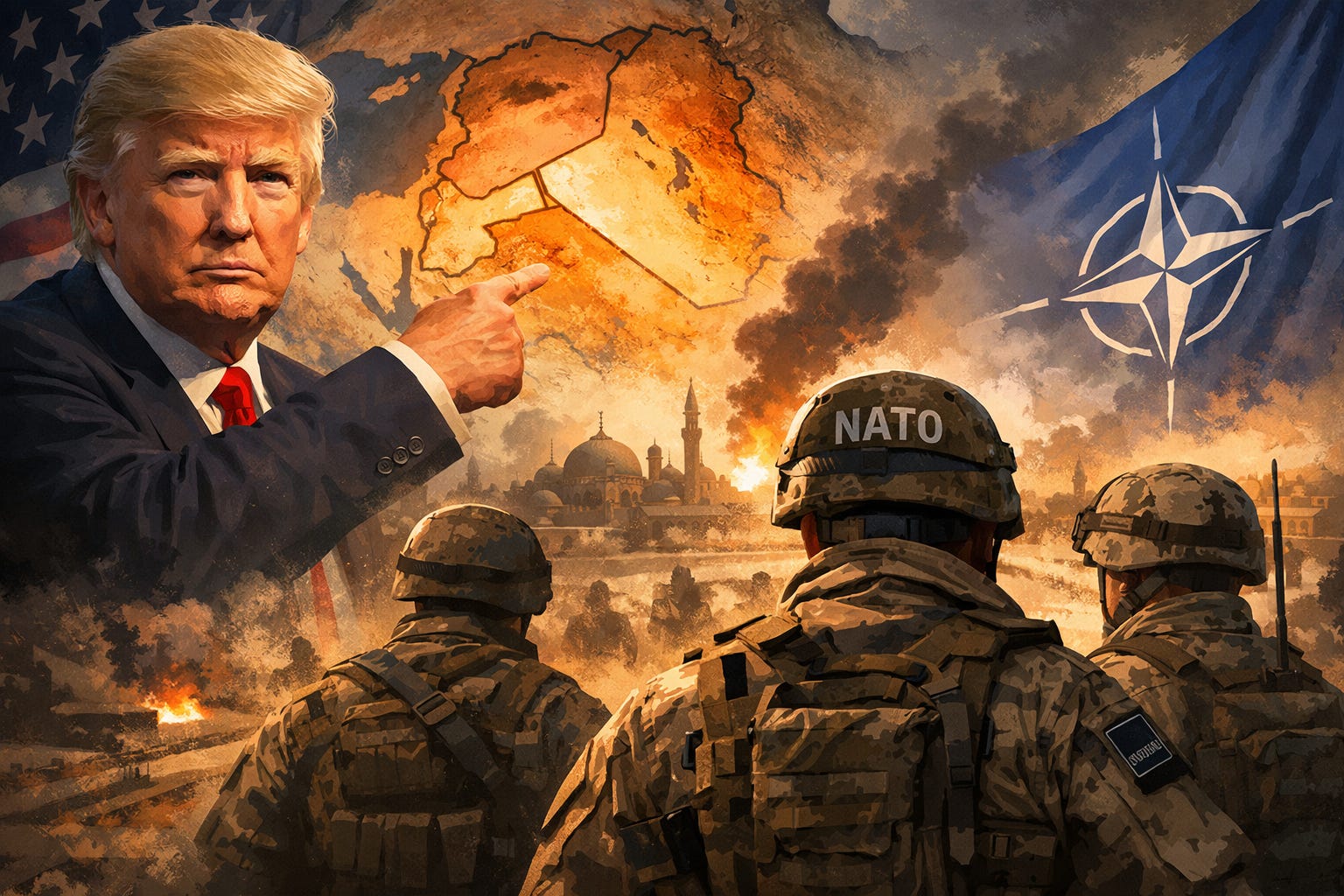
Trump’s Pressure on EU Members of NATO
The current conflict with Iran has created a situation that Washington cannot manage alone.
President Donald Trump has made that point explicitly.
In recent days he has warned that NATO could face a “very bad future” if allies refuse to help secure global shipping routes in the Middle East, particularly the Strait of Hormuz, through which roughly a fifth of the world’s oil flows. (Reuters)
Trump’s message is blunt.
Countries that rely on energy from the region should help secure it.
Europe sits squarely in that category.
The United States may have become far less dependent on Middle Eastern oil over the past decade, but Europe and Asia remain deeply tied to the stability of the Persian Gulf. When that region erupts, energy prices surge, shipping routes choke, and global markets wobble.
Trump is essentially telling EU NATO allies that the security architecture of the last seventy years may be shifting.
The United States will act.
But others will need to join.
The Question Europe Cannot Avoid
If the current conflict leads to a long period of instability in the Middle East, the international community will face a familiar challenge.
Not the war itself.
But what comes after.
History has shown that removing a regime is the easy part. Stabilizing a region afterward is far harder. Reconstruction, security, infrastructure, and political rebuilding can take decades.
The question eventually becomes unavoidable.
Who will help rebuild?
Who will help secure the peace?
The Demographic Clock
This is where the migration crisis begins to look different through the lens of time.
The migration wave that surged into Europe around 2015 brought millions of people from the very region now sitting at the center of global instability.
Many arrived as families.
Many brought children.
At the time, those children were largely invisible in the political debate.
But demographics operate on a quiet clock.
A child who was eight years old in 2015 is now eighteen.
A child who was ten is now twenty.
An entire generation that arrived during the migration crisis is now entering adulthood across Europe.
And that reality intersects with a geopolitical shift unfolding at the same moment.
Europe’s Unexpected Population Bridge
Europe today contains millions of people whose families come from the Middle East and North Africa.
For years this demographic shift was framed purely as a political burden.
But history sometimes reveals strange ironies.
If Europe is eventually drawn into a multinational effort to stabilize and rebuild parts of the Middle East, those same communities may become one of its most valuable strategic bridges.
They understand the languages.
They understand the culture.
They understand the social dynamics of the region in ways that Western policymakers have often struggled to navigate.
In a world where rebuilding societies will require diplomacy, infrastructure development, business investment, and cultural mediation, those connections matter.
A great deal.
The Blessing No One Expected
Ten years ago the migration crisis looked like a geopolitical earthquake.
Borders were strained. Politics fractured. The future seemed uncertain.
But sometimes history plants seeds inside crises that only become visible later.
Today Europe possesses something it did not have before.
A larger population tied directly to the region where global stability may now need rebuilding.
A population bridge between Europe and the Middle East.
And now, as President Trump pressures NATO allies to step forward and help secure the region, the strange possibility emerges that the migration crisis may have unintentionally prepared Europe for exactly this moment.
Not through planning.
Not through strategy.
But through the quiet mathematics of time.
When History Reveals Its Ironies
The migration crisis was once seen as Europe’s great vulnerability.
But as the current Middle East conflict unfolds, another possibility begins to emerge.
What if it also became Europe’s hidden advantage?
History is filled with moments where events that appeared chaotic in one decade turn out to be strangely aligned with the challenges of the next.
Sometimes the stars do not make sense until years later.
And right now, looking at the map of Europe, the Middle East, and the pressures now building around NATO, it is difficult not to notice something unusual in the sky.
The possibility that a crisis everyone feared may contain the seeds of an unexpected solution.
It is now…….