


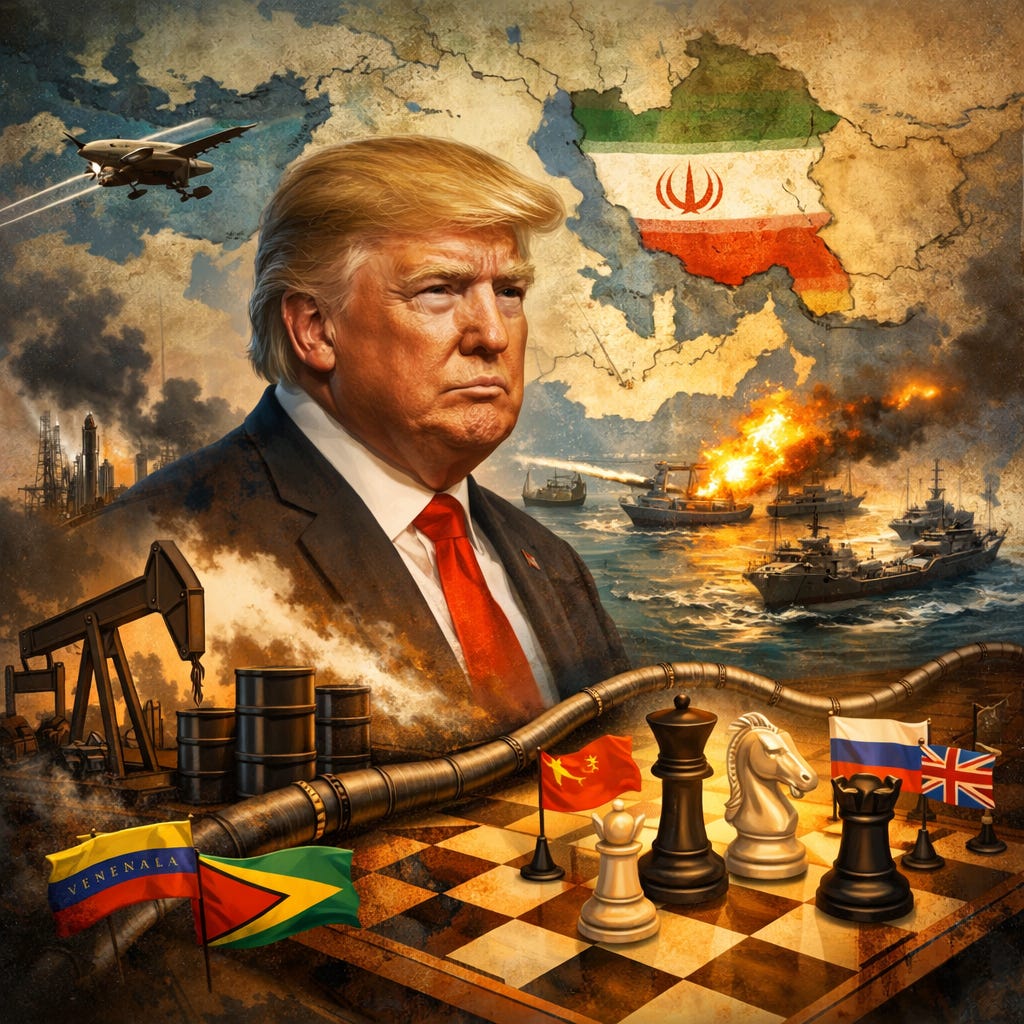
For years the criticisms of Donald Trump have been predictable.
He’s crazy.
He’s reckless.
He’s evil.
He’s greedy.
He’s corrupt.
Every political faction seems to have its own version of the same argument. Some say he’s an authoritarian. Others say he’s a clown who stumbled into power. Still others believe he’s simply too impulsive to understand the consequences of what he’s doing.
And now, with the war involving Iran, those criticisms have exploded again.
Even people who once stood firmly inside Trump’s political coalition are openly questioning him.
One of the most striking examples is Tucker Carlson.
Carlson, who for years acted as one of the most influential voices inside the MAGA ecosystem, reacted to the opening strikes against Iran with fury. In an interview he called the operation “absolutely disgusting and evil,” warning that the decision would “shuffle the deck in a profound way.” (ABC News)
On his show and podcast, Carlson went even further, arguing that the conflict was not in America’s interest and claiming the war was driven by outside forces rather than the United States itself. (Wikipedia)
This is not some random critic.
Carlson helped shape the intellectual backbone of the “America First” foreign policy movement. When someone like him breaks ranks publicly, it signals that something deeper is happening inside the political coalition that brought Trump to power.
But what if the surface chaos is hiding a deeper logic?
What if there is a method to what looks like madness?
The Hybrid War Nobody Talks About
For years I’ve written about something that doesn’t fit neatly into traditional war categories.
The United States is already in conflict with multiple adversaries. But the battlefield isn’t only tanks and missiles.
It’s economic.
It’s informational.
It’s criminal.
Tariffs, sanctions, trade restrictions, cyber warfare, propaganda networks, smuggling routes, fentanyl pipelines, election interference, human trafficking rings, and digital influence operations.
This is hybrid warfare.
And if you look closely at the problems tearing at American society right now, many of them share a common feature.
They are not purely domestic problems.
They are transnational operations often supported, tolerated, or financed by sanctioned states and organized criminal networks.
The fentanyl crisis is the most obvious example. Supply chains stretch from chemical producers overseas to cartel networks that operate across multiple continents.
Illegal migration networks are similar.
Human smuggling operations, fake asylum pipelines, and cross-border trafficking routes have become multi-billion dollar industries.
Add to that the digital battlefield.
Election interference.
Bot networks.
Social media disinformation campaigns.
Radicalization pipelines.
Even fringe political movements have drawn attention from researchers studying foreign influence operations. A Rutgers University report examining the Groyper movement around Nick Fuentes highlighted concerns that foreign actors may be amplifying or supporting elements of that ecosystem.
None of this is easy to confront publicly.
Because the moment you expose it, you expose the financial networks behind it.
And those networks often touch powerful people.
Corrupt politicians.
Business elites.
Sanctioned governments.
Organized crime groups.
This is why transparency has been so difficult.
And it’s why the conflict we’re watching may not be what it appears to be on television.
Securing the Western Hemisphere
One of the strangest things about the Iran conflict is what happened before it started.
Look at the Western Hemisphere.
The United States spent years quietly stabilizing the energy landscape in its own backyard.
Venezuela.
Guyana.
Brazil.
Energy corridors across the Americas.
Guyana in particular has become one of the fastest-growing oil producers in the world. Its offshore discoveries transformed the country almost overnight into a major player in global energy markets.
At the same time, Venezuela’s political environment has shifted in ways that reopened discussions about energy cooperation and regional stability.
These moves did something extremely important.
They diversified global oil supply.
So when the conflict with Iran erupted and the Strait of Hormuz faced disruption, the energy shock was smaller than many analysts predicted.
That wasn’t an accident.
It was preparation.
The Energy Chessboard
Iran sits in one of the most strategic locations on Earth.
The Strait of Hormuz carries roughly a fifth of the world’s oil shipments.
Historically, that chokepoint gave Iran enormous leverage.
Threaten the strait, and the entire global economy trembles.
But the world of 2026 is not the world of 2006.
New oil production zones have emerged.
Guyana.
Brazil’s offshore fields.
Potential Venezuelan recovery.
North American production capacity.
Ironically, rising oil prices triggered by geopolitical instability actually strengthen these alternative energy regions.
Guyana earns more revenue.
Venezuela gains economic breathing room.
Western Hemisphere supply expands.
Which means the global economy becomes less dependent on a single chokepoint in the Persian Gulf.
That changes the entire strategic equation.
The Burden of Policing Hormuz
For decades the United States carried the primary burden of protecting global oil shipping routes.
The U.S. Navy essentially acted as the security guard of the world’s energy system.
But something interesting may now be happening.
If Iran’s leadership structure collapses or changes under international pressure, maintaining stability in the region will require a coalition effort.
China depends heavily on Gulf oil.
Japan and South Korea rely on the same shipping routes.
Europe depends on them as well.
Suddenly the responsibility for keeping the Strait of Hormuz open becomes a shared global interest, not simply an American one.
In other words:
America may be shifting from sole enforcer to architect of a coalition security system.
The Irony
Here is the irony few people are talking about.
The conflict that many critics said would destroy global energy markets may actually accelerate a transition already underway.
Higher oil prices help expand production in places like Guyana and Venezuela.
Those revenues strengthen governments that have incentives to maintain political stability.
And the more stable those countries become, the more resilient the global energy system becomes.
Meanwhile the burden of protecting Persian Gulf oil flows becomes internationalized.
If that is the outcome, the geopolitical balance of the energy world quietly shifts westward.
Toward the Americas.
The Offramp Perspective
If you’ve read my Offramp Politics work, you’ve seen me explore pieces of this puzzle before.
Energy corridors.
Hybrid warfare.
Organized crime networks tied to sanctioned states.
The role of corruption and political instability in shaping global economic systems.
None of these things exist in isolation.
They are pieces of a larger geopolitical machine.
And sometimes what looks like chaos is actually the grinding movement of that machine shifting into a new gear.
Method in the Madness?
Does that mean Donald Trump is some master chess player orchestrating a perfect geopolitical strategy?
No.
History is rarely that clean.
But it is possible that what appears impulsive on the surface is part of a broader strategic logic emerging inside the American national security apparatus.
Secure the Western Hemisphere.
Diversify energy supply.
Reduce dependence on Middle Eastern chokepoints.
Force global powers to share responsibility for regional security.
If that is the direction this is heading, the world may be witnessing a fundamental shift in how global energy stability is maintained.
And if that’s true, then the critics calling Trump crazy might eventually find themselves asking a very uncomfortable question.
What if there really was a method to the madness?