
The Trump–Schiff Debate Misses the Real Solution
How a Mature Society Fixes Broken Arguments
Every few years, the same argument resurfaces in American economic life, usually framed as a shouting match between two camps that never quite hear one another.
On one side, Donald Trump argues that the United States has been subsidizing the rest of the world. We shipped out our factories, hollowed out our industrial base, protected global trade routes, and accepted permanent trade deficits as if they were harmless accounting artifacts. In Trump’s framing, America gave away something real—productive capacity, leverage, and dignity—in exchange for short-term consumption.
On the other side, Peter Schiff argues that this view is backward. The world, he says, subsidizes the United States. Because the dollar is the global reserve currency, Americans consume more than they produce, finance deficits at artificially low rates, and export inflation abroad. The U.S. isn’t weak, Schiff argues—it’s privileged, and that privilege is quietly corroding the system.
Most people pick a side.
I don’t think that’s necessary.
I think they’re both right.
And I think the reason the argument never resolves is that they’re looking at two different ledgers.
Two Ledgers, One Fracture
Trump is looking at the real-economy ledger.
That ledger tracks factories, ports, skills, supply chains, logistics, and national resilience. In that ledger, the United States absolutely paid a price for decades of offshoring and financialization. You cannot outsource production indefinitely and expect sovereignty to remain intact. You cannot treat labor as a cost center forever and still call yourself a durable nation.
From that perspective, “subsidizing the world” isn’t rhetoric. It’s descriptive.
Schiff is looking at the monetary ledger.
That ledger tracks debt, currency privilege, capital flows, and purchasing power. In that ledger, the United States has enjoyed extraordinary advantage. We print the currency everyone else needs. We borrow in our own denomination. We roll debt forward instead of retiring it. We import real goods and export paper claims.
From that perspective, the world is subsidizing us.
The mistake is assuming only one ledger matters.
They both do.
And the danger is that they are no longer aligned.
The Hidden Cost: When Time Horizons Diverge
The real problem isn’t that Trump is wrong or Schiff is wrong.
It’s that monetary benefit is immediate while real-world cost is delayed.
That delay creates political confusion and social strain. Jobs disappear first. Asset prices rise next. Costs creep upward. Wages lag. Debt fills the gap. Stability erodes quietly, then suddenly.
The middle class becomes the shock absorber between two realities it didn’t design.
So the real question isn’t who’s right.
It’s whether there’s a way to fix both failure modes at once.
I believe there is.
Why Social Security Can’t Carry the Future Alone
This is where most debates derail.
Social Security is treated as sacred or untouchable, or else as a burden to be cut. Both framings miss the point. Social Security was designed for a different era, under different demographic and economic assumptions. Pretending otherwise doesn’t preserve it. It guarantees its eventual failure.
The answer is not to tear it down overnight. That’s reckless and unnecessary.
The answer is to stop asking Social Security to carry the future alone.
The Missing Third Option: A Fleet of Funds
Instead of framing reform as “save Social Security” versus “replace Social Security,” I propose something structurally different:
A fleet of privately financed, publicly accountable national funds that operate in parallel with Social Security and gradually absorb the growth burden it was never designed to carry.
Social Security remains a baseline stabilizer.
The future is built elsewhere.
The Reparations Fund (Flagship)
At the center of this fleet is the Reparations Fund, designed specifically for descendants of enslaved people in the United States.
Not as a symbolic gesture.
Not as a one-time check.
But as a permanent capital structure.
Its foundation rests on three principles:
Education that never expires
Workforce participation tied directly to rebuilding the nation and region
Dividends and asset formation linked to contribution, not dependency
This is not welfare.
It is capitalization.
It treats people as assets to be developed rather than problems to be managed.
The American Heritage Fund (Parallel Structure)
Alongside it sits the American Heritage Fund.
Same architecture.
Same transparency.
Same governance rules.
Different historical justification.
This fund exists for Americans who are not descendants of slaves but want access to the same rebuild-and-dividend framework. It prevents the zero-sum framing that kills serious policy discussion while preserving the moral specificity of reparations.
Different histories.
Shared future.
Identical mechanics.
And once this structure exists, additional funds can emerge organically: regional rebuild funds, infrastructure apprenticeship funds, climate hardening funds, industry-specific workforce funds.
A fleet.
How These Funds Are Financed (This Is Not Theoretical)
These funds are not speculative constructs. They are modeled on existing, legal, and well-understood financial mechanisms already operating inside the American system.
Structurally, they resemble how Puerto Rico and certain U.S. territories finance development: through the ability to issue U.S. government tax-free bonds.
That matters.
Tax-free bond status does three things immediately:
First, it lowers the cost of capital. Investors accept lower yields because income is exempt from federal taxation. More money goes to actual rebuilding instead of servicing debt.
Second, it attracts long-duration capital. Pension funds, insurance pools, family offices, and institutional investors already understand this market. No reinvention required.
Third, it ties financing to real assets: infrastructure, education pipelines, workforce participation, housing, ports, grids, and measurable outputs.
This is boring finance by design.
And that’s the point.
State Pension Funds: Where This Model Really Scales
This is where the architecture becomes unavoidable.
State pension funds are among the largest pools of patient capital in the world. Their liabilities are long-term. Their mandate is stability. Infrastructure, workforce development, and human capital are not exotic assets to them. They are natural fits.
The fleet of funds I’m describing is structurally aligned with pension logic:
– long horizons
– predictable cash flows
– real assets
– social stability as a return multiplier
Instead of pension capital being deployed abstractly while domestic capacity decays, pension funds become direct stakeholders in rebuilding the communities their beneficiaries live in.
That’s not ideology.
That’s alignment.
Ownership, Not Optics: Board-Level Voice
Here’s the piece most reform efforts avoid.
These funds are not passive investors.
They must have the ability to hold board seats in corporations they invest in.
Capital without voice is charity.
Capital with governance is power.
For the Reparations Fund in particular, this includes golden board seats—long-term governance representation tied to partnership and accountability, not quarterly theatrics.
Corporations already do this with sovereign wealth funds and strategic investors. There is no reason it cannot apply here.
Imagine the Reparations Fund holding board-level representation at companies like Nike or Apple—not as symbolism, but as structure.
That ensures:
– capital is not extracted without responsibility
– workforce pipelines are real, not performative
– communities are stakeholders, not marketing demographics
This is not anti-corporate.
It is corporate adulthood.
Why This Solves Both Trump’s and Schiff’s Problems
Trump’s concern is lost capacity.
These funds put Americans to work rebuilding ports, grids, housing, logistics, flood control, and skills pipelines. They convert abstract capital into physical output and durable expertise.
Schiff’s concern is monetary illusion.
These are capitalized institutions. Dividends come from returns on real assets and productivity, not from rolling promises forward through debt and monetary expansion.
This is the transition from IOUs to ownership.
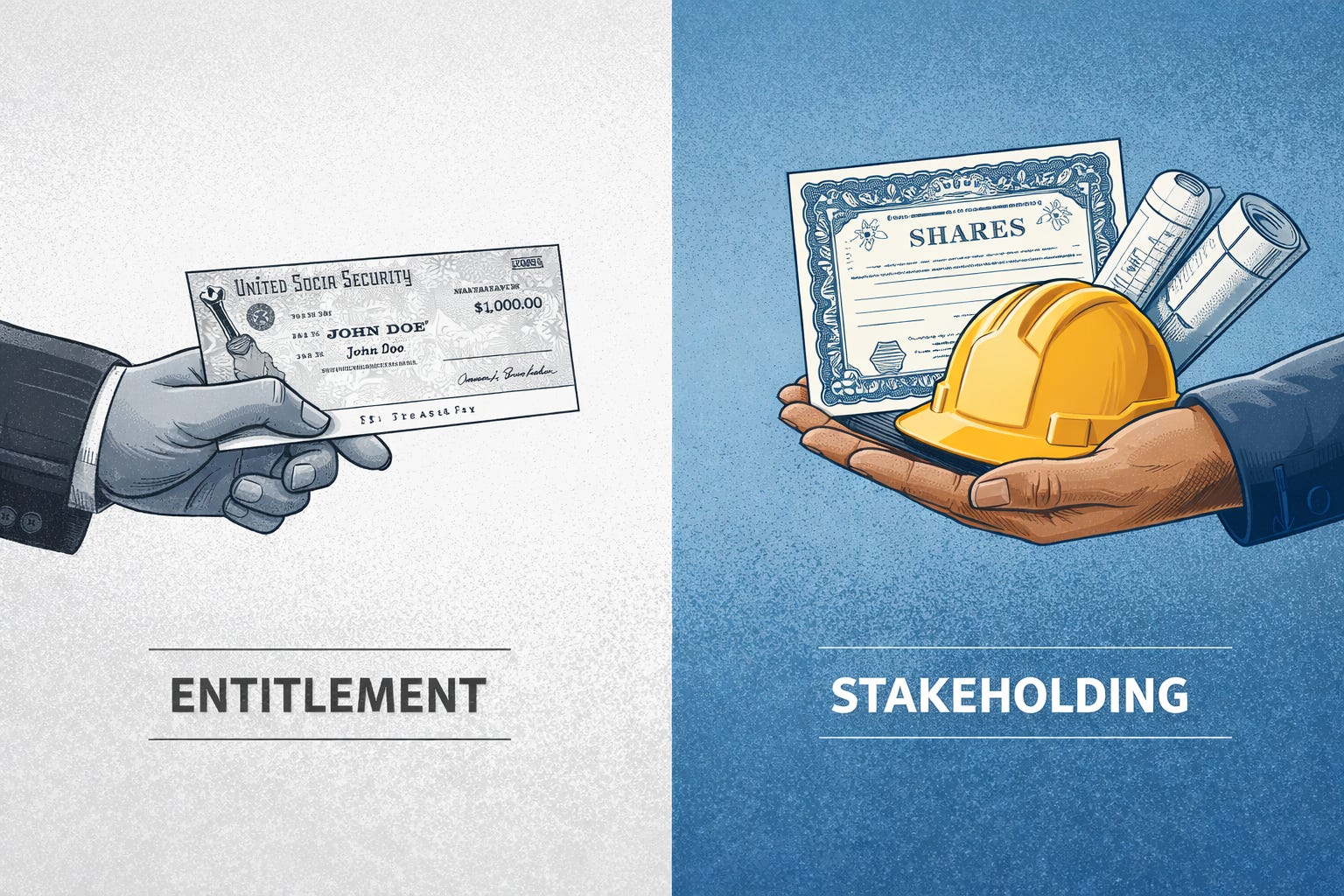
The Deeper Shift: From Entitlement to Stakeholding
This is the part that matters most.
What I’m proposing is not just a policy fix. It is a redefinition of society.
For decades, we’ve defined citizenship increasingly through entitlement—what the system owes you, what you receive, what stabilizes you.
That model is breaking down.
The future requires stakeholding:
– participation instead of passivity
– ownership instead of dependency
– dividends tied to contribution
– voice tied to capital
Social Security stabilizes the floor.
The fleet of funds builds the ceiling.
That is how a mature society evolves without collapsing.
Final Thought
Trump sees the factories.
Schiff sees the balance sheet.
I see the people caught between them—and a system that keeps asking them to absorb contradictions they didn’t create.
We don’t need to choose between production and sound money.
We need institutions that make them reinforce each other.
That’s not radical.
It’s overdue.


