


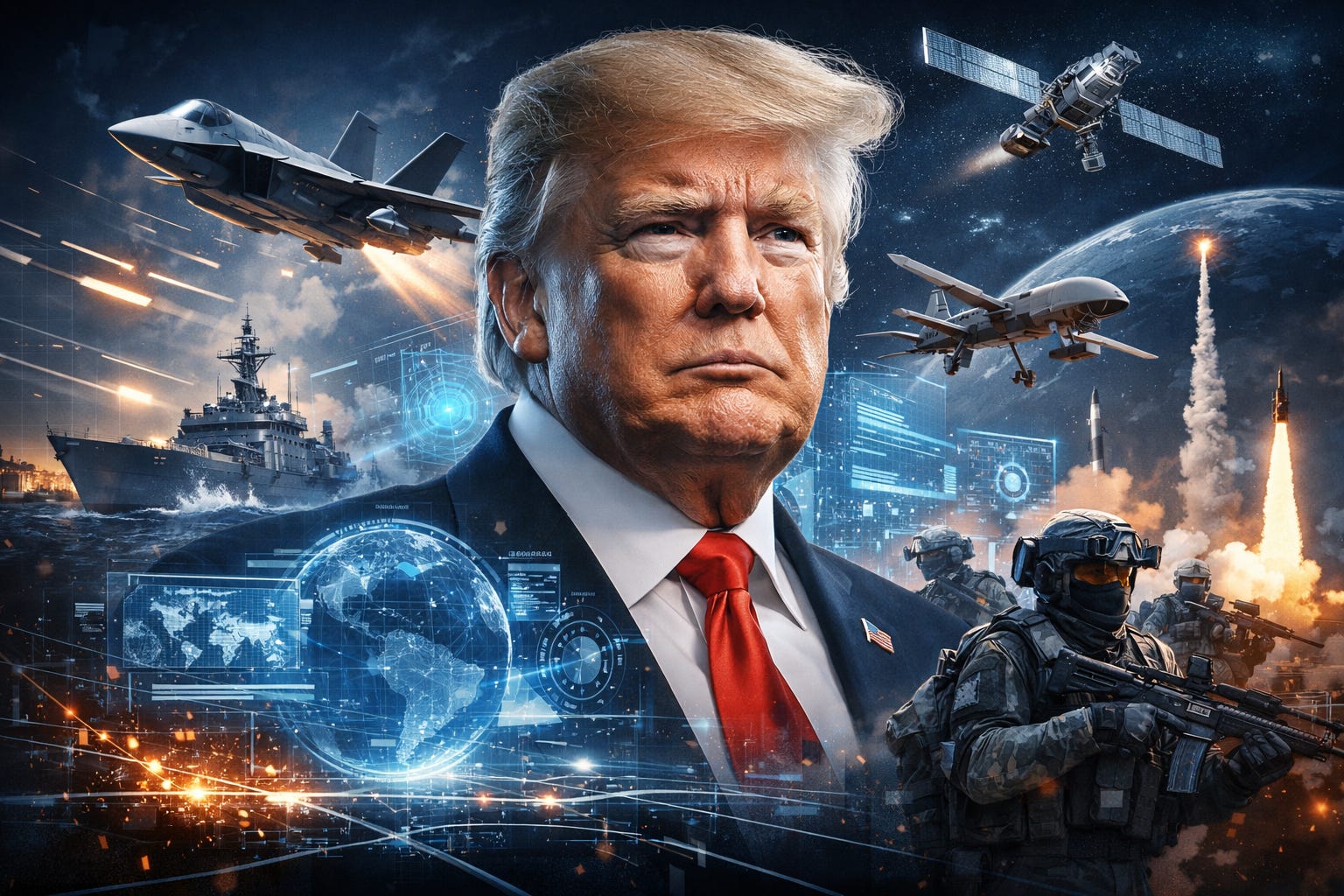
There are moments in history when a country doesn’t just act…
It redefines how it acts.
Not with a speech. Not with a document. Not even with a formal declaration.
But through a pattern.
A series of decisions that, when viewed together, form something larger than policy.
A doctrine.
President Donald Trump may have done exactly that.
Not by announcing it…
But by operating inside a new logic of power that the United States has been quietly building toward for decades.
A logic forged in failure.
Refined through fatigue.
And now… deployed with precision.
What we may be witnessing is the emergence of a new American doctrine:
Project overwhelming military capability…
Avoid prolonged entanglement…
Let hybrid conflict play out…
But dominate the moment it turns kinetic.
If that sounds familiar, it should.
Because the foundation of this doctrine wasn’t built during Trump’s presidency.
It was built in the long shadow of Vietnam…
Tested in Iraq…
And exhausted in Afghanistan.
Those wars didn’t just shape American policy.
They reshaped American instinct.
And now, for the first time, that instinct may be operating in its purest form.
Not as reaction.
But as strategy.
There’s a strange irony sitting at the center of American power.
The wars that damaged the nation most deeply… may have also rebuilt it into something far more dangerous.
Vietnam fractured trust.
Iraq exposed illusion.
Afghanistan drained patience.
Each one felt like erosion. Each one looked like decline.
But what if those wars weren’t just failures?
What if they were training data?
The Long Burn of Failure
America’s post-Vietnam military history reads like a sequence of unresolved arguments.
We argued with terrain in Southeast Asia.
We argued with ideology in the Middle East.
We argued with time itself in Afghanistan.
And we lost something in each one.
Not just lives. Not just money.
We lost certainty.
That loss matters.
Because certainty is what makes empires rigid.
And rigidity… is what gets empires broken.
What America Learned (Quietly)
While the public saw failure, something else was happening underneath.
The U.S. military wasn’t standing still.
It was evolving.
Precision targeting.
Real-time intelligence fusion.
Drone warfare.
Cyber integration.
Command-and-control disruption.
What used to take weeks now takes minutes.
What used to require armies now requires signals.
The modern battlefield isn’t a place anymore.
It’s a system.
And the United States has become exceptionally good at operating inside systems.
Recent conflicts show this shift clearly.
Leadership-targeting strikes now happen at the opening of conflicts, not the end (New York Post)
Adversary command structures can be disrupted almost immediately
Military outcomes are increasingly shaped before the public even understands a war has begun
That’s not traditional warfare.
That’s system warfare.
The Hybrid Battlefield Split
Now look at the global landscape.
Russia, China, and Iran are playing a different game.
They specialize in what could be called pre-war warfare:
Disinformation campaigns
Election interference
Economic pressure
Proxy conflicts
Cyber disruption
Russia’s “shadow warfare” model is built around sabotage and ambiguity, staying below the threshold of open war (CEPA).
Iran is actively using AI-driven information campaigns to influence public perception inside the United States itself (The Guardian).
China blends economic leverage with technological infiltration and long-term positioning, often avoiding direct military confrontation while shaping the battlefield years in advance (Jamestown Foundation).
That’s hybrid warfare.
But here’s the divergence.
Where America Is Different
For America, hybrid warfare doesn’t replace the military.
It orbits it.
For its adversaries, hybrid warfare is the strategy.
For the United States, it’s the opening act.
The difference is subtle, but it changes everything.
Because when hybrid tactics escalate into kinetic conflict…
America’s system turns on.
And when it does, the equation shifts.
The Kinetic Override
Recent events show something important.
When war crosses the line into direct military engagement, the United States still dominates the escalation ladder.
Even adversaries building layered defenses with Russian and Chinese systems have struggled to withstand U.S. and allied operations (JINSA).
Iran’s asymmetric tools like cheap drones can disrupt and complicate operations, but they don’t fundamentally overturn the balance of power (The Washington Post).
What they do instead is reveal something deeper:
The battlefield is becoming a contest between cost efficiency and system dominance.
And right now, America dominates the system.
The China Problem
China presents the most interesting counter-model.
Its strength is economic gravity.
Supply chains.
Trade routes.
Industrial scale.
But those strengths come with a vulnerability.
They require stability.
And kinetic conflict disrupts stability.
We’re already seeing signs of this tension:
Maritime competition and undersea warfare positioning is accelerating (Reuters)
Drone saturation strategies are being developed to offset U.S. advantages (Reuters)
China’s hybrid model works best in a world where war doesn’t fully ignite.
But if it does?
Its economic engine becomes exposed.
The Trump Variable
This is where instinct lands.
The Trump-era posture, particularly in its current form, appears to lean into a specific idea:
Reduce entanglement.
Increase strike capability.
Maintain dominance without occupation.
The 2025 National Security Strategy reflects this shift toward showing strength without long-term commitments, emphasizing deterrence through capability rather than prolonged engagement (Brookings).
In theory, that creates a new kind of equilibrium:
Let adversaries operate in the gray zone
Avoid being pulled into endless wars
But maintain overwhelming superiority when escalation occurs
That’s not traditional doctrine.
That’s something closer to strategic minimalism with maximum lethality.
But There’s a Catch
Every system has a pressure point.
And this one is no different.
While U.S. military power remains dominant, extended conflicts can stretch attention and resources, potentially creating openings elsewhere (The Washington Post).
At the same time:
Cheap, scalable weapons are challenging expensive defense systems
Information warfare is shaping domestic perception
Political decision-making still determines how power is applied
In other words:
The machine is powerful.
But the hand guiding it still matters.
The Offramp Question
So here’s the real question for 2028.
Not whether America is strong.
But how it chooses to use that strength.
Has the United States found the sweet spot?
Or is it standing at the edge of another cycle?
Because history has a rhythm.
And America has danced this pattern before:
Confidence
Expansion
Friction
Correction
The difference now?
The battlefield isn’t just physical anymore.
It’s informational.
Economic.
Psychological.
Technological.
And for the first time in modern history…
War can reshape the system without fully revealing itself.
Final Thought
America didn’t just learn from its failures.
It encoded them.
Into doctrine.
Into technology.
Into instinct.
The result is a military that doesn’t just fight wars.
It alters the conditions around them.
The question now is simple.
And maybe a little uncomfortable.
Is this the balance point…
Or just the calm before the next redesign?
The offramp doesn’t tell you where to go.
It gives you a different angle on where you already are.
And from this angle, something becomes clear.
America isn’t the same country that walked into Vietnam.
It isn’t the same military that stayed too long in Iraq.
It isn’t the same system that got lost in Afghanistan.
It’s something more adaptive now.
More restrained in some ways.
More precise in others.
More willing to let the world move… until it decides it needs to move it back.
That’s the edge.
Not dominance in the traditional sense.
But the ability to reshape the environment when it matters most.
And if that’s true… if this really is the sweet spot you’re seeing…
Then 2028 isn’t just another election.
It’s a referendum on whether America leans fully into this model…
Or drifts back into something it already outgrew.
So the real question isn’t whether the United States has found its footing.
It’s whether it recognizes the ground it’s standing on.
Or misses it…
Because it’s still looking at the road it already left behind.
Murder is still murder. We need to evolve beyond the ancient paradigm of aggression and bloodletting.
In other words :
Grow the fuck up…….