
The Third Rail and the Legends We Forgot How to Build
There is something strange happening beneath the noise.
We live in an age where information moves at light speed, outrage travels faster than reason, and loyalty is measured in amplification. Everyone has a take. Everyone has a tribe. Everyone has a strategy.
And yet something essential feels missing.
Not intelligence.
Not access.
Not even passion.
What’s missing is courage anchored in principle.
Not performative courage.
Not partisan aggression disguised as bravery.
Not the kind that earns applause from your own side while infuriating the other.
I’m talking about the rarer form.
The kind that costs you allies.
The kind that risks exile.
The kind that makes your own tribe uncomfortable.
In a disinformation-saturated environment, this may be the clearest signal we have left.
Because cost is hard to fake.
Political Courage vs Political Convenience
I’ve framed much of modern politics through a simple lens:
Political Courage vs Political Convenience.
Convenience protects position.
Courage protects principle.
Convenience optimizes for the next election cycle.
Courage optimizes for the next generation.
Convenience soothes anxieties today.
Courage prevents crises tomorrow.
Most of our system now rewards convenience.
Polls guide language.
Algorithms reward escalation.
Donors reward loyalty.
Media cycles reward emotional spikes.
So what would courage anchored in principle even look like right now?
Let’s talk about the velvet-wrapped third rail.
The Highest Political Cost
The highest political cost today may not be foreign policy.
It may not be cultural battles.
It may not even be immigration.
It may be entitlement reform.
Because entitlement reform touches identity, dignity, and generational promise.
It is not abstract. It is personal.
These programs represent decades of work and expectation. They represent trust between citizen and state.
And yet arithmetic does not bend to sentiment.
Demographics shift.
Birth rates decline.
Life expectancy extends.
Healthcare costs compound.
Convenience whispers: Don’t touch it.
Principle whispers: Stabilize it before instability chooses for us.
The moment someone speaks honestly about long-term structural reform, the machinery activates.
Fear spreads quickly.
“Cuts.”
“Broken promises.”
“Taking away what was earned.”
So most leaders delay.
And delay compounds.
But this is bigger than policy.
Why “Truth” Is Not the Highest Virtue
We have made a mistake in this era of information warfare.
We have elevated “telling the truth” to the highest political virtue.
It is not.
Truth detached from principle can be as destabilizing as deception.
Raw disclosure is not the same as moral clarity.
There is a growing belief that if someone says what others are afraid to say — if they trigger backlash, lose contracts, or get de-platformed — that alone makes them courageous.
But boldness is not automatically principled.
Provocation is not architecture.
Consider Kanye West.
There is no denying he has displayed personal fearlessness. He has said things that cost him billions of dollars, corporate relationships, and public approval.
That is risk.
But risk alone is not virtue.
If speech is unmoored from a coherent moral framework — if it is impulsive, contradictory, or driven by ego rather than disciplined principle — the result is not cultural stability.
It is volatility.
Volatility attracts attention.
It does not build institutions.
Now consider Candace Owens.
She has challenged dominant narratives. She has endured backlash from media and from within her own political ecosystem.
Again, that requires a level of fortitude.
But courage anchored in principle is not defined by how loudly you confront your opponents.
It is defined by whether you apply standards evenly — including to your own side.
It is defined by restraint.
It is defined by coherence over time.
The modern temptation is to confuse disruption with depth.
To confuse social exile with moral alignment.
To confuse saying something costly with saying something constructive.
But history does not reward turbulence.
History remembers those who built.
Principled courage is not about shattering norms for applause or shock value.
It is about absorbing pressure in order to preserve something larger than yourself.
There is a difference between:
• Speech that destabilizes for impact
• And speech that stabilizes through discipline
One generates headlines.
The other generates continuity.
Truth without principle can fracture.
Courage without discipline can inflame.
But courage anchored in principle creates gravity.
And gravity is what civilizations require when the winds begin to rise.
Courage Is Older Than Politics
Across time and culture, the individuals we remember — the ones whose names endure — are not those who mastered convenience.
They are those who absorbed cost.
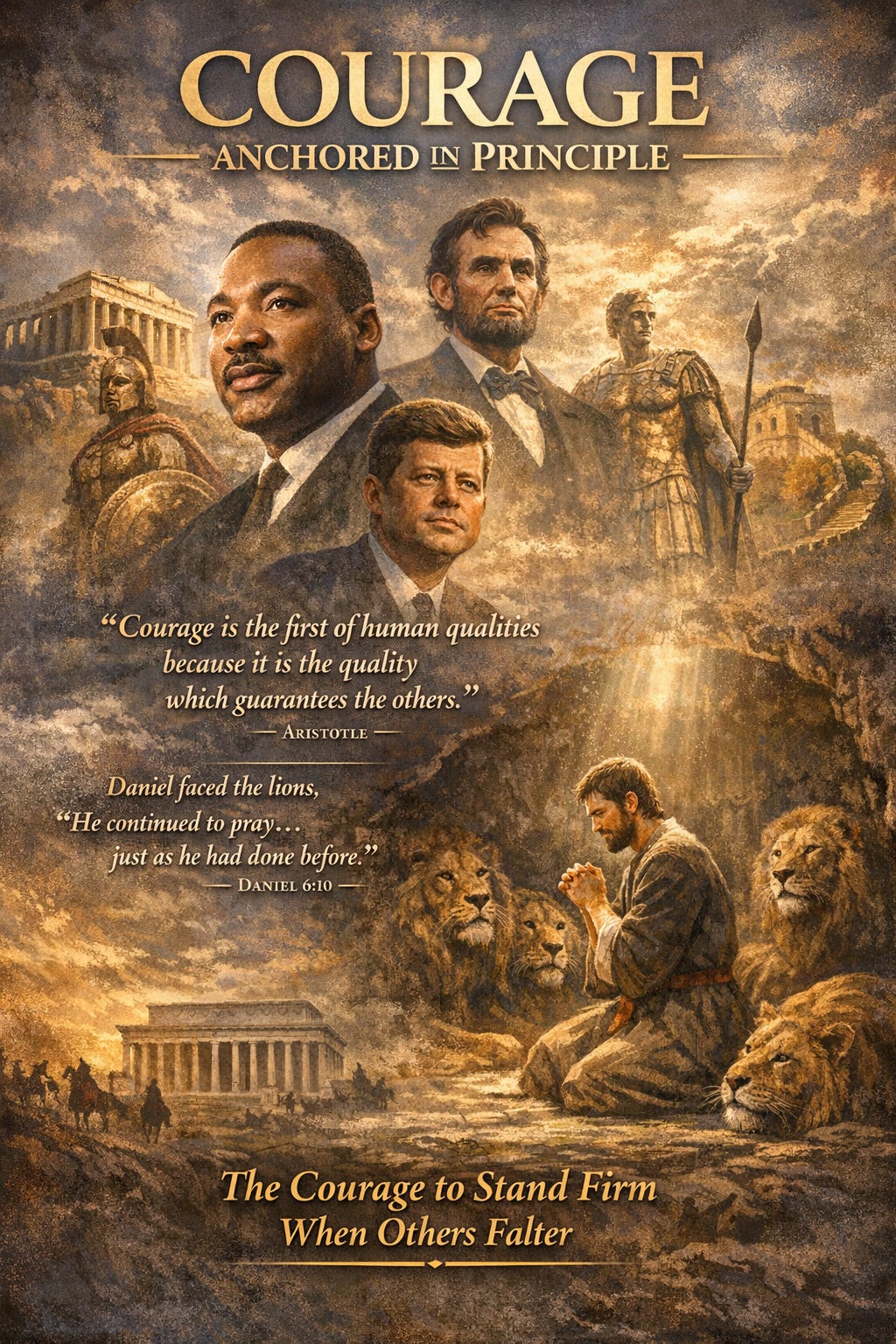
Aristotle wrote:
“Courage is the first of human qualities because it is the quality which guarantees the others.”
That insight was not about battlefield frenzy.
For Aristotle, courage was disciplined virtue. The mean between cowardice and recklessness. Without courage, justice cannot act. Without courage, truth remains silent. Without courage, prudence becomes paralysis.
In other words, courage guarantees the survival of principle.
Civilizations understood this long before polling.
When we speak of moral courage in America, the name of Martin Luther King Jr. endures not because he followed incentives.
He spoke against segregation when it was dangerous.
He spoke against war when it fractured his coalition.
He endured imprisonment, threats, and ultimately assassination.
His courage was anchored in principle.
That is why it remains powerful.
Consider John F. Kennedy during the Cuban Missile Crisis.
He faced intense pressure inside his own ranks to escalate militarily. The politically safer move in the emotional climate of the Cold War would have been force.
Instead, he chose measured restraint layered with firmness.
He absorbed criticism from hawks within his own camp to prevent catastrophic war.
Principle over panic.
Look at Abraham Lincoln.
He was attacked relentlessly, including from factions inside his own coalition. He did not preserve the Union through convenience.
He preserved it through relentless adherence to principle under pressure.
Across oceans, the pattern repeats.
Nelson Mandela emerged from decades of imprisonment without vengeance as his guiding force. He chose reconciliation over retaliation.
That decision altered the trajectory of a nation.
Children are not told bedtime stories about strategic optimizers.
They are told stories about those who stood firm when retreat would have been safer.
The archetype is universal.
The warrior who does not abandon his post.
The judge who refuses bribery.
The leader who speaks truth to his own tribe.
The Courage of Daniel
And long before republics and democracies, there was Daniel.
In Book of Daniel 6, a decree is issued forbidding prayer to anyone but the king. The cost of disobedience is death.
Daniel does not stage a rebellion.
He does not shout.
He does not negotiate.
He simply continues praying as he always has.
Windows open.
Routine unchanged.
Principle unmoved.
He is thrown into the lions’ den.
Daniel’s courage is not dramatic. It is immovable.
He absorbs consequence rather than bend conviction.
That is courage anchored in principle.
It is steady under threat.
Calm under pressure.
Aligned with something higher than survival.
And that archetype has echoed through every civilization since.
Empires rarely collapse because they lack intelligence.
They collapse because convenience overtakes principle.
When elites begin protecting their position instead of protecting the structure, decay accelerates quietly.
Courage interrupts that decay.
It is the decision to anchor to something higher than political survival.
That is why it is timeless.
That is why it is powerful.
And that is why, in moments of saturation and cynicism, it feels almost revolutionary when it reappears.
The Public Is Starved
We are saturated with performance.
Optimized messaging.
Calibrated outrage.
Strategic positioning.
Watch any press conference. The answers are pre-loaded. The phrasing has been tested. The emotion is measured for impact. Even apology sounds rehearsed.
Watch any viral clip. It is engineered for a ten-second reaction. Anger travels faster than analysis. Certainty travels faster than humility.
Everything feels managed.
When politicians speak, we often hear consultants in the background.
When commentators speak, we hear brand positioning.
When corporations speak, we hear legal teams.
It is rare to hear someone say:
“This is difficult. Here is the reality. Here is the cost. And here is why we must do it anyway.”
Instead, we hear deflection.
One side blames the other.
The other side escalates.
Both sides fundraise.
Meanwhile, structural problems compound quietly.
This is why the public is starved.
Look at the reaction anytime a public figure breaks script — even briefly. When someone admits uncertainty. When someone criticizes their own side. When someone refuses to inflame a crowd that wants escalation.
The response is disproportionate.
People lean in.
Because it feels real.
Notice the exhaustion around debt debates. The same brinkmanship. The same last-minute theatrics. The same “historic compromise” that solves nothing long-term.
Notice the reaction when leaders dodge questions about deficits with talking points instead of numbers.
Notice how quickly trust drops when voters sense they are being managed instead of addressed.
Poll after poll shows declining trust in institutions — Congress, media, corporations, even universities.
That decline is not just ideological.
It is emotional.
People are tired of the choreography.
Tired of outrage cycles that lead nowhere.
Tired of leaders who perform strength but avoid substance.
Starved for leaders who speak without hedging.
Starved for standards applied evenly.
Starved for adults.
Scarcity increases value.
In a culture saturated with convenience, principled courage becomes disproportionately powerful.
When someone says something costly and coherent — not reckless, not theatrical, but steady — it cuts through the noise like silence in a crowded room.
And in a strange way, this may be the moment for it.
Not because the math is new.
But because the fatigue is.
Fatigue changes thresholds.
A public that has endured years of performance may be more ready than we think for something unfashionable:
Seriousness.
And seriousness, historically, has always been the companion of courage anchored in principle.
The Test Before Us
Entitlement reform is the clearest test case.
Not because it is controversial.
But because the numbers are no longer theoretical.
Social Security and Medicare together account for roughly half of federal spending. Add Medicaid and you move well beyond that threshold.
The federal government is currently spending around $6.5 to $7 trillion per year.
The national debt stands above $34 trillion.
Annual deficits hover in the $1.5 to $2 trillion range.
These are not partisan statistics.
They are structural realities.
The Social Security trust fund is projected to face depletion in the early 2030s. If nothing changes, benefits would be automatically reduced to match incoming payroll taxes. Not because a politician chose to cut them. But because arithmetic would enforce it.
That is what delay produces.
Automatic disruption instead of deliberate reform.
Entitlement reform is the clearest test because it forces a choice:
Managed adjustment now
or
Forced adjustment later.
It would require someone to say:
“We will not promise what cannot be sustained.”
And to say it before a crisis makes the decision for us.
Not in panic.
Not in blame.
But in stewardship.
Preservation.
Dignity.
Intergenerational fairness.
Because this is not about stripping benefits. It is about preventing sudden instability.
When programs represent trillions of dollars and tens of millions of Americans, small percentage changes compound into enormous consequences.
A two-year adjustment in eligibility phased over decades.
A modest change in indexing formulas.
Means testing at higher income levels.
These are politically explosive words.
But they are far less explosive than an automatic benefit reduction triggered by insolvency.
That is the uncomfortable truth.
And it is precisely why this moment demands courage anchored in principle.
Shared responsibility would replace scapegoating.
No blaming retirees.
No blaming young workers.
No blaming one party.
Just acknowledging that longer life expectancy, lower birth rates, and rising healthcare costs create mathematical pressure.
And math does not respond to applause.
Yes, it would be politically dangerous.
Because fear mobilizes faster than nuance.
Because attack ads are easier to produce than actuarial tables.
Because it is always safer to promise more than to explain limits.
But here is the paradox.
The public may punish leaders more for pretending the math does not exist than for acknowledging it honestly.
Trust erodes when citizens feel managed.
Trust grows when they feel respected enough to hear the truth.
Even when the message is difficult.
Especially when the message is delivered calmly, with clarity, without hysteria.
If a leader stood before the country and said:
“These programs are worth protecting. That is why we must strengthen them now.”
That would not be weakness.
That would be architecture.
And the real test before us would not be whether the numbers add up.
It would be whether we are mature enough as a nation to face them without flinching.
Because courage anchored in principle is not about avoiding hard math.
It is about refusing to let hard math become a crisis.
What Happens If We Get This Right
We say we admire legends.
We say we value courage.
We say we want leaders of character.
History — from Aristotle to Book of Daniel, from Abraham Lincoln to Martin Luther King Jr. — suggests something clear:
Civilizations endure when leaders choose principle over convenience under pressure.
But here is the part we don’t talk about enough.
When courage anchored in principle succeeds, it does more than solve a problem.
It resets the culture.
If entitlement reform were approached honestly, gradually, and transparently — if leaders chose stewardship over applause — the benefits would ripple far beyond budget tables.
First, credibility would compound.
For decades, voters have been trained to assume that politicians overpromise and under-explain. A leader who openly addresses structural limits and preserves programs through disciplined reform would signal something rare:
Promises matter.
Truth matters.
Math matters.
That kind of credibility does not disappear after one policy victory. It becomes institutional capital.
Second, markets would respond to stability.
Debt trajectories influence interest rates. Interest rates influence investment. Investment influences growth. Growth influences wages and opportunity.
A credible long-term fiscal plan reduces uncertainty. Reduced uncertainty lowers risk premiums. Lower risk premiums create room for private expansion.
Principled courage, in this case, would not just stabilize government. It would unlock economic oxygen.
Third, generational trust would strengthen.
Right now, younger Americans quietly wonder whether the promises made before them will exist when it is their turn.
Older Americans fear that reform language is simply coded abandonment.
If reform were done carefully — phased, transparent, respectful — both generations would see something powerful:
The system is being preserved, not dismantled.
Intergenerational fairness is not an abstract virtue. It is the glue that keeps a republic cohesive.
Fourth, political tone could shift.
When leaders demonstrate that difficult truths can be discussed without collapse, the culture adapts.
Panic gives way to planning.
Rhetoric gives way to design.
Fear gives way to structure.
Courage is contagious.
Not because it is dramatic.
But because it lowers the emotional temperature of hard conversations.
And perhaps most importantly, getting this right would restore something deeper than fiscal balance.
It would restore seriousness.
A nation that proves it can confront long-term challenges without hysteria proves something about its maturity.
It proves it is not governed by impulse.
It proves it can think in decades rather than news cycles.
That is the kind of maturity that sustains free societies.
Now we have to decide whether we are prepared to recognize that kind of courage if it emerges again.
Because courage anchored in principle has reshaped civilizations before.
And when it succeeds, it does more than prevent collapse.
It creates confidence.
It creates stability.
It creates a story future generations can point to and say:
That was the moment we chose structure over comfort.
And courage, when aligned with principle, never asks whether the timing is comfortable.
It asks whether the structure is worth preserving.
The answer to that question determines whether legends remain stories — or become policy.


