
The Test That Will Define Trump’s Legacy
Can Trump Turn a World Crisis Into a Peace Opportunity?
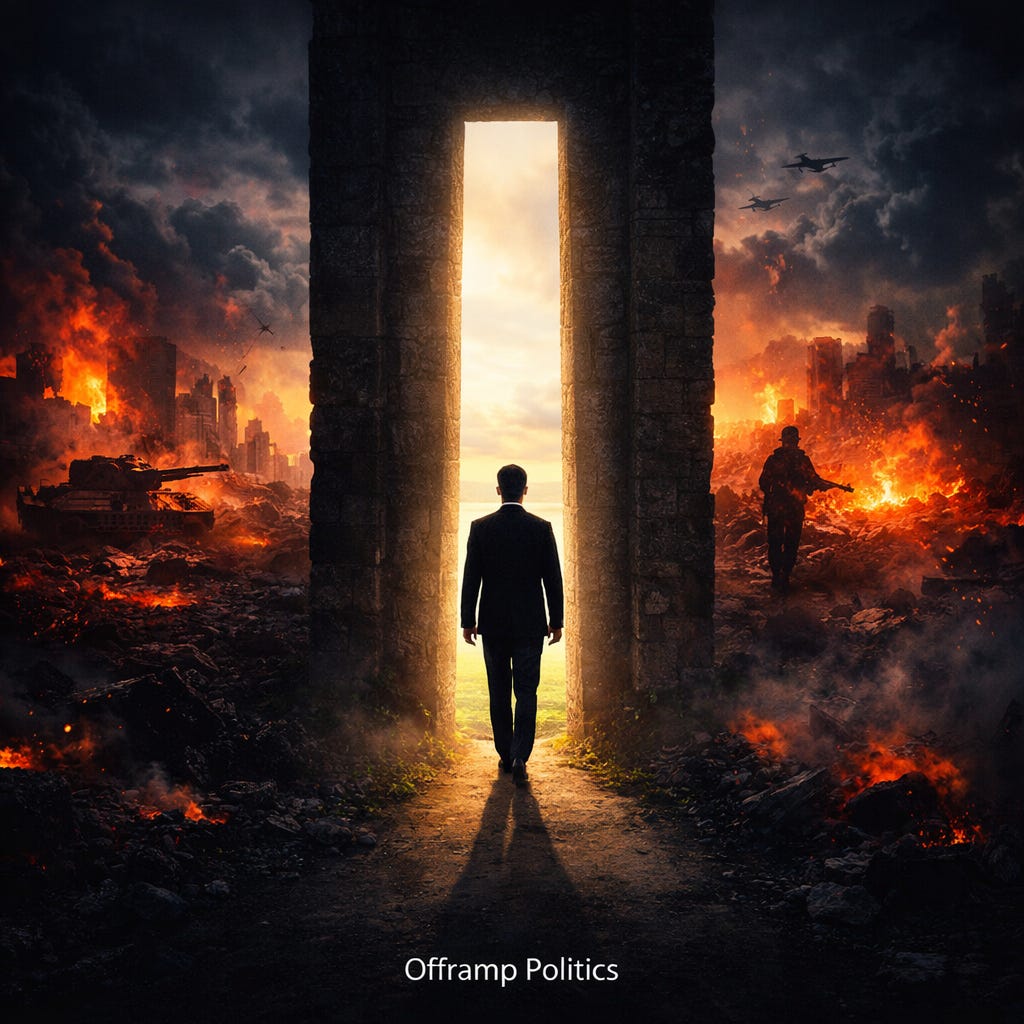
There are moments in history when the world narrows to a single doorway.
Walk through it and something extraordinary becomes possible.
Miss it, and the darkness on the other side grows deeper.
We may be standing in one of those moments now.
For the last several weeks I have been writing about the strategic triangle now shaping global politics. Three pressure points pulling on the same alliance system.
Russia in Ukraine.
China circling Taiwan.
Iran destabilizing the Middle East.
Each of these conflicts pulls on the same military capacity. The same diplomatic bandwidth. The same political will.
Three different theaters.
One shared strategic problem.
Overstretch.
For the Trump administration the early phase of this crisis has already demonstrated something important. Washington has shown that it can change the math on the battlefield. Military force in the Middle East altered the immediate balance with Iran and sent signals across the geopolitical chessboard.
But kinetic action is the easy part.
History remembers leaders not for the wars they start, but for the moments when they find a way to prevent the next one.
And that is the challenge now facing the Trump presidency.
Because hidden inside this moment of instability is something remarkable.
A narrow door to peace.
For years the war in Ukraine has functioned like a geopolitical pressure cooker. Europe poured resources into the fight. Russia committed its military. The United States and NATO poured weapons, intelligence, and political capital into sustaining Ukraine’s defense.
The conflict became the gravitational center of European security.
But the eruption of instability in the Middle East has suddenly changed the incentives.
Europe cannot fight Russia and manage Middle Eastern chaos simultaneously.
The United States cannot focus on the Pacific if every other region is burning.
China needs stable energy flows from the Middle East.
Russia ultimately needs access to global markets.
Suddenly the incentives begin to shift.
Peace in Ukraine is no longer simply a moral aspiration.
It may now be the most strategically intelligent move on the board.
If Europe stabilizes Ukraine, the continent frees itself to focus on the Middle East.
If Russia stabilizes Ukraine, it gains breathing room to pursue its interests without permanent economic siege.
And if the Middle East stabilizes, something interesting happens in Asia.
The coalition defending Taiwan becomes stronger.
Japan, South Korea, Australia, and the United States gain the strategic clarity needed to deter Chinese expansion.
China’s window of opportunity narrows.
Possibly for a generation.
This is the domino effect that could emerge from a single courageous decision.
Peace in Ukraine.
Stability in the Middle East.
Deterrence in the Pacific.
A cascade of stability instead of a cascade of war.
But history teaches us that such moments rarely arrive without difficulty.
They require something rare in politics.
Courage.
Not the kind of courage that wins applause in the moment.
The kind that risks criticism from every direction.
The kind that forces leaders to step outside the comfortable script of escalation.
For Donald Trump this may become the defining test of both of his presidencies.
He has built his political identity around disruption. Around challenging the assumptions of Washington and the global diplomatic establishment.
But disruption alone is not the measure of political courage.
The true measure comes when disruption must evolve into responsibility.
Can the administration move beyond changing the math with force and begin changing the math with diplomacy?
Can Marco Rubio and the American diplomatic machine align European and Asian allies around a shared strategic vision?
Can the United States persuade the major powers that stability is suddenly more profitable than chaos?
These are the questions now sitting quietly on the global stage.
The opportunity is there.
But opportunities in geopolitics rarely linger.
They pass like shadows across the wall.
If the moment slips away, the world could face something much darker.
Russia and Europe locked in endless war.
Iran pulling the Middle East deeper into chaos.
China watching patiently as Western alliances stretch themselves thin.
A three-front strategic crisis with no easy exit.
History has seen this story before.
The warning echoes like a whisper from an old poem, carried across the years.
A reminder that moments of decision rarely come twice.
And if courage fails in the hour when it is needed most, the answer from history can feel hauntingly familiar.
Nevermore.
The world now stands before a narrow doorway.
Peace may be waiting on the other side.
But it will not open on its own.
Someone must have the courage to push it.


