


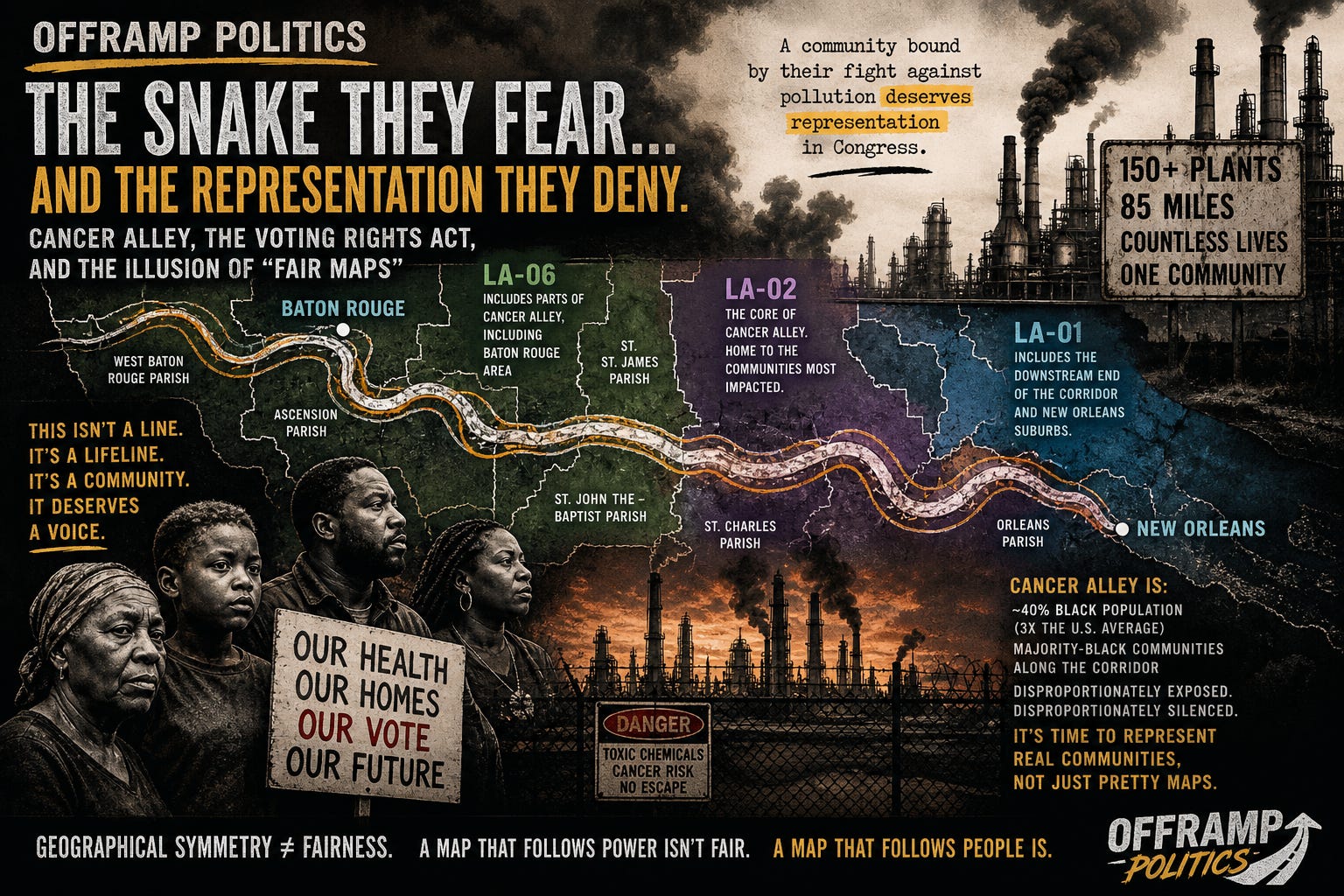
There’s a stretch of land in Louisiana that doesn’t behave like a district.
It doesn’t respect parish lines.
It doesn’t care about tidy shapes on a map.
It doesn’t fit inside the clean geometry that political consultants and redistricting commissions like to present to the public.
It moves like a current.
Eighty-five miles along the Mississippi River…
from Baton Rouge to New Orleans…
a corridor of petrochemical plants, refineries, and communities that have learned to live with something most Americans will never have to think about.
They call it Cancer Alley.
But what if we stopped calling it an “alley”…
and started calling it what it actually is:
A community.
The Community That Maps Can’t Contain
Look at a congressional map of Louisiana and you’ll see something familiar:
Clean lines.
Balanced shapes.
Districts that appear to make sense at a glance.
Now look at Cancer Alley.
It cuts through those districts like a river cuts through rock.
It spans multiple parishes
It crosses multiple congressional districts
It pulls together towns that, politically, are treated as separate worlds
But socially, economically, and existentially?
They are bound together.
Not by ideology.
Not by party.
But by exposure.
By proximity.
By the shared reality of living next to industrial infrastructure that defines their daily lives.
This is not a coincidence of geography.
This is a shared condition.
The Voting Rights Act Was Built for This
When Congress passed the Voting Rights Act of 1965, it wasn’t trying to create pretty maps.
It was trying to correct something deeper.
The law recognized that communities of shared experience, particularly those historically marginalized, could be diluted—not just by denying the vote, but by fracturing their representation.
That principle matters here.
Because what is Cancer Alley if not:
A population with a shared lived experience
A population disproportionately affected by a specific system
A population whose political influence is weakened by fragmentation
The Voting Rights Act didn’t say communities had to look symmetrical.
It said they had to be heard.
The Myth of the “Ugly Map”
Somewhere along the way, we adopted a strange belief:
That a “fair” congressional map should look… nice.
Compact.
Balanced.
Geometrically pleasing.
And anything that stretches, curves, or winds its way across a state?
That must be manipulation.
That must be partisan advantage.
That must be wrong.
But Cancer Alley challenges that assumption at its core.
Because if you tried to draw a district that actually represented this community…
It would look like a snake.
It would follow the Mississippi River.
It would stretch.
It would bend.
It would ignore the artificial boundaries that separate one parish from another.
And it would do something else:
It would finally align political representation with lived reality.
Fragmentation as a Form of Silence
Right now, Cancer Alley is divided.
Split across districts.
Portioned out into separate political jurisdictions.
Absorbed into broader constituencies where its defining issue is just one concern among many.
And when you divide a community like that, something subtle happens.
You don’t eliminate their voice.
You lower its volume.
Each representative sees only a piece of the problem.
Each district absorbs only a fraction of the urgency.
Each election dilutes the singular focus that this community naturally holds.
The result?
A corridor that is unified in experience…
but fragmented in power.
What Representation Is Supposed to Be
Representation was never meant to be an exercise in cartographic aesthetics.
It was meant to answer a simple question:
Who speaks for this group of people?
Not in theory.
Not in abstraction.
But in reality.
Cancer Alley presents a challenge to the system because it doesn’t conform to the traditional model.
It isn’t:
A single city
A single parish
A neatly contained population
It is something more fluid.
A community defined by condition rather than location.
And that’s exactly the kind of community the system struggles to represent.
The Offramp
We spend a lot of time arguing about fairness in maps.
About partisan advantage.
About which side benefits.
About whether a district “looks right.”
But what if we’re asking the wrong question?
What if fairness isn’t about shape…
but about alignment?
Alignment between:
Experience and representation
Exposure and advocacy
Community and voice
Cancer Alley forces us to confront something uncomfortable:
That a perfectly symmetrical map can still produce perfectly asymmetrical outcomes.
And that sometimes, the map that looks the most “unnatural”…
is the one that finally reflects reality.
Final Thought
If a community exists in the real world…
bound by shared risk, shared conditions, and shared stakes…
Then it deserves representation that recognizes that unity.
Even if that representation winds like a river.
Even if it stretches across boundaries.
Even if it looks, to the untrained eye, like something is off.
Because sometimes the map isn’t distorted.
Sometimes…
it’s the first time it’s been honest.