
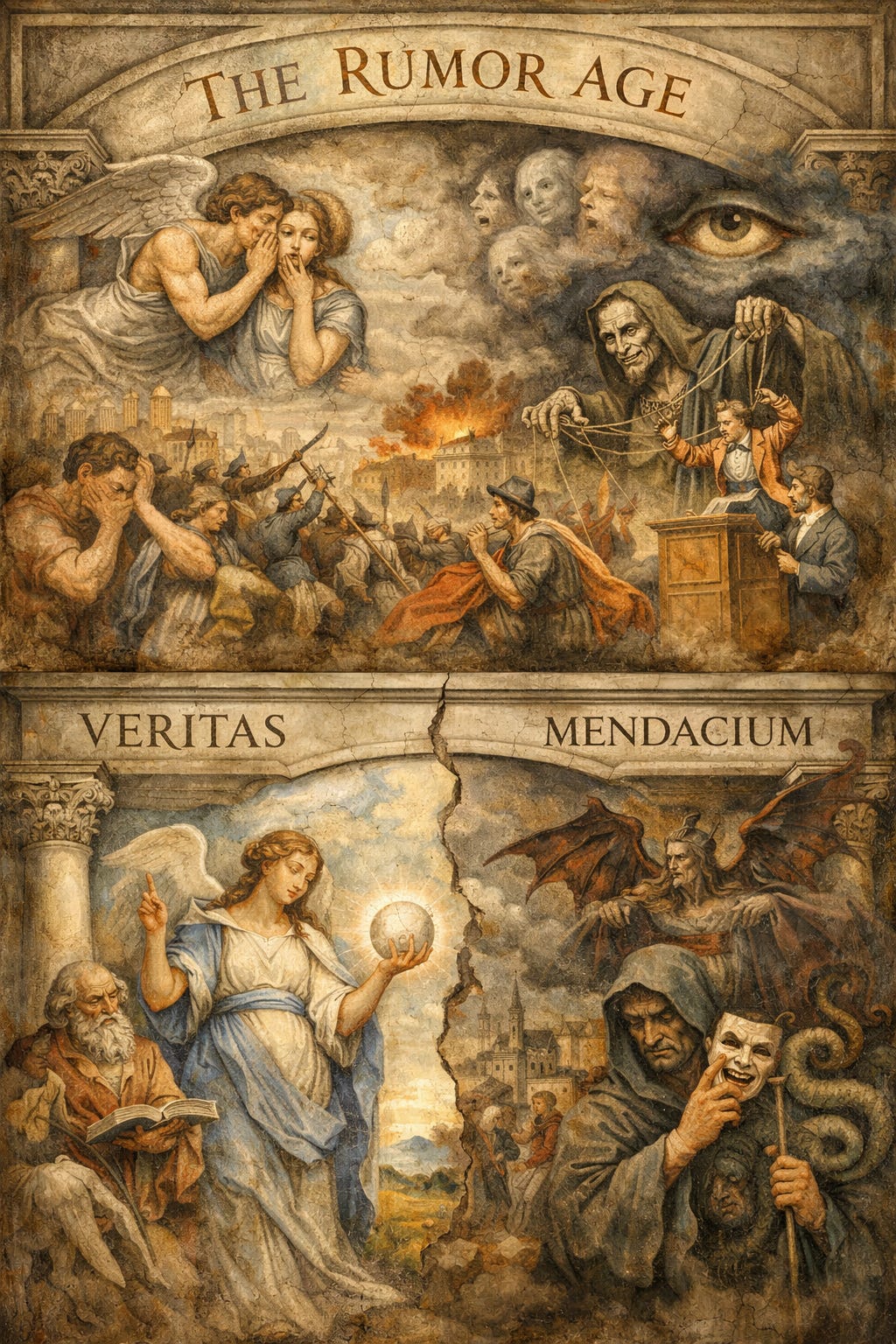
The Rumor Age
There have always been rumors. Empires rose and fell on whispers long before printing presses, radios, or television screens ever existed. But what we are living through now is not merely a louder version of the past. It is something structurally different.
This is the Rumor Age.
Not because people lie more than they used to, but because technology has finally outpaced the human nervous system’s ability to discern proportion, timing, and truth. What once traveled at the speed of feet and horses now travels at the speed of light. What once required witnesses now requires only plausibility. What once dissolved under scrutiny now persists through repetition.
Social media, algorithmic amplification, deepfakes, synthetic voices, manipulated documents, selective leaks, and AI-generated imagery have created an environment no civilization in history ever had to navigate. Rumor is no longer local. It is global, persistent, and emotionally optimized.
This changes everything.
Rumor as a civilizational force
Ancient civilizations treated rumor seriously. Not morally, but structurally.
Egypt understood that speech was power. The Hebrews understood that words could bless or destroy. Early Christian writers understood that deception spreads faster than discipline. None of them dismissed rumor as trivial. They understood it as an early warning signal that order was slipping.
This is why a short line in scripture keeps resurfacing with uncomfortable relevance:
“You will hear of wars and rumors of wars. See that you are not alarmed.”
The warning is not about ignorance. It is about posture.
Rumor is not dangerous because it is false. It is dangerous because it destabilizes judgment. It overwhelms the ability to weigh, test, and integrate information. In the Rumor Age, people do not lack facts. They lack filters.
Technology broke the old constraints
For most of history, rumor had natural limits. Geography slowed it. Memory distorted it. Time filtered it. Falsehoods often died quietly because they could not sustain momentum.
Modern technology erased those constraints.
Social platforms reward emotional intensity over accuracy. Algorithms amplify engagement, not coherence. Deepfakes collapse the distinction between seeing and knowing. AI-generated text can flood the zone faster than any human institution can respond.
What once required conspiracy now requires only software.
This creates a condition where verification always arrives too late. By the time truth enters the conversation, identities have already formed around belief. Retractions feel like attacks. Corrections feel like censorship. Silence feels suspicious.
Rumor becomes a permanent background condition rather than a passing disturbance.
Jung and the psychology of rumor
This is where Carl Jung helps translate the ancient into the modern.
Jung understood that when systems suppress uncertainty or deny their shadow, compensation follows. He called this enantiodromia: when something is pushed too far in one direction, it flips into its opposite.
In the Rumor Age, institutions overextended claims of certainty. Media systems overpromised objectivity. Political movements overidentified with moral clarity. When those structures cracked, the psyche did not gently recalibrate. It swung.
Distrust replaced trust. Suspicion replaced skepticism. Certainty fractured into a thousand competing certainties.
Rumor thrives in this psychological environment because it offers belonging, identity, and narrative in a landscape where institutions no longer provide them.
America has seen this before, but not like this
The United States has experienced rumor-driven destabilization before. The 1850s stand out as the clearest historical rhyme.
That decade featured:
explosive partisan media ecosystems
moral absolutism layered onto economic anxiety
institutions unable to speak with one voice
communities living inside separate realities
The Civil War did not begin because Americans lacked information. It began because they could no longer agree on what information meant.
But even then, rumor had friction. Printing took time. Distribution took effort. Counterarguments could catch up.
Today, friction is gone.
The Rumor Age collapses the distance between speculation and belief, between reaction and identity. People are no longer merely persuaded. They are recruited.
Disclosure without integration
One of the great myths of the modern age is that disclosure automatically produces clarity. It does not.
Ancient systems understood this. Floods reveal what was hidden, but they also destroy infrastructure. Without proportion, revelation overwhelms rather than enlightens.
We see this now in the endless cycle of leaks, files, releases, screenshots, and partial documents. Each new disclosure promises closure. Instead, it fuels further speculation. People select fragments that reinforce existing beliefs. Context dissolves. Narrative hardens.
Truth becomes a raw material rather than a destination.
The economics of rumor
Rumor is no longer accidental. It is monetized.
Attention is currency. Outrage is acceleration. Confusion keeps people engaged. Platforms are not neutral carriers. They are incentive systems. And incentives shape behavior.
In the Rumor Age, those who calm situations lose reach. Those who escalate gain visibility. Those who hedge get ignored. Those who polarize get rewarded.
This creates a perverse environment where the loudest voices are mistaken for the most insightful, and the most stable figures are dismissed as irrelevant or compromised.
Scripture’s second warning
Another passage captures the deeper danger:
“For the time will come when they will not endure sound teaching; but according to their own desires they will heap up teachers for themselves, having itching ears, and will turn away from truth and turn aside to myths.”
This is not about censorship or ignorance. It is about selection.
In the Rumor Age, people curate belief the way they curate media. They choose voices that soothe anxiety or validate identity. Contradiction feels hostile. Nuance feels weak.
Myth does not mean fantasy here. It means narrative unmoored from proportion.
The cost to relationships and institutions
Rumor corrodes quietly.
Families fracture over interpretations rather than events. Workplaces become politicized by ambient anxiety. Institutions lose legitimacy not because they fail entirely, but because they can no longer command shared reality.
People begin speaking past one another, not because they disagree, but because they are operating on different timelines of belief.
This is one of the most dangerous aspects of the Rumor Age: it isolates individuals inside epistemic bubbles while convincing them they are well-informed.
The difference between being informed and being oriented
Ancient wisdom cared less about how much someone knew and more about whether they were oriented.
Orientation means:
the ability to hold uncertainty without panic
the capacity to integrate new information without identity collapse
restraint in speech
patience across time
proportion between reaction and reality
The Rumor Age erodes orientation. It rewards immediacy. It punishes patience. It treats silence as complicity and caution as weakness.
Who thrives in the Rumor Age
The Rumor Age does not favor the wise. It favors the reactive.
Those who thrive tend to:
escalate language quickly
frame disagreement as betrayal
collapse complexity into moral binaries
demand allegiance rather than understanding
These traits look like strength in unstable environments. They are not. They are volatility mistaken for leadership.
The quiet counterforce
Every era of excess produces its counterweight.
In times like this, the most important figures are not those who dominate discourse, but those who remain moored. Moored to reality. Moored to time. Moored to proportion.
They do not deny corruption or conflict. They simply refuse to let rumor hijack judgment. They reduce confusion rather than monetizing it. They speak carefully. They move steadily.
Ancient Egypt would have called this alignment with Ma’at. Hebrew wisdom would call it walking the straight path. Christian scripture would call it not being alarmed by rumors.
Different traditions. Same posture.
Why this moment feels unprecedented
What makes the Rumor Age unique is scale and speed.
Never before has humanity lived inside a continuously updating hall of mirrors. Never before could images lie convincingly. Never before could voices be synthesized. Never before could entire belief systems be assembled, reinforced, and defended in real time by machines optimized for engagement.
This is not a moral failing. It is a structural one.
Human psychology did not evolve for this environment.
The work ahead
The task of this era is not to eliminate rumor. That is impossible. The task is to recognize it without being ruled by it.
That means:
slowing response time
resisting emotional recruitment
distinguishing signal from amplification
choosing relationships grounded in reality rather than narrative
valuing consistency over intensity
The Rumor Age will not end because truth finally wins an argument. It will end when enough people withdraw energy from distortion and restore proportion.
A final thought
This is not the end of history. It is not the collapse of civilization. It is the end of an information environment that no longer maps cleanly to human discernment.
Every transition feels chaotic from the inside.
The future will not belong to the loudest voices, the fastest reactions, or the most viral claims. It will belong to those who stayed oriented while others were pulled into oscillation.
Rumors will continue. Wars will continue. Technology will advance.
The question is not what you hear.
The question is what you align with while you hear it.


