


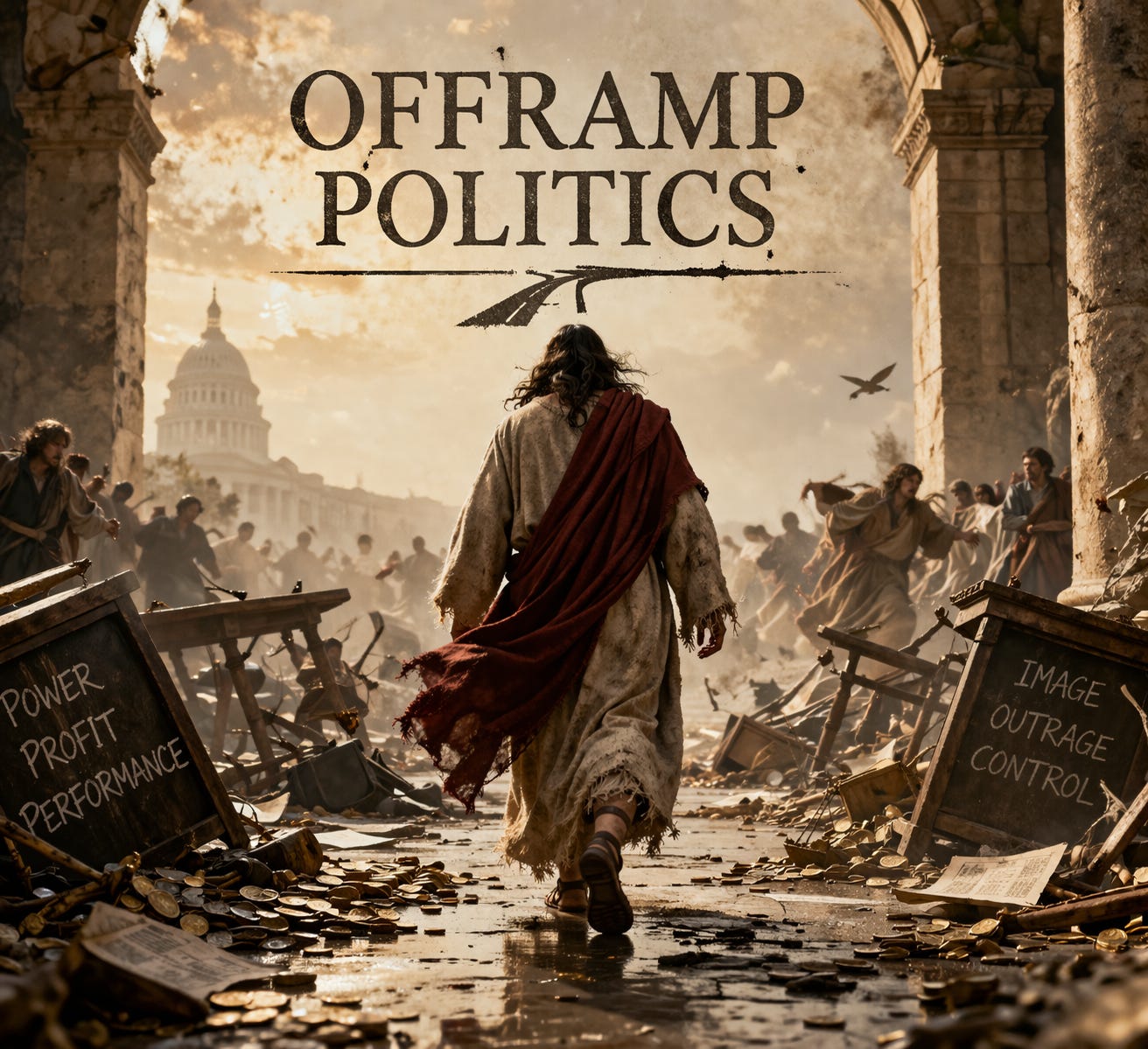
The Offramp: A Stumbling Block, or an Exposure?
There are moments in culture that look like noise until you slow them down.
An image. A reaction. A wave of outrage that feels immediate and unquestioned.
Then you step back and realize you’re not looking at the image anymore.
You’re looking at people.
You’re looking at where they place weight. Where they place God. Where they place offense.
Recently, an AI-generated image connected to Donald Trump and Jesus Christ stirred exactly that kind of reaction. Some called it blasphemy. Others called it disrespect. Some went further and framed it as a direct attack on Christ Himself.
One pastor said plainly, “This is deeply offensive to Christians and trivializes the Lord we worship.” Another religious commentator described it as “mockery of the sacred, something no leader should ever participate in.”
I read those reactions carefully.
Not to dismiss them.
But to understand what they reveal.
Because Scripture already told us moments like this would divide people, not along political lines, but along lines of spiritual maturity.
In First Epistle to the Corinthians, Paul writes something most modern believers avoid saying out loud:
“I fed you with milk, not solid food, for you were not ready for it.” (1 Corinthians 3:2)
There is such a thing as being early in the faith.
There is such a thing as being a “babe in Christ.”
And that’s not condemnation. It’s a stage. But it comes with a certain vulnerability. A tendency to attach meaning to things that feel close to God, even if they were never meant to hold Him.
Paul expands on this in the same letter:
“But take care that this right of yours does not somehow become a stumbling block to the weak.” (1 Corinthians 8:9)
That word matters. Stumbling block.
Not everything is a stumbling block to everyone.
The same object, the same act, the same image can mean nothing to one person and everything to another.
So what actually happened here?
Did Trump create blasphemy?
Or did he reveal where people believe holiness resides?
Because I’ll be honest about where I stand.
I don’t see those images of Jesus that exist all over the world as sacred. I don’t see them as aligned with God. I don’t see them as vessels of anything divine. If anything, I see them as human attempts to capture something that cannot be captured.
And if we’re being consistent with Scripture, that concern isn’t new.
In Exodus, the command is clear:
“You shall not make for yourself a carved image… you shall not bow down to them or serve them.” (Exodus 20:4–5)
That command doesn’t come with a footnote that says “unless the intention is good.”
It draws a line between God and representation.
Between presence and projection.
So when I see outrage over an image being mocked, I don’t immediately see blasphemy.
I see something else.
I see people reacting as if the image itself carries weight.
As if it holds proximity to Christ.
As if altering it, distorting it, or mocking it somehow reaches Him.
But Scripture gives a different anchor point.
In Gospel of John:
“God is spirit, and those who worship Him must worship in spirit and truth.” (John 4:24)
Not image.
Not depiction.
Not likeness.
Spirit and truth.
So if God is not housed in an image, then what exactly is being defended?
That’s the question that doesn’t get asked.
Because asking it forces a level of reflection most people aren’t ready for.
And this is where the divide sharpens.
For someone early in their walk, that image may function as a reference point. A visual anchor. Something that helps them orient themselves toward Christ. And if that’s the case, then seeing it mocked feels personal. It feels like an attack on the very thing helping them connect to God.
That is a real experience.
And Scripture acknowledges it.
In Epistle to the Romans:
“One person believes he may eat anything, while the weak person eats only vegetables… Let not the one who is strong despise the one who is weak.” (Romans 14:2–3)
The dynamic is the same.
Something that is nothing to one person carries meaning to another.
But Paul doesn’t stop there.
He also says this:
“We know that an idol has no real existence, and that there is no God but one.” (1 Corinthians 8:4)
No real existence.
That’s a hard statement.
It means the thing itself does not carry power.
It does not carry presence.
It does not carry God.
So if an image has no real existence in a spiritual sense, then mocking it is not mocking God.
It is mocking the idea that the image represents Him.
And that’s where things get uncomfortable.
Because now we’re not talking about Trump.
We’re talking about the possibility that many believers have placed reverence into something God never asked them to.
And when that thing is challenged, it feels like God is being challenged.
But is He?
Or is something else being exposed?
At the same time, Scripture doesn’t give a free pass to those who see clearly.
Just because something has no real existence doesn’t mean how you engage it doesn’t matter.
Paul warns:
“And so by your knowledge this weak person is destroyed, the brother for whom Christ died.” (1 Corinthians 8:11)
That lands heavy.
Because it means you can be right and still cause harm.
You can see through something and still mishandle the moment.
So now we’re left in tension.
An image that holds no inherent spiritual power.
A group of believers who assign it meaning.
Another group who reject that meaning entirely.
And a public act that forces both sides to reveal where they stand.
From where I sit, this wasn’t just controversy.
It was a sorting mechanism.
A moment that separates milk from solid food.
Not in a way that elevates one person over another, but in a way that reveals where each person is anchored.
Because in the end, the question is not about whether an image was offensive.
The question is simpler, and much harder at the same time.
What actually connects you to God?
If it can be drawn, generated, or recreated, then it can also be distorted.
And if it can be distorted, then it was never the source to begin with.
So when something like this happens, I don’t immediately react.
I observe.
I ask a different question.
Was something real attacked…
or was something assumed to be real simply exposed?
That’s the Offramp.
And once you see it, it’s hard to unsee.