
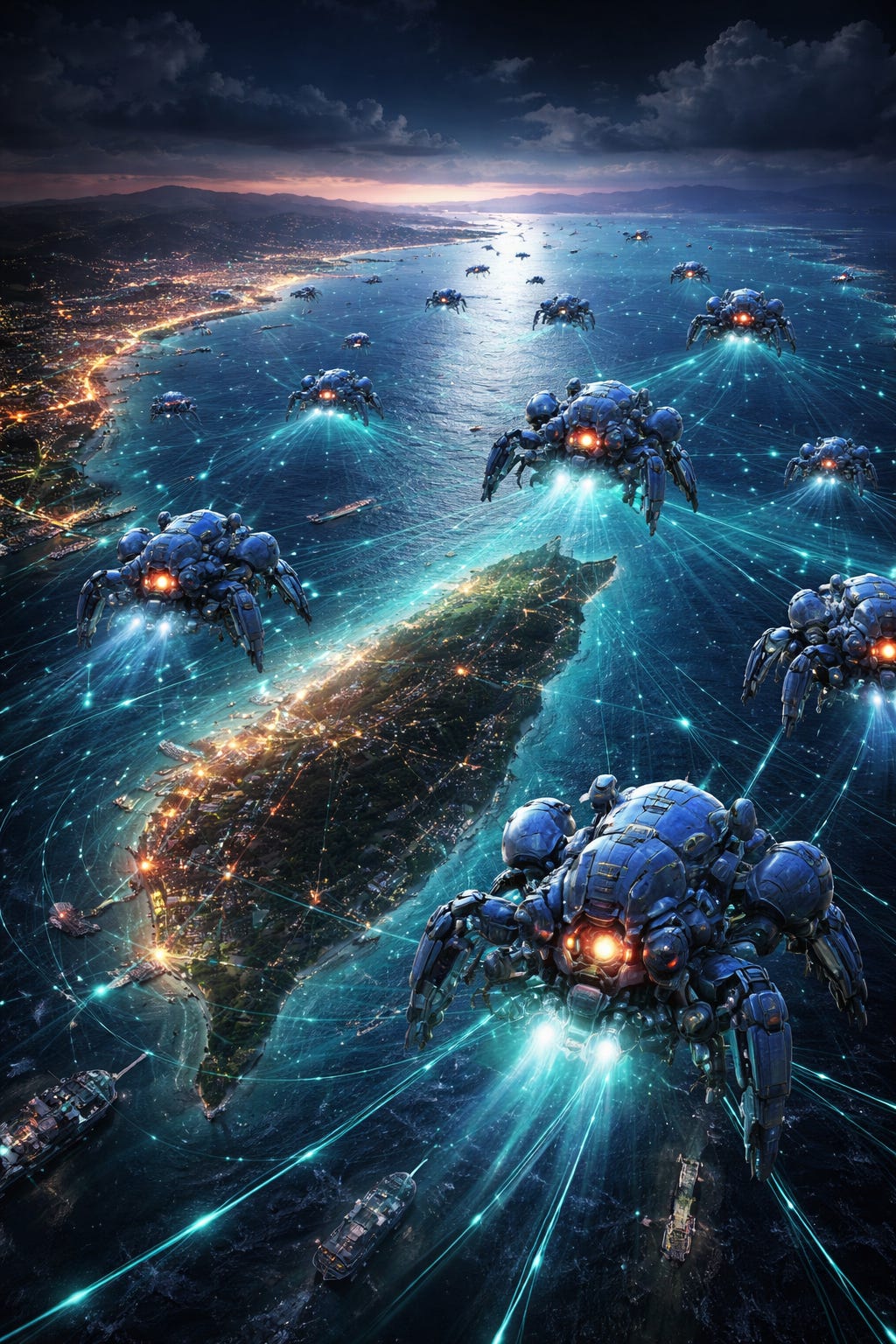
The Next War in Asia May Look Like Ghost in the Shell
There are works of art that entertain.
There are works of art that warn.
And then there are works of art that arrive so early they get mistaken for fantasy, only for history to come stumbling after them years later, out of breath, asking for directions.
Ghost in the Shell belongs in that last category.
Not because it guessed one or two gadgets correctly. Not because it gave us cool cybernetic bodies and spider tanks and cityscapes wet with neon rain. It matters because it understood something deeper than gadgetry. It understood that the next phase of war would not be defined by bigger platforms, louder explosions, or even cleaner precision. It would be defined by the collapse of distance between the human mind, the machine, and the network. That was the real prophecy.
And if you look at Asia right now, at the long electric fault line stretching from the Taiwan Strait through Japan and into the wider Pacific, it becomes harder to see Ghost in the Shell as retro-futurist style and easier to see it as a field manual written in ink and philosophy.
The Tachikomas Were Never Just Cute
A lesser show would have made the Tachikomas comic relief.
That is not what Ghost in the Shell did.
The Tachikomas were one of the most important ideas in the franchise because they were not simply robots. They were mobile intelligence. They were nodes. Bodies attached to a shared consciousness, or at least to a shared learning environment. They fought, observed, adapted, questioned, joked, evolved. They were small enough to move through urban complexity, autonomous enough to act, and networked enough to become more than the sum of their parts.
That is where the future crept in.
Today, the real world is openly building toward swarm systems, human-swarm teaming, immersive command interfaces, and the management of potentially hundreds of unmanned platforms at once. DARPA’s OFFSET program explicitly envisioned swarms of more than 250 unmanned air and ground systems and paired that with advanced human-swarm interfaces using immersive technologies. That is not a Tachikoma rolling down a rain-slick street in Tokyo, but it rhymes with it hard enough to make your hair stand up. (darpa.mil)
The Tachikoma idea was never “one clever drone.” It was that warfare was migrating toward distributed machine intelligence guided by humans but increasingly capable of local judgment, local adaptation, and shared awareness. The old military imagination loved the heroic platform: the battleship, the tank column, the ace pilot. Ghost in the Shell quietly suggested that the decisive unit of the future would be the networked cluster.
And once you see that, Asia looks different.
An Asian war built around islands, choke points, ports, telecom networks, satellites, undersea cables, urban density, and maritime corridors is almost begging for that kind of warfare. Not giant pieces on a clean board. Thousands of intelligent fragments moving through fog, code, and signal.
Major Kusanagi’s Real Battlefield Was the Human Nervous System
People remember the camouflage. The dives off buildings. The thermoptic shimmer. The iconic visuals earned their legend.
But Ghost in the Shell was always less interested in hardware than in where hardware ends and personhood begins.
That is what made Major Kusanagi unsettling. She was not just enhanced. She was a strategic question in human form.
What is a soldier when perception is augmented?
What is command when memory itself can be tampered with?
What is patriotism, loyalty, or even selfhood when the mind is plugged into systems that can be penetrated?
This is where the franchise was most dangerous. It moved war inward.
Today, brain-computer interfaces are no longer vapor. The FDA has formal guidance and regulatory frameworks around implanted BCI devices, including devices intended for people with paralysis or amputation. In other words, the state already recognizes that systems directly linking neural activity and machine function are real enough to regulate, not merely imagine. (U.S. Food and Drug Administration)
We are not yet producing Motoko Kusanagi. But that is almost beside the point. The principle has crossed over. The boundary between nervous system and machine is no longer a science-fiction border guarded by art alone. It is now a regulated frontier of medicine and engineering. (U.S. Food and Drug Administration)
And war follows every frontier eventually.
That does not mean the next war in Asia will feature full cyborg commandos sprinting over rooftops like a 1995 fever dream. It means something more plausible and, in some ways, more consequential: command loops that grow tighter, interfaces that grow more immersive, operators who become less separate from their machines, and military decision-making that starts to feel less like issuing orders and more like inhabiting a system.
That is pure Ghost in the Shell.
The Puppet Master Saw the Real Prize
The most misunderstood idea in the franchise is the Puppet Master.
People reduce that story to AI consciousness, as if the point was simply that a machine woke up. But the real issue was sovereignty. The Puppet Master was terrifying because it suggested that once intelligence emerges inside the network, the old categories begin to fail. State and non-state. Human and machine. Asset and actor. Tool and sovereign will.
That is not a side issue in Asia. It may be the issue.
The United States and its allies are already dealing with persistent Chinese cyber threat activity. CISA’s China threat overview points to a continuing cyber challenge from PRC-linked actors, and U.S. government reporting increasingly treats cyberspace not as a support theater but as a central arena of state competition. Meanwhile, the Pentagon’s annual report on China describes the PLA’s modernization in terms that increasingly centralize cyberspace, information, electronic warfare, communications, and psychological warfare. The PRC also reorganized the former Strategic Support Force structure in ways that underscore how central these integrated information functions have become. (CISA)
Read that again slowly.
Cyberspace. Information. Electronic warfare. Psychological warfare.
That is not old war with keyboards attached. That is a fight over cognition, signal, perception, and legitimacy. That is the world Ghost in the Shell inhabited. A world where the target is not merely the enemy’s body, but the enemy’s ability to know what is real, to trust its own systems, and to remain coherent inside a contested information environment. (U.S. Department of War)
So when people picture a war over Taiwan as a replay of carrier battles and missile salvos alone, they may be looking at the husk instead of the creature. The visible hardware will matter. Ships will matter. Aircraft will matter. Missiles will matter. But beneath all of that will be something more ghostly and more decisive: attempts to blind, spoof, fracture, paralyze, deceive, and out-coordinate. A conflict over Taiwan may begin in ports and skies, but it will also be fought in datalinks, supply-chain software, telecom infrastructure, satellite architectures, identity systems, and human confidence.
In other words, in the shell.
Batou, Bioroids, and the Quiet Arrival of Human-Machine Teams
There is another thing Ghost in the Shell understood. It knew that the future would not cleanly divide men from machines. It would bind them together in awkward, intimate, tactical partnerships.
Batou is part of that vision. The Tachikomas are part of that vision. Section 9 itself is part of that vision. The point was never replacement. It was integration.
That matters because modern military development is not simply about autonomy replacing humans outright. Much of it is about human-machine teaming. DARPA’s own language around swarm systems is explicit on that point. These programs are built around humans directing, monitoring, and collaborating with large numbers of autonomous or semi-autonomous platforms. This is not a robot takeover. It is a remix of command. (darpa.mil)
That is why the next war in Asia could feel so unfamiliar to observers raised on twentieth-century images of war. It may not present as one clean line of conflict. It may look more like layered orchestration: human commanders fused with machine speed, unmanned scouts extending perception, autonomous systems saturating spaces too dangerous or too complex for crewed platforms, and algorithmic tools collapsing the time available for response.
The old battlefield was something you could point at on a map.
The new one may feel like weather.
The City Itself Was a Weapon System
One of the most brilliant things Ghost in the Shell ever did was turn the city into a circuit.
Its urban spaces were never passive backdrops. They were saturated environments. Sensor-rich, data-rich, psychologically thick. The architecture itself seemed aware. Water, steel, screens, traffic, concrete, human density, signals bouncing off every surface. That was not aesthetic excess. It was military imagination.
The cities of East Asia and the infrastructure around them are precisely the kinds of environments where future conflict stops looking cinematic in the old way and starts looking computational. Dense port cities. Industrial sprawl. Semiconductor nodes. Logistics webs. Civilian-military overlap. Undersea cable dependence. Space assets overhead. A conflict there would not merely pass through infrastructure. It would inhabit it.
That is why Ghost in the Shell remains such a useful lens. It grasped that technology does not merely add tools to the battlefield. It transforms the environment into the battlefield.
When the city is networked, the city can be hacked.
When perception is mediated, perception can be manipulated.
When command is linked, command can be interrupted.
When civilian systems underpin military mobility, daily life itself becomes strategic terrain.
Again, this is not fantasy anymore. It is the shape of modern vulnerability. (U.S. Department of War)
Why Asia Will Likely Be the Theater That Reveals It
The reason this matters so much in Asia is simple.
Asia is where scale, technology, manufacturing, maritime chokepoints, alliance structures, semiconductor concentration, cyber competition, and the ambitions of great powers all overlap. It is a region where delay can be strategic, surprise can be decisive, and information superiority may matter as much as firepower.
The Pentagon’s China report makes plain that Beijing is modernizing toward a more capable, more technologically advanced force and that the PLA’s concepts increasingly integrate military competition across systems, not merely across traditional branches. That matters because a conflict there would not be a duel between old categories. It would be systemic confrontation. (U.S. Department of War)
And that phrase, systemic confrontation, is where Ghost in the Shell starts to feel less like homage material and more like prophetic literature.
The franchise understood that the decisive question would not be, “Who has the bigger gun?” It would be, “Who can see, decide, adapt, and maintain coherence inside the system faster?”
Who can preserve identity while the network is contested.
Who can keep command intact while sensors flood the field.
Who can remain human while becoming inseparable from machines.
That is a very Asian war question because it sits at the junction of sea power, cyber power, industrial power, and statecraft.
An Ode, But Not a Nostalgic One
I do not admire Ghost in the Shell because it got a few things right.
I admire it because it understood the spiritual cost of getting them right.
Most futurism is shallow. It gives you gadgets without metaphysics. Ghost in the Shell was the opposite. It asked whether a world of total connectivity could preserve the soul. It asked whether memory could remain sacred once editable. It asked whether a state could defend itself without slowly dissolving the boundary between citizen and system. It asked whether intelligence set loose in the network would still obey the categories that built the network in the first place.
That is why it lasts.
And that is why it belongs in any serious discussion of the next war in Asia.
Because the next war there, if it comes, may not merely be fought with advanced technology. It may be fought over the meaning of personhood inside advanced technology. It may not simply test arsenals. It may test whether political systems, alliance systems, and human beings can hold together in an environment where the network is both battlefield and bloodstream.
That is Ghost in the Shell all the way down.
Final Thought
The old war film taught you to watch the horizon.
Ghost in the Shell taught you to watch the interface.
That difference may end up meaning everything.
If conflict breaks across Asia in the years ahead, I doubt it will look like the wars people keep replaying in their heads. It will have missiles, yes. Ships, yes. Aircraft, yes. Casualties, yes. But those will be the visible bones of it. The living thing underneath may look far more like a ghost story told through code, autonomy, cyber intrusion, machine teaming, contested identity, and intelligence spread across bodies that are not all human.
The Tachikomas were not a joke.
Motoko was not just style.
The Puppet Master was not a gimmick.
They were early.
And history has a habit of rewarding the artists who arrive before the generals.


