
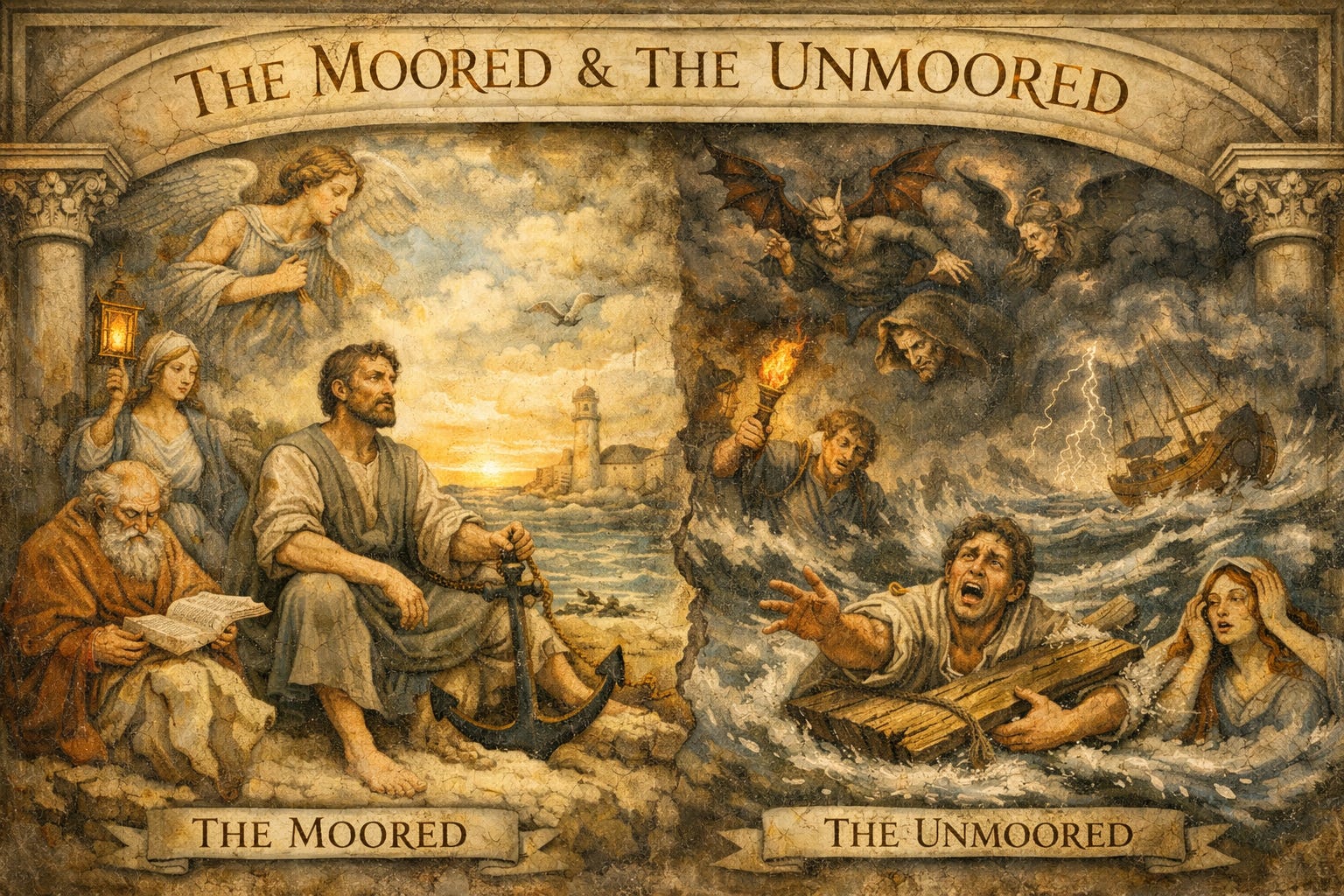
The Moored and the Unmoored
How to recognize stability in a time of rumor, swing, and revelation
There are moments in history when the noise level rises so high that people begin mistaking motion for direction.
We are in one of those moments now.
If you listen carefully, you can hear it everywhere: anxiety disguised as urgency, certainty shouted where patience used to live, loyalty demanded by systems that no longer understand themselves. Families feel it. Workplaces feel it. Political parties feel it. Even long-standing friendships feel suddenly brittle, as if one wrong sentence might shatter something that once felt solid.
This is not accidental. And it is not new.
What is new is how many people are discovering it all at once.
For years, I have watched political systems not from the surface, but from the way they interface with the real world: geopolitically, nationally, locally, psychologically. When you do that long enough, patterns stop feeling abstract. You begin to understand what the machine can do, what it cannot do, and where it inevitably fails regardless of who is operating it.
That vantage point changes how panic looks.
It also changes how people look.
A time of rumors, not clarity
There is a short line of scripture that feels almost uncomfortably precise for this moment:
“You will hear of wars and rumors of wars, but see to it that you are not alarmed.”
What often gets missed is not the reference to conflict, but the warning about rumors. Rumors are not events. They are psychological accelerants. They move faster than facts, attach themselves to fear, and spread most efficiently through unstable systems.
Rumors flourish when institutions lose credibility and individuals lose internal grounding. They fill the vacuum where trust once lived.
We are now fully inside a rumor economy: politically, socially, digitally. Information is abundant, meaning is scarce, and emotional volatility is treated as proof of insight.
This is where discernment becomes less about what someone believes and more about how they are positioned.
Jung and the loss of the center
This is where Carl Jung becomes essential, not decorative.
Jung understood something modern politics still resists: when balance is lost internally or collectively, the psyche does not drift gently. It swings. He called this principle enantiodromia—the tendency of things pushed too far in one direction to turn into their opposite.
What Jung saw in individuals, we now see in societies.
Movements built on moral certainty collapse into cruelty.
Institutions built on control unravel into chaos.
Ideologies obsessed with order breed disorder.
Cultures that suppress the shadow eventually become governed by it.
These swings feel dramatic because they are compensatory. They are not progress. They are correction attempts by systems that refused integration earlier.
The danger is not that people are changing. The danger is that many are unmoored, mistaking intensity for truth and acceleration for inevitability.
The difference between movement and collapse
Here is an important distinction that gets lost in times like this:
Not everything that is changing is collapsing.
Not everything that is collapsing is visible yet.
Systems do not fail all at once. They shed coherence first. Language becomes erratic. Standards shift hourly. Loyalty replaces competence. Emotion replaces process. Identity replaces accountability.
At the human level, this looks like:
people oscillating between certainty and despair
relationships suddenly politicized
moral absolutes applied selectively
constant urgency without clear action
hostility toward calm or nuance
When you see this pattern repeating across family systems, workplaces, media environments, and political movements, you are not watching awakening. You are watching destabilization.
The role of the moored
In moments like this, the most important people are rarely the loudest. They are the ones who remain moored.
Being moored does not mean being passive. It does not mean disengagement or indifference. It means being anchored to something deeper than the emotional weather of the moment.
Moored people tend to share certain traits:
They acknowledge uncertainty without amplifying fear.
They accept personal limitations without self-loathing.
They are capable of depth without dramatization.
They do not need events to validate their identity.
They move steadily while others oscillate.
Jung would say these individuals have integrated enough of their inner opposites that the psyche does not need to compensate violently. They are not immune to change. They are simply not hijacked by it.
Ironically, this steadiness often makes them appear suspicious during chaotic periods. Calm is misread as indifference. Patience is misread as detachment. Balance is misread as complicity.
This is projection, not diagnosis.
What to look for in others right now
If there is one practical takeaway from this moment, it is this: pay less attention to what people are claiming, and more attention to how they are holding themselves.
When evaluating family members, friends, colleagues, or political figures, consider:
Are they grounded across time, or reactive to headlines?
Do they escalate language, or clarify it?
Do they frame events as inevitable collapse, or as constrained outcomes?
Are they capable of saying “I don’t know” without anxiety?
Do they integrate complexity, or demand total allegiance?
People who are unmoored will push you toward extremes. They will demand urgency, certainty, and emotional alignment. They will frame disagreement as betrayal and patience as weakness.
People who are moored will not recruit you into panic. They will not require you to perform belief. They will remain legible even when the environment is not.
These are the people worth staying close to.
The revealing time
This period is revealing, not because secrets are being exposed, but because structure is.
Stress reveals what was load-bearing and what was decorative. It reveals which relationships were built on shared reality and which were built on shared illusion. It reveals which leaders understood systems and which merely occupied offices.
Jung believed that crises accelerate individuation for those willing to remain conscious. For everyone else, crises feel like fate or persecution.
That difference matters.
The timeline we are entering does not reward volatility. It punishes it. Systems under strain cannot tolerate wild swings for long. They either stabilize or fracture.
The people who survive and shape what comes next will not be the most animated or ideologically pure. They will be the ones who remained anchored while others burned energy thrashing against inevitability.
Choosing where to stand
This is not a call to withdraw. It is a call to choose alignment wisely.
Stay close to people who can sit inside uncertainty without theatrics. Distance yourself from those who need chaos to feel alive. Be wary of movements that cannot tolerate calm voices. Pay attention to who grows more grounded as pressure increases, not more frantic.
The scripture says, “see to it that you are not alarmed,” not because nothing serious is happening, but because alarm clouds judgment. Jung would agree.
The work now is not to predict collapse or cling to narratives. It is to recognize who is still standing on solid ground and who is being pulled by the undertow of rumor, fear, and compensatory swing.
Connect to those who are moored to the timeline that is forming, not the one dissolving.
The noise will pass.
The anchors will remain.
And in the end, it will not be the loudest voices that matter most, but the ones that never lost their center when the ground began to shake.


