

There are moments in politics when the economy does not collapse all at once.
It starts breathing differently.
CEOs begin to speak in lower tones. Consumers keep spending, but with less confidence. Markets keep rising, but more narrowly. Oil prices become more than a line on a chart. Inflation stops feeling like yesterday’s problem. War spending slips into the bloodstream of the national budget. And then, somewhere between Wall Street optimism and Main Street exhaustion, the political system realizes the economy has become a voter.
That may be where America is right now.
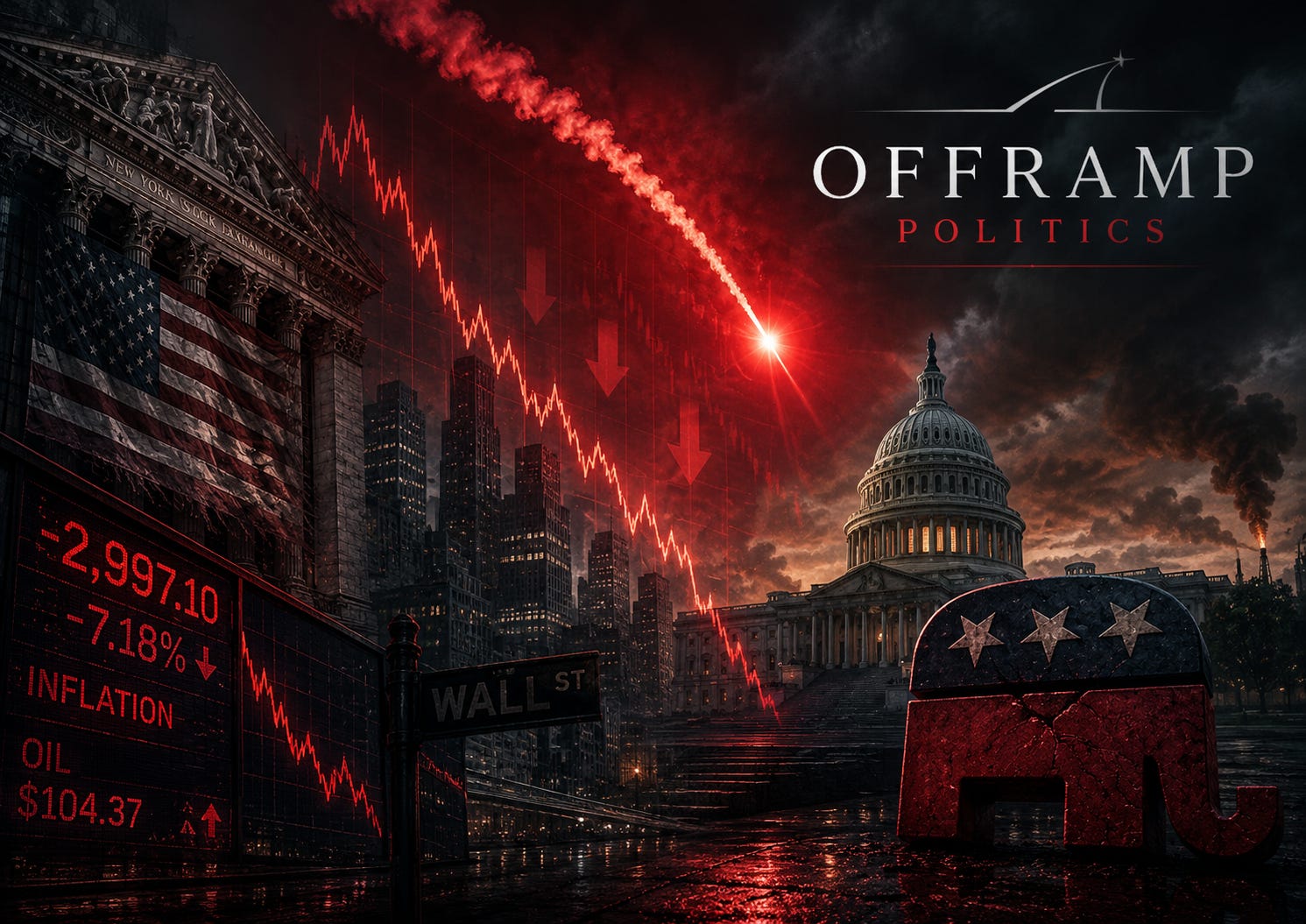
The stock market has not cratered. The economy has not officially broken. The headlines have not yet settled into the language of panic. But the warning lights are no longer blinking one at a time. They are starting to blink together.
Axios reported that CEO confidence has fallen sharply, with business leaders turning gloomy on the broader economic outlook. That matters because CEOs are not just commentators on the economy. They are operators inside it. When they lose confidence, they do not always announce a recession. They quietly slow hiring. They delay investment. They rethink expansion. They preserve cash. They stop acting like tomorrow is friendly.
That is how economic fear travels before it becomes visible.
And for Republicans heading into the midterm elections, that should be the real danger. Not simply that the stock market might fall. Not simply that inflation might remain sticky. Not simply that the Iran war might continue to drag energy prices higher.
The danger is that all of these pressures may converge at the exact moment voters begin asking the oldest political question in America:
Are we better off than we were two years ago?
Right now, the GOP may not like the answer forming in the distance.
This Is Not a Normal Midterm Setup
Midterms are already dangerous for the party in power. They are usually a referendum, not a love letter. Voters tend to use them as a correction mechanism, a national pressure valve, a way to say: enough, slow down, change direction.
But 2026 is carrying an extra charge.
Donald Trump is in his second term. That means Republicans are not just defending a presidency. They are defending a lame-duck presidency. The clock is already ticking on the Trump era, even as MAGA remains the central organizing force of the party.
That creates a strange political geometry.
Trump still dominates the GOP. His endorsements still matter. His movement still has force. Republican candidates still orbit him like moons around a very loud planet.
But voters may begin to see something different: a party clinging to one man while the economy underneath him starts to shake.
That is where a stock market decline becomes politically dangerous. A mild correction is survivable. A serious decline heading into the midterms becomes a narrative machine. It gives Democrats a simple message. It gives independents a reason to break away. It gives anxious voters a symbol they can understand without reading a white paper.
The retirement account becomes the campaign ad.
The grocery bill becomes the debate stage.
The gas pump becomes the polling memo.
The Market Does Not Need a Crash to Become a Political Problem
The question is not whether a 1929-style collapse is inevitable. That is the wrong frame.
The better question is whether America has built a market that now requires too many things to go right at the same time.
The market needs inflation to cool. It needs the Federal Reserve to have room to cut or at least avoid tightening. It needs oil prices to behave. It needs consumers to stay strong. It needs corporate earnings to keep justifying high valuations. It needs the AI boom to remain a growth engine rather than become another speculative sugar rush. It needs the Iran war not to widen. It needs tariffs not to keep bleeding into prices. It needs Washington not to spook bond markets with deficits, debt fights, or another round of fiscal theater.
That is a lot of plates spinning in a room with bad lighting.
And this is where GOP governance comes into the picture.
Republicans came into power selling strength, competence, and economic restoration. But over the past two years, the party’s record has created several pressure points that could now feed into the very downturn they will have to answer for.
First, the tariff strategy has been a tax on uncertainty. Tariffs may sound strong in a rally speech, but inside the economy they can become sand in the gears. Businesses do not always know where to source goods. Importers eat costs until they cannot. Consumers eventually pay more. Companies delay planning because the rules keep changing.
Second, the GOP tax-and-spending approach has not solved the deficit problem. It has enlarged the question. The Republican brand has long claimed fiscal discipline, but voters are watching a party that wants tax cuts, military escalation, tariff revenue, and lower inflation all at once. That is not a governing philosophy. That is a wish list stapled to a campaign banner.
Third, the Iran war has become an economic weight. War is not just fought with missiles. It is fought through oil markets, shipping routes, insurance costs, military replenishment, interest payments, and household inflation. Even if Americans support stopping Iran from obtaining nuclear weapons, they may not support a war that makes their daily life more expensive while Washington pretends the bill is smaller than it is.
Fourth, Republicans may have underestimated how fragile post-COVID economic patience really is. Voters have lived through pandemic inflation, housing pressure, interest-rate pain, food-price fatigue, and years of being told the economy is fine while their own budgets say otherwise. If the market drops hard now, many voters will not treat it as an isolated financial event. They will treat it as confirmation.
That is the political danger.
A market decline would not have to create dissatisfaction from scratch. It would only need to activate what is already there.
History Has a Warning Label
The 1974 midterms remain the ghost in the machine.
That year, Republicans were punished in the wake of Watergate, recession, inflation, and an oil shock. The market had already been battered. The economy felt unstable. Trust in government had been cracked open. Democrats surged, and the GOP paid the price for scandal and economic decline.
No two elections are the same. Trump is not Nixon. Iran in 2026 is not the Arab oil embargo of the 1970s. The structure of the modern market is different. The media environment is different. The electorate is different.
But the pattern is familiar enough to matter.
Energy shock. Inflation pressure. Political exhaustion. Trust deficit. Party in power forced to defend conditions voters experience directly.
That is not a perfect comparison. It is a warning flare.
The 2018 midterms offer another lesson. Republicans lost the House under Trump even with a strong economy by many conventional measures. Democrats flipped dozens of seats and turned anti-Trump sentiment into a nationalized campaign. Trade-war politics also hurt Republicans in key places. That matters because 2026 may carry both problems at once: Trump fatigue and economic stress.
In 2018, the GOP could still point to growth.
In 2026, if the market rolls over, what exactly do they point to?
A tariff regime that raised prices?
A deficit picture that worsened?
A war that pushed energy costs higher?
A governing party that promised control and delivered volatility?
That is not a midterm message. That is a hostage note written by the economy.
The Iran War May Be the Hidden Fuse
The Iran war is the piece Republicans may not be able to message their way around.
Foreign policy often feels distant to voters until it enters the price of gasoline, groceries, airfare, shipping, or interest rates. Once that happens, the war is no longer “over there.” It is in the driveway. It is in the pantry. It is in the credit card balance.
If energy prices remain elevated, inflation becomes harder to kill. If inflation remains sticky, the Federal Reserve has less room to rescue the market. If the Fed cannot rescue the market, equities become more vulnerable. If equities fall, voters feel poorer. If voters feel poorer, the party in power gets blamed.
That is the chain.
And Republicans cannot easily escape it because the war is happening under their watch. They can argue necessity. They can argue strength. They can argue national security. But voters have a brutal way of simplifying politics when money gets tight.
They do not ask whether the strategy was theoretically defensible.
They ask why everything costs more.
The GOP’s Bigger Problem Is That It Owns the Dashboard
The Republican Party controls the frame of this economy because Trump controls the Republican Party.
That may be useful when the stock market is rising. It is dangerous when the market starts falling.
For years, Trump treated the market as a scoreboard. When stocks climbed, he claimed the credit. When markets cheered deregulation or tax cuts, the GOP treated Wall Street optimism as proof of national success.
But once a party hugs the market on the way up, it cannot pretend not to know it on the way down.
That is the trap.
If the stock market suffers a serious decline before November, Democrats will not need a complicated argument. They will say Republicans had the White House, Congress, the tariffs, the tax bill, the war strategy, and the economic messaging machine. They will say the GOP promised stability and delivered a crater.
They will say America needs to turn the page.
And for once, that message may not sound like a slogan. It may sound like a receipt.
The Crash May Not Be Inevitable. The Reckoning Might Be.
Markets are strange creatures. They can float above bad news longer than logic says they should. They can turn fear into rallies and rallies into traps. They can ignore war one week and panic over bond yields the next. Anyone claiming certainty about a crash is selling thunder in a bottle.
But politics does not require certainty.
Politics runs on direction, mood, and lived experience.
And the direction right now is not clean. The mood is not calm. The lived experience is not matching the victory speeches.
CEO confidence is weakening. Inflation is still alive. The Iran war is pressing into energy prices. Tariffs have added cost pressure. Deficits are rising. Midterm history already favors volatility. And Republicans are heading into November as the party that owns the government, owns the policy choices, and owns the consequences.
The market may not be voting yet.
But it may be registering.
And if it walks into the midterms bleeding red, the GOP may discover that Wall Street can become a precinct faster than anyone expects.
Because when voters open their retirement accounts and see losses, they do not think in partisan talking points.
They think in exits.
And in 2026, that exit may point straight toward the offramp.