
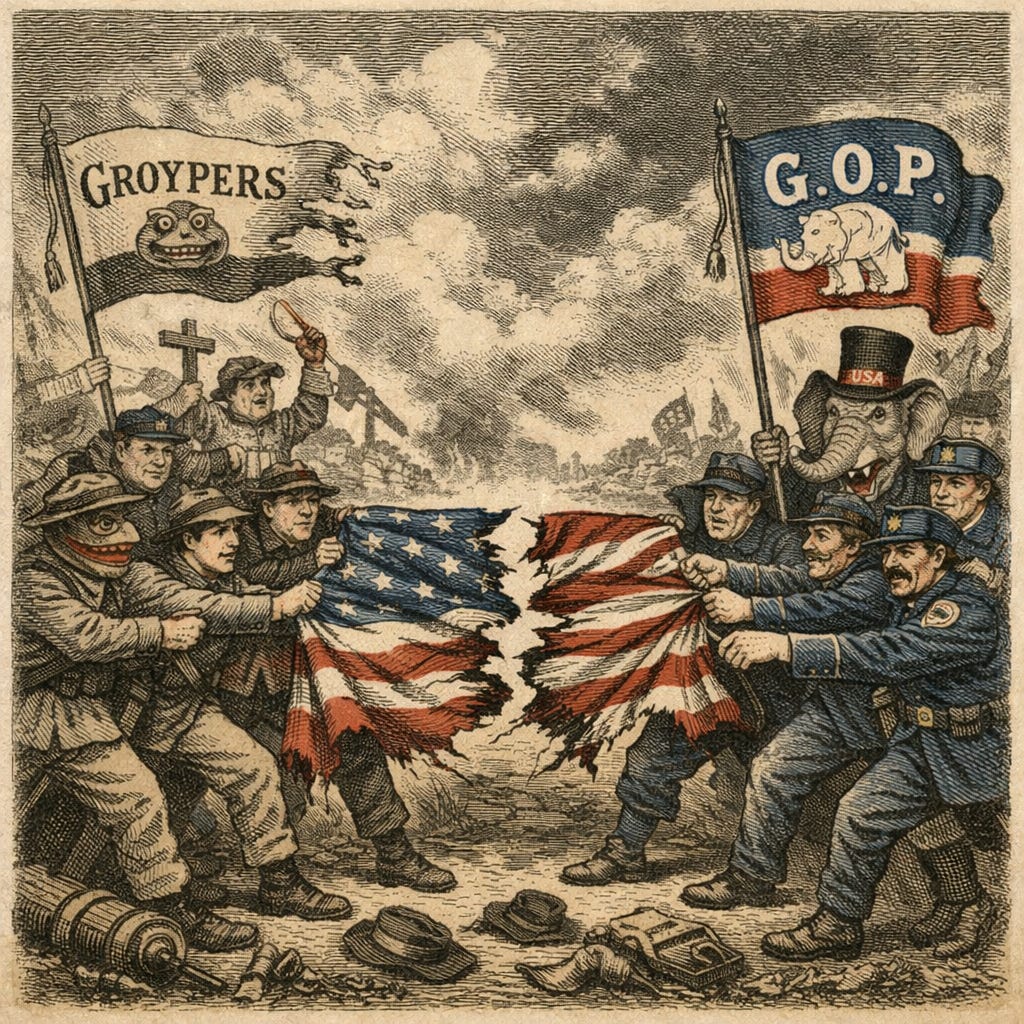
The Line in the Sand Was Always Coming
Rufo, Rutgers, and the end of the Groypers
When I wrote in November that Tucker Carlson had taken a wild swing into Groypers and away from the conservative movement that once elevated him, I wasn’t writing about personality. I was writing about trajectory.
Movements do not implode overnight. They drift. They tolerate. They rationalize. They explain away. And then one day someone with institutional weight decides the drift has gone too far.
That is why Chris Rufo matters.
Rufo is not a fringe operator. He is not a back-bencher trying to go viral. He is not an anonymous X account throwing rhetorical Molotov cocktails into the night. Rufo sits in the intellectual bloodstream of the conservative movement. He helped define the cultural combat architecture around CRT, DEI, and institutional capture. He understands institutions. He builds narratives that become policy. When he moves, donors notice. Think tanks notice. Governors notice.
So when Rufo criticizes the Groypers and the ecosystem that has increasingly normalized them, that is not noise. That is boundary enforcement.
The conservative movement is not a monolith. It is a coalition of power centers. Donors. Policy shops. Media platforms. Grassroots activists. Elected officials. Some factions are insurgent. Some are institutional. The Groypers have thrived on insurgency. They thrive on friction. They feed on outrage. They weaponize digital intensity to create the appearance of scale.
For years, that intensity created hesitation among institutional conservatives. No one wants to fracture a coalition while the opposition controls cultural institutions and bureaucratic power. So there was tolerance. There was distance, but not rupture.
What Rufo did was different.
He did not merely say he disagreed. He questioned the strategic and moral cost of allowing the Groyper wing to become normalized inside the broader conservative ecosystem. He signaled that the cost-benefit calculus has shifted.
And that is where the Rutgers-linked Network Contagion Research Institute report enters the frame.
The report, America Last, did something critical. It challenged the perception of organic growth. It examined early engagement spikes, amplification patterns, and geographic anomalies. It raised the possibility that the digital footprint inflating Groypers and Nick Fuentes was not purely grassroots enthusiasm, but at least partially the product of coordinated amplification networks.
Now pause there.
In modern political movements, perceived strength is power. If a faction appears large, intense, and rapidly expanding, institutional actors hesitate to confront it. If that perception weakens, the calculus changes.
Rufo’s critique provided the moral and strategic argument. The Rutgers analysis provided technical reinforcement. Together, they reduce the fear factor.
This matters because political coalitions fracture not when people get offended, but when leaders conclude that a faction is a liability.
When I wrote about Tucker’s pivot—about the prostitution diversion during my Menendez investigation, about Manuel Rocha, about Cuban intelligence IP addresses, about the humiliation architecture that surrounded that episode—I was documenting the early stages of a drift. Tucker did not simply criticize the left. He mainstreamed Groypers. He platformed them. He blurred the boundary between insurgent nationalism and institutional conservatism.
That boundary was always going to matter.
Movements can tolerate hard rhetoric. They cannot tolerate strategic destabilization. When a faction begins to undermine donor relationships, policy credibility, and coalition coherence, institutional actors eventually respond.
Rufo’s placement in the movement makes his criticism catalytic. He is not simply a commentator. He is part of the machinery that translates ideas into institutional action. When someone in that position draws a line, it gives permission to others.
The Rutgers report then serves as armor. It allows critics to argue that what appeared to be a surging populist force may in part be algorithmically amplified. It reframes the Groypers not as an unstoppable grassroots army, but as a network benefiting from digital coordination dynamics that distort perception.
That shift is subtle but profound.
If the Groypers are seen as electorally indispensable, the movement adapts to them. If they are seen as digitally inflated and strategically corrosive, the movement contains them.
The trajectory from Tucker’s swing to this moment now looks less chaotic and more structural. Tucker’s shift was a symptom of a larger tension inside the right. The tension between insurgent spectacle and institutional durability.
Rufo represents durability.
Rutgers represents measurement.
Together they create conditions for a break.
Is it inevitable? No.
Breaks require enforcement. Donors must distance. Elected officials must clarify. Platforms must decide what they will and will not legitimize. But the intellectual groundwork is being laid.
The conservative movement is now facing a choice it has delayed for years: is it a coalition built on disciplined institutional strategy, or a movement driven by algorithmic insurgency?
When I wrote about Tucker’s demons, about Moscow ballet trips and rhetorical deference to foreign strongmen, I was not diagnosing a personality crisis. I was observing a coalition strain. A strain between those who see America’s strength in institutional resilience and those who see it in cultural combustion.
Rufo has signaled that combustion has limits.
The Rutgers report suggests the combustion may not be as organic as it appears.
That combination sets the stage.
The Groypers have survived on the perception of unstoppable energy. If that perception fades, institutional conservatives gain confidence to enforce boundaries. If boundaries are enforced, the break becomes real.
For years, the right has tolerated internal friction in the name of unity. Unity is valuable. But unity without guardrails becomes vulnerability. Hybrid warfare environments reward digital intensity. Foreign actors exploit ideological fractures. Amplification can be weaponized.
The conservative movement cannot afford to ignore that reality.
This moment is not about canceling dissidents. It is about strategic survival. Rufo’s intervention signals that some leaders understand that distinction.
The question now is whether others will follow.
The stage is set. The geometry is shifting. The next move will determine whether this was a tremor—or the beginning of a realignment.


Tender, soft citizens, so palsied by power,
Can we rally and march through Liberty's dark hour?
Freedom ain't free,
She takes work to be:
By shared sweat alone shall our Republic yet flower.
It will work. Watch the clowns. Kanye apologized for being anti-Semitic. Although he is not on the right he always starts things. Two down.