


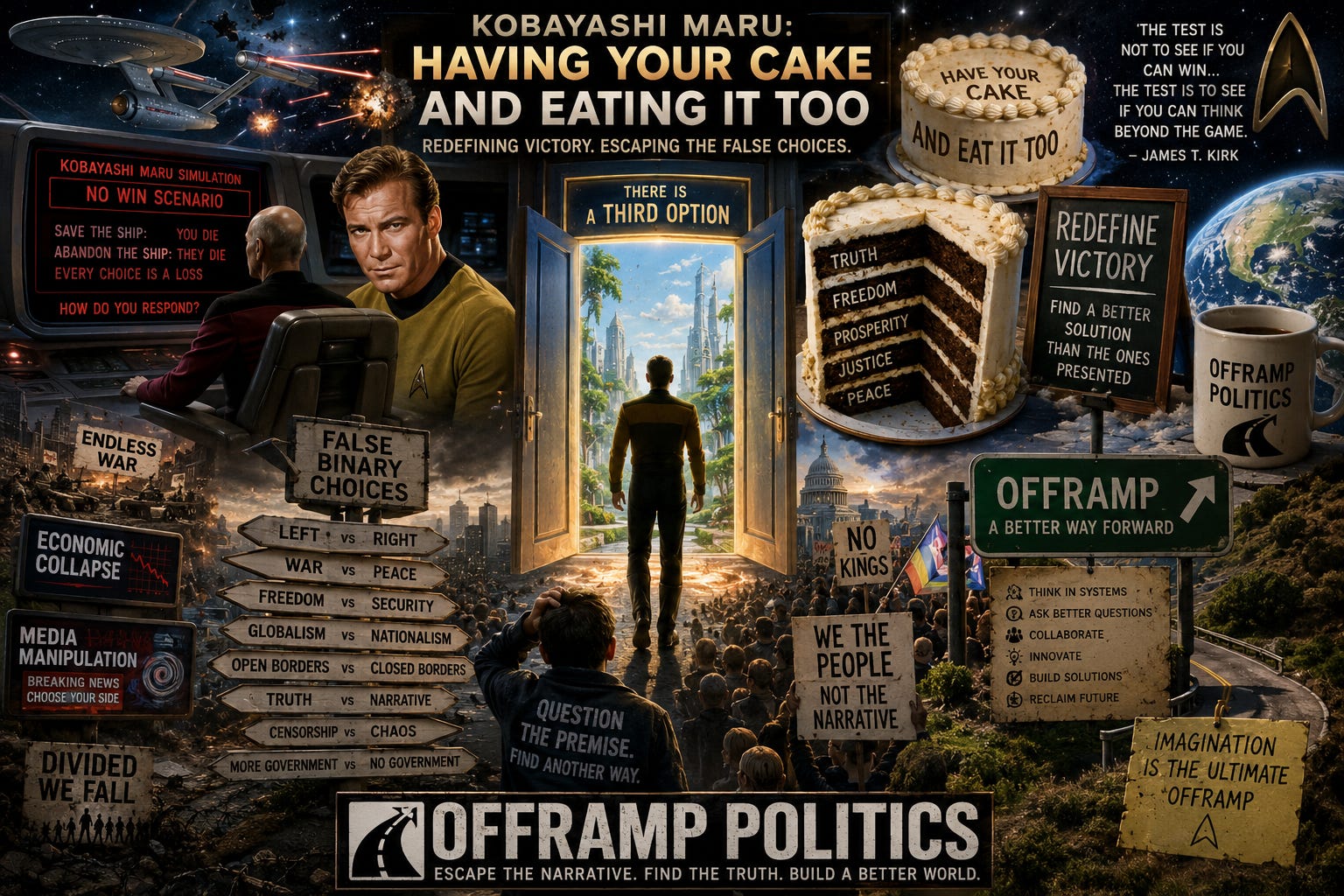
Everywhere you look today, the public is being handed binary choices dressed up as inevitabilities.
Either security or freedom.
Either economic growth or environmental stability.
Either nationalism or globalism.
Either institutional order or populist revolt.
Either technological acceleration or human dignity.
Either censorship or chaos.
Either endless war or strategic surrender.
Modern politics increasingly resembles a game show designed by exhausted empires. The audience is handed two burning doors and told wisdom consists of choosing which fire hurts less.
The problem is not merely polarization.
The deeper problem is that entire populations have unconsciously accepted the idea that the choices being presented are the only choices available.
And once people accept that premise, the architecture of control becomes almost effortless.
The public begins managing decline instead of imagining transformation.
That is why I keep thinking about Star Trek.
More specifically, the Kobayashi Maru.
For those unfamiliar, the Kobayashi Maru was the final psychological test given to prospective captains within Starfleet. It was not merely a tactical simulation. It was an existential trap disguised as military training.
A civilian vessel, the Kobayashi Maru, sends out a distress signal from inside hostile territory. The cadet captain must decide whether to violate treaty boundaries to attempt a rescue. If they refuse, innocent people die. If they enter the neutral zone to save the ship, enemy forces overwhelm them.
Every possible outcome ends in loss.
The simulation was specifically designed to have no winning answer.
The purpose was not victory.
The purpose was observation.
How does a future leader behave when trapped inside inevitability?
Do they panic?
Do they compromise morality?
Do they preserve themselves?
Do they freeze?
Do they accept death?
Do they emotionally collapse under the pressure of impossible decisions?
Most cadets accepted the premise of the test itself.
James T. Kirk did not.
Kirk famously altered the simulation.
Some call it cheating.
I do not.
Kirk’s genius was not that he found a loophole. His genius was that he questioned the invisible assumptions surrounding the entire exercise.
Everyone else believed they were being tested on how well they navigated the choices presented.
Kirk realized the real test might be whether someone possessed the imagination to reject the framework itself.
That distinction matters.
Because much of modern life functions as a Kobayashi Maru simulation.
The public is constantly informed:
these are your only choices
this outcome is inevitable
this sacrifice is unavoidable
this conflict cannot be escaped
this system is too large to change
this corruption is simply “how the world works”
People become psychologically imprisoned long before they become physically trapped.
I have spent much of my life refusing to fully accept those premises.
Over the years, I developed a phrase for it:
“Having your cake and eating it too.”
Most people use that phrase mockingly, as if it describes childish fantasy or greed. Society trains people to believe that wanting two good outcomes simultaneously is naive.
But what if the highest form of intelligence is not choosing between presented victories?
What if true intelligence is discovering a victory nobody in the room originally imagined?
That is the philosophy I carried into sales long before I fully understood what I was doing.
Years ago, while working in sales environments, I noticed something that separated average salespeople from exceptional ones.
Most salespeople treated customers like combat scenarios.
The client walks in wanting Product A.
The salesperson pushes Product B.
The negotiation becomes psychological trench warfare.
Pressure.
Objections.
Counter-objections.
Closing tactics.
But I found myself approaching the interaction differently.
When a client came to me, I rarely believed their stated request was the true objective. I believed the product they asked for was often just the visible expression of a deeper need they themselves had not fully identified yet.
So instead of trying to “win” the interaction, I entered into a collaborative discovery process with them.
I would ask questions.
Not manipulative questions.
Real questions.
What are you trying to accomplish?
What problem are you actually solving?
What frustration brought you here?
What outcome are you hoping to avoid?
What would success actually look like six months from now?
Something fascinating would happen during those conversations.
The client would begin evolving in real time.
You could almost see the shift occur in their eyes.
At first they believed they needed one thing. But through dialogue, exploration, and trust, they would slowly become more aware of what they truly needed beneath the surface.
And often, the final solution was not the product they originally walked in seeking.
Many of my best closes happened when both me and the client realized together that the real answer existed outside the binary choice that initially framed the interaction.
That was my Kobayashi Maru.
Not manipulating people into accepting my solution.
Not cornering them psychologically.
Not forcing them into a purchase.
The victory came from collaboratively discovering an outcome neither of us initially saw when the conversation began.
The client got what they actually needed.
I got a successful close.
Both sides “had their cake and ate it too.”
But only because the original definition of victory evolved.
That experience permanently changed the way I view politics, media, institutions, and society itself.
Because once you recognize how often people operate inside false binaries, you begin seeing them everywhere.
You see it in political discourse.
You see it in media narratives.
You see it in geopolitical conflicts.
You see it in economic policy.
You see it in race relations.
You see it in how corporations manage public opinion.
Entire populations are maneuvered into emotionally exhausting battles between pre-approved outcomes while the deeper possibilities remain unexplored.
And perhaps that is the real danger of our age.
Not disagreement.
Not conflict.
But the shrinking of imagination.
A civilization loses something sacred when it forgets how to envision outcomes beyond the walls placed in front of it.
Yet despite all of this, I remain optimistic.
Because history repeatedly shows that humanity advances through people who refuse to accept the limits of the current simulation.
Every major breakthrough in civilization was once viewed as impossible:
ending monarchies
flight
civil rights
the internet
space exploration
decentralized communication
global knowledge access
Progress often begins with someone calmly questioning the assumptions everyone else unconsciously obeys.
That is why I do not view the present moment as hopeless.
Complicated? Absolutely.
Dangerous? Without question.
But hopeless? No.
I believe humanity is in the middle of a global Kobayashi Maru scenario. Political systems, economic systems, media systems, technological systems, and even spiritual systems are all straining simultaneously under pressures they were never designed to withstand.
And yet, somewhere inside the noise, I believe new pathways are emerging.
Not through blind optimism.
Not through denial.
But through people willing to step outside the false binary choices being presented to them.
People willing to ask:
“Who decided these were the only possible outcomes?”
Sometimes the greatest victory is not defeating the system.
Sometimes the greatest victory is discovering the doorway the system never realized existed. 🚪🌌