


There are moments in American politics when the headline tells one story, the market tells another, and the truth is somewhere in the machinery underneath.
Today may have been one of those moments.
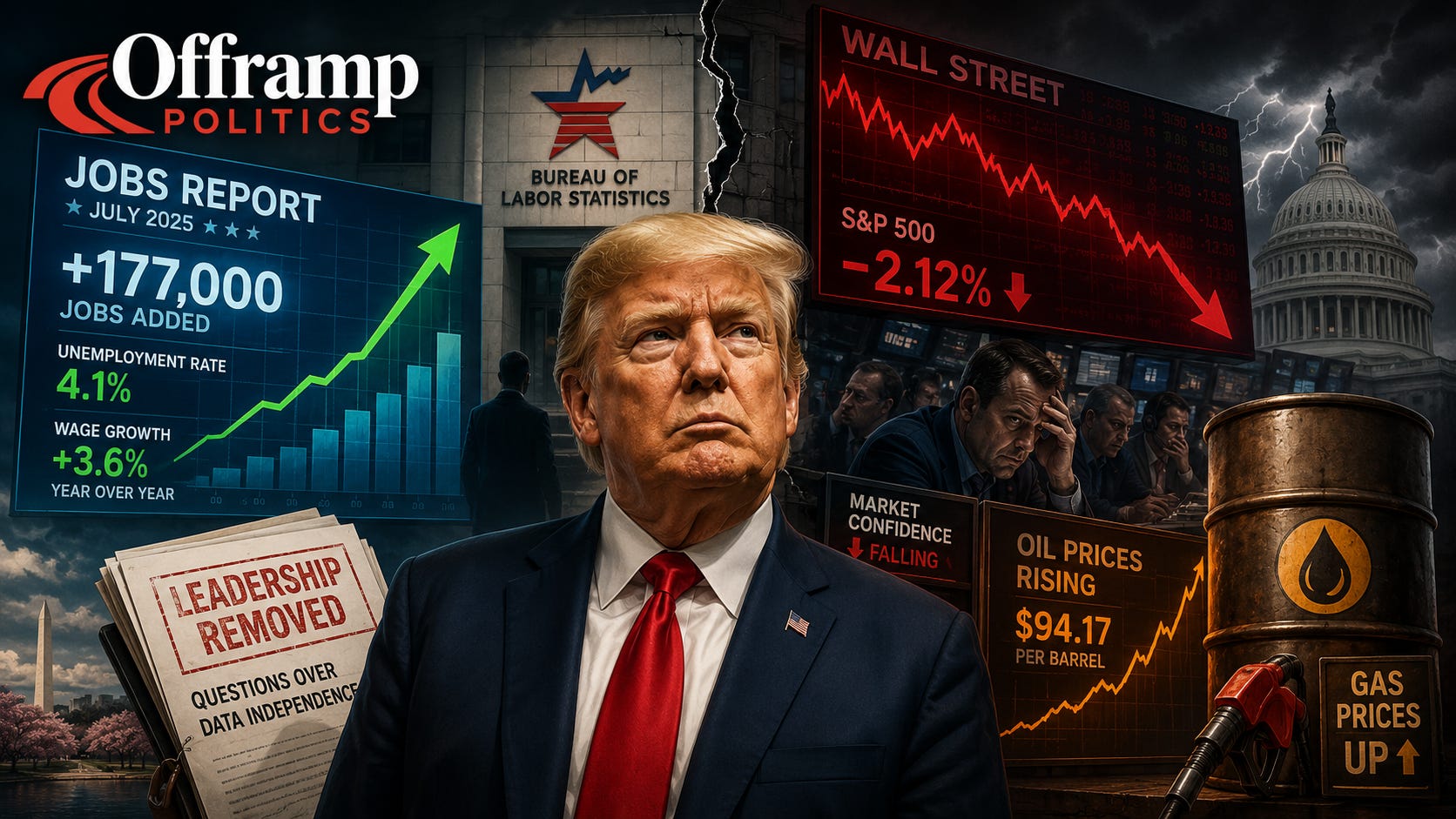
The official jobs number came in strong. Very strong. The Bureau of Labor Statistics reported that the economy added 172,000 jobs in May, with unemployment holding at 4.3 percent. On paper, that looks like the kind of report any administration would want to frame, hang, and walk around Washington with like a championship belt.
But the stock market did not celebrate.
The market sold off hard. The Dow fell. The S&P 500 fell harder. The Nasdaq took the worst of it. Treasury yields jumped. The same jobs number that looked good on television looked dangerous on Wall Street.
That contradiction is worth sitting with.
Because a strong jobs report can mean the economy is healthy. But in the current environment, it can also mean the Federal Reserve has less room to cut interest rates. It can mean inflation pressure is still alive. It can mean higher borrowing costs for longer. It can mean the market sees something in the report that the political class would rather not discuss.
And there is another layer here that cannot be ignored.
This jobs report comes after President Trump’s controversial decision last year to remove the head of the Bureau of Labor Statistics, Erika McEntarfer, after a weak jobs report and major downward revisions. At the time, Trump accused the numbers of being manipulated against him. He offered no public evidence of fraud. But the move sent a very clear message through Washington: economic data was no longer just economic data. It had become a political battlefield.
That is dangerous territory.
The Bureau of Labor Statistics is one of those quiet institutions most Americans do not think about until the numbers hit their wallets. Jobs. Inflation. Wages. Unemployment. These are not just charts for economists. They are the scoreboard for the American household. They shape Fed decisions, investor behavior, mortgage rates, business confidence, and political campaigns.
So when the president removes the person overseeing that data operation because he dislikes the result, the country has to ask a bigger question.
Not whether the numbers are fake. Not whether someone committed fraud. Not whether there is some cartoon villain sitting in a federal office changing spreadsheets with a cigar in his mouth.
The more serious question is quieter than that.
Can political pressure bend the culture around the numbers?
That is where the real concern lives.
There is a long history of administrations wanting economic statistics presented in the most favorable possible light. That does not mean illegality. That does not mean fraud. It does not even mean someone is deliberately lying. But there are always gray areas in government statistics: seasonal adjustments, birth-death models, revisions, survey response rates, classification choices, timing, assumptions, and emphasis.
The numbers are real, but they are also produced through models. And models have pressure points.
This is where public trust becomes fragile. If an administration creates the perception that bad numbers get people fired and good numbers get rewarded, then even a legitimate strong jobs report enters the public bloodstream with a bruise on it.
That may be part of what we saw today.
The headline said the labor market was strong. The market said: hold on.
If the jobs number is truly strong, then the Fed may have to stay tougher for longer. That is bad for stocks. But there is another possible interpretation too. The market may be reacting not only to strength, but to uncertainty. Investors may be asking whether the jobs data is giving a clean picture of the economy, or whether the picture is being stretched at the edges.
Again, stretched does not mean fraudulent.
It means a number can be technically defensible and still politically convenient. It means an economy can look strong in the headline while ordinary people feel weak in real life. It means jobs can be added while wages fail to keep up, debt rises, layoffs hide in certain sectors, small businesses get squeezed, and consumers quietly run out of room.
America has seen this movie before.
Washington loves the big number. Markets read the footnotes. Families read the grocery bill.
And right now, the footnotes do not look simple.
Oil prices appear ready to become a major problem again. If energy prices spike, that feeds into inflation, transportation, food costs, business expenses, and consumer psychology. A country already tired from years of price pressure does not need another oil shock walking into the room wearing muddy boots.
So now we have a strange and troubling combination.
A jobs report that looks strong.
A stock market that looks sour.
Oil prices that look threatening.
A Federal Reserve that may have less room to help.
And a federal statistics system that is operating under the shadow of a political shake-up that never should have been handled so casually.
That is not a clean economic picture. That is a warning light.
The danger for Trump is that he may get the headline he wants while inheriting the market reaction he does not. A strong jobs number can be used in a speech. But if Wall Street believes that number means higher rates, weaker earnings, more inflation pressure, or less confidence in the data itself, then the speech will not matter very much.
Markets are not sentimental. They do not clap because a politician tells them to clap.
They sniff weakness. They sniff risk. They sniff uncertainty.
And today, they smelled something.
For Offramp Politics, the question is not whether America added jobs in May. The government says it did. The question is whether the country is being given a full picture of what those jobs mean inside a strained economy.
Are these numbers signaling strength?
Or are they the last good-looking numbers before the pressure breaks somewhere else?
That is the question Americans should be asking.
Because if oil spikes, if markets keep souring, if borrowing costs stay high, and if the public begins to doubt the independence of the statistics that guide the economy, then we may be entering a rougher period than the headline suggests.
The jobs number may look great.
But today, the market looked at that same number and said: not so fast.
And sometimes, when Wall Street refuses to applaud good news, it is because the good news is not as good as it looks.