

By the time the opening bell rang, the newsroom already felt wrong.
It was not panic yet. Panic has a sound. Panic is chairs scraping, phones ringing without pause, producers yelling over one another, graphics teams misspelling names in real time, and junior staffers pretending they know what a credit freeze means because nobody wants to look young during history.
This was different.
This was silence trying to pass itself off as discipline.
At 9:28 a.m., the executive editor of one of the largest newsrooms in the country stood in the center of the assignment desk with a coffee she had not touched. On the big screen, the pre-market numbers bled red across the wall. Futures were collapsing so quickly the graphics system kept refreshing before anchors could read the numbers out loud.
“Get business on the floor now,” she snapped. “I want markets, banking, Fed, Treasury, White House, campaigns, all of it. Nobody leaves their desk.”
A producer near the back called out that the Dow was set to open down more than 2,000 points.
“Do not say that on air unless we have it confirmed,” the editor said.
Another producer said the Nasdaq looked worse.
Then the opening bell rang.
The market did not open.
It fell.
Not in steps. Not in waves. Not like a bad day on Wall Street.
It fell like a floor had been removed from beneath the country.
The first halt came within minutes. Then another. Then the talking heads started using careful language, which only made everything worse. “Unprecedented volatility.” “Systemic pressure.” “Liquidity concerns.” “Contagion.” “Emergency conversations.”
The editor turned toward the control room.
“Stop letting them say volatility. This is not volatility. This is a crash.”
At 9:47 a.m., her email chimed.
The sender was a banker. Not a cable-news banker. Not one of the polished men who explains recessions in a blue suit while pretending he did not see them coming. This was someone who had never wanted to be a source, which made him valuable. He knew where the bodies were buried because he helped finance the cemeteries.
The subject line had only four words.
Print the history books.
She opened it.
This is not a correction.
This is not a panic.
This is not even 2008.
Get your team ready.
By lunch they will know.
By dinner everyone will know.
This is the greatest crash in American history.
The editor read it twice.
Then she looked up at the newsroom.
For one second, she was not an editor. She was a citizen standing at the edge of a cliff with the rest of the country.
Then the job returned to her body.
“Everyone listen to me,” she said, loud enough to cut through the monitors. “We are moving to emergency coverage. I want a crash package, election package, global reaction package, retirement package, housing package, food prices, gas prices, crypto, bonds, banks, state pensions, campaign money, everything. If it touches money, politics, or fear, I want it covered.”
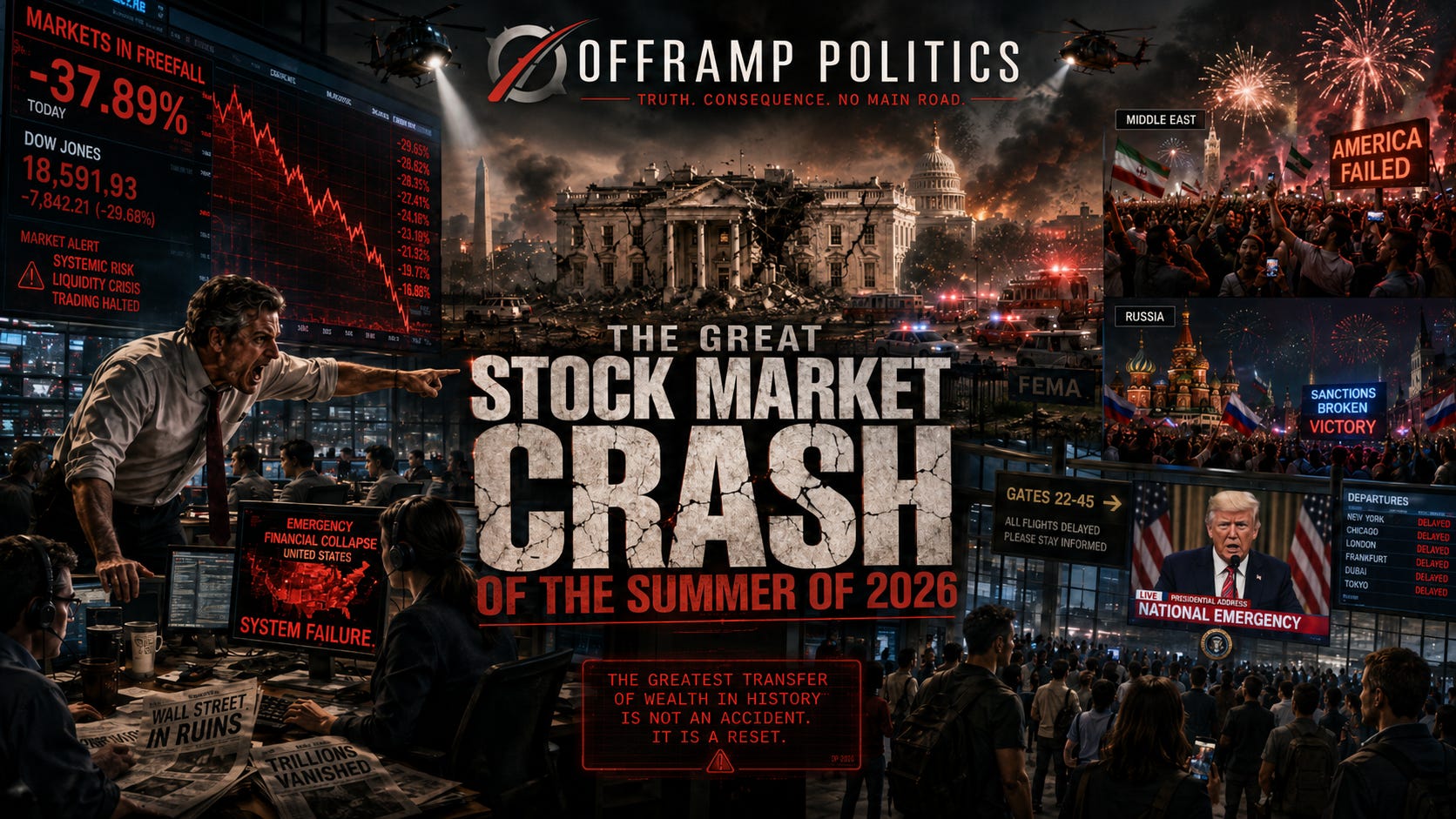
By 10:30 a.m., airports across the country had turned into waiting rooms for a nervous empire.
At Terminal C in Atlanta, passengers gathered under the televisions with boarding passes in their hands and dread on their faces. A delayed flight to Phoenix was forgotten. A family heading to Orlando stood frozen beside a stroller. A man in a golf shirt kept refreshing his retirement account on his phone, then stopped, as if the numbers might become less real if he refused to look.
Every screen switched to the same image.
The President of the United States.
The seal. The flags. The narrow face of a government trying to convince the world it still had control of the machine.
“My fellow Americans,” he began.
Nobody in the terminal moved.
The President spoke of resilience. He spoke of strength. He spoke of temporary market dislocation and emergency liquidity measures. He said Treasury was coordinating with the Federal Reserve. He said there was no reason for Americans to lose faith in the system.
But the split screens betrayed him.
On one screen, Wall Street traders stood frozen beneath red numbers so large they looked fictional.
On another, a live shot showed crowds in the Middle East gathering in the streets, waving flags, chanting in celebration.
On a third, Russian state media carried images of people cheering outside a government building.
The translation crawled across the bottom of the screen.
Down with the Great Satan.
The words hit the airport like smoke slipping under a door.
Not because most Americans understood the chant in any deep historical sense. Not because the average traveler in Terminal C had spent years studying the symbolic language of anti-American movements.
It hit because everyone understood humiliation.
A crash is not just financial. A crash is spiritual. It is the moment a nation that told itself it was inevitable begins to wonder whether inevitability was only a marketing campaign.
By noon, campaign offices across America were no longer thinking about their messaging calendars.
No more kitchen-table economics. No more border spots. No more crime ads. No more “protect democracy” language carefully tested in suburban focus groups. No more consultant poetry about working families and lowering costs.
The crash had eaten the script.
In Washington, members of Congress began moving like animals before a storm. Public statements came first. Then private calls. Then leaks. Then the anonymous quotes.
Republicans blamed the President’s economic mismanagement.
Democrats blamed reckless deregulation, debt games, tariffs, tax policy, corporate greed, and the failure to protect ordinary people from Wall Street’s hunger.
But behind the public theater, something stranger began to happen.
They started agreeing.
Not in public. Not yet.
But inside the cloakrooms, on secure calls, at private lunches nobody would confirm, the conversation turned from November to survival.
The crash was too big to belong to one party. It had become a national wound. The old political math began to break down. The question was no longer who could use the crash to win the midterms. The question was whether anyone could prevent the crash from consuming the legitimacy of the entire government.
At 1:15 p.m., the editor received a call from one of the most famous political consultants in the world.
He was the kind of source who did not call unless the chessboard had been kicked over.
She stepped into a glass office and closed the door.
“You seeing this?” he asked.
“I’m watching it happen,” she said.
“No,” he said. “You’re watching the market. I’m asking if you’re seeing the politics.”
She looked out through the glass at the newsroom. Staffers were moving fast now. The silence had broken. History had found its sound.
“Tell me,” she said.
“This is bigger than November,” he said. “That’s what people are missing. Everyone is still trying to plug this into the midterms. Who benefits? Who gets blamed? Does it hurt the party in power? Does it blow up the House? Does it flip the Senate?”
“And?”
“And that’s all dead math now.”
The editor said nothing.
The consultant continued.
“If this closes where it looks like it’s closing, you’re not covering an election cycle anymore. You’re covering a legitimacy crisis. The President can give speeches all day. It will not matter. If retirees are wiped out, if banks freeze credit, if pension funds start screaming, if state governments realize their budgets are melting, Congress will need a sacrifice.”
“The President?”
“Not just from the opposition,” the consultant said. “That’s the part you need to understand. There are members of his own party already asking whether impeachment becomes the release valve.”
She almost laughed. Not because it was funny. Because it was too large to process.
“Impeachment over a crash?”
“Impeachment over collapse,” he said. “There’s a difference.”
On the newsroom screens, the market opened again after another halt.
It fell harder.
The consultant lowered his voice.
“When the American people lose money, they get angry. When they lose homes, they get desperate. When they lose faith, they start looking for a ritual. Washington understands ritual. Hearings. Investigations. Resignations. Impeachment. These are not only constitutional processes. They are national ceremonies. They tell the public someone is being held responsible.”
“You think they rush it?”
“I think if tonight is bad enough, they move faster than anyone thinks possible. People assume impeachment is slow because they remember the last wars. But those were partisan impeachments. This would be different. This would be Congress trying to save itself from the fire.”
The editor looked down at the banker’s email still open on her screen.
Print the history books.
She asked the consultant one final question.
“What happens to the election?”
He exhaled.
“The election becomes a referendum on who gets to rebuild the country after the machine breaks.”
Outside the office, a producer waved both arms.
The editor opened the door.
“What?”
The producer’s face had gone pale.
“Emergency broadcast is coming in.”
“What kind?”
“We don’t know.”
Every screen in the newsroom flashed.
Then televisions across the country changed at once.
In airports. In bars. In diners. In brokerage offices. In hospitals. In schools. In living rooms where people had already spent the morning watching their futures evaporate.
Radios cut through music.
Computer terminals froze.
Phones vibrated with the same alert.
A tone sounded.
Then the message appeared.
Emergency Broadcast System
A massive earthquake has struck Washington, D.C.
For a moment, the country did not understand what it was reading.
Washington does not belong to earthquake imagination. Washington belongs to marble, ceremony, motorcades, arguments, monuments, flags, and men in suits pretending the pillars cannot crack.
Then the video came.
A news helicopter over the capital.
The camera shook as it tried to focus through dust.
The White House was broken.
Not destroyed. Not erased.
Broken.
A wound had opened through the building. Smoke rose from one side. Sirens screamed across the lawn. Emergency vehicles tore through the streets. Chunks of stone and debris scattered across the grounds. The symbol of executive power, the house every child recognizes before they understand government, stood cracked and smoking beneath a gray summer sky.
In the Atlanta airport, the man in the golf shirt stopped looking at his phone.
A woman covered her mouth.
A child asked if the President was dead.
Nobody answered.
In the newsroom, the executive editor stood beneath the screens as the crash, the chants, the impeachment whispers, and the broken White House fused into one impossible American image.
The market had fallen.
The government had shaken.
The world was watching.
And somewhere inside the machinery of the 2026 election, every campaign plan, every poll, every speech, every carefully drawn district, every consultant memo, every donor strategy, and every partisan assumption turned to ash.
This was no longer a bad summer.
This was a before-and-after line.
The kind historians argue over for generations.
The kind citizens remember by saying where they were when the screens changed.
The kind that makes a nation ask the question it was never supposed to ask out loud:
What happens if the system does not bend?
What happens if it breaks?
By nightfall, America was in mourning.
Not only for the dead and injured.
Not only for the capital.
Not only for the money lost in a single savage day.
America was mourning the old illusion that tomorrow was guaranteed to look enough like yesterday for politics to keep playing the same game.
The 2026 midterms had not been suspended.
They had been transformed.
Every race became a question of reconstruction.
Every candidate became either a builder, a scavenger, or a ghost from the world before the fall.
And somewhere, beneath the smoke and emergency lights, the Offramp finally appeared.
Not as a slogan.
Not as a campaign message.
As a demand.
Turn away from the road that brought us here.
Or keep driving into the ruins.