


In the last piece, I laid out something that’s been sitting with me for a while.
That faith is not just what produces works.
It’s what allows you to recognize them.
That idea didn’t come from trying to resolve a theological debate. It came from watching how differently people interpret the exact same reality.
The same action.
The same life.
The same moment.
Completely different conclusions.
So the question became:
What’s actually driving the interpretation?
I argued that faith itself is the mechanism.
And once I stepped into that… I started noticing something else.
This isn’t new.
It’s been here.
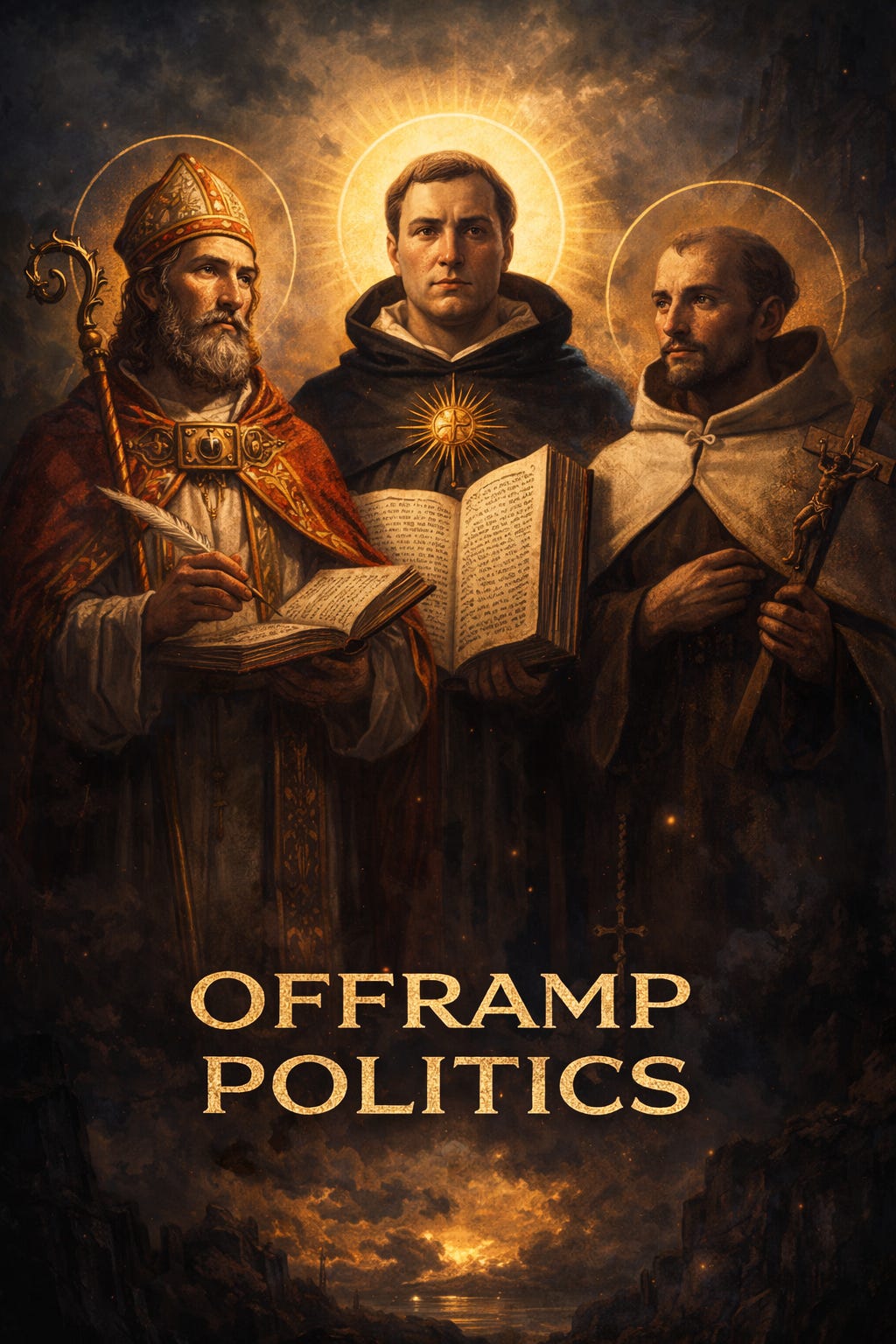
Augustine and the Gift of Sight
Augustine of Hippo writes a line that reframes everything:
“Give what You command, and command what You will.”
— Confessions, Book X
That’s not just about obedience.
It’s about capacity.
Augustine is saying God does not just command righteousness… He provides the ability to live it.
But Augustine goes further. He speaks directly to perception:
“The mind needs to be enlightened by light from outside itself, so that it can participate in truth.”
— On the Trinity (De Trinitate)
And even more plainly:
“You called and cried out loud and shattered my deafness. You were radiant and resplendent, you put to flight my blindness.”
— Confessions, Book X
That’s not metaphor alone.
That’s structure.
It means:
Without illumination…
You can look directly at truth… and still not see it.
Aquinas and the Structure of Perception
Thomas Aquinas builds this into a system.
He writes:
“Faith is a habit of the mind, whereby eternal life is begun in us, making the intellect assent to what is non-apparent.”
— Summa Theologica, II-II, Q.4, Art.1
Focus on that:
A habit of the mind.
Faith is not just belief.
It reshapes how the mind operates.
And then he says something that cuts right into interpretation:
“The knowledge of God is implanted in us by nature, inasmuch as God is man’s beatitude; but the knowledge of Him as He is in Himself requires grace.”
— Summa Theologica, I, Q.12
Which means:
You can know something exists…
And still not understand what you’re looking at.
Without grace.
The Mystics and the Misread Path
John of the Cross takes this into lived experience.
He writes:
“The soul that is attached to anything, however much good there may be in it, will not arrive at the liberty of divine union.”
— Ascent of Mount Carmel
And then describes the deeper process:
“This dark night is an inflow of God into the soul, which purges it of its habitual ignorances and imperfections.”
— Dark Night of the Soul
From the outside, this looks like loss. Confusion. Even failure.
But from within faith…
It is purification.
Which leads to a critical realization:
The same experience…
Can be interpreted as destruction… or transformation.
The Original Debate, Revisited
Now go back to Paul the Apostle and James the Just.
Paul writes:
“For we hold that one is justified by faith apart from works of the law.”
— Romans 3:28
James writes:
“Faith by itself, if it does not have works, is dead.”
— James 2:17
But Scripture also tells us something critical about interpretation:
“The natural person does not accept the things of the Spirit of God… they are spiritually discerned.”
— 1 Corinthians 2:14
Not just acted out.
Discerned.
What We Missed
The debate assumes something that doesn’t hold.
That works are self-evident.
But Scripture corrects that assumption:
“Man looks on the outward appearance, but the Lord looks on the heart.”
— 1 Samuel 16:7
And Christ sharpens it:
“Do not judge by appearances, but judge with right judgment.”
— John 7:24
Which implies something uncomfortable:
Appearance is not reliable.
The System Comes Into Focus
So now the structure becomes clear:
Faith produces works.
Faith interprets works.
Because even recognition requires alignment.
As Paul writes:
“The spiritual person judges all things, but is himself to be judged by no one.”
— 1 Corinthians 2:15
Not because he is above judgment.
But because he is operating within a different framework of perception.
The Offramp (Again)
The debate was never just about faith or works.
It was about something deeper.
Faith is not competing with works.
Faith is the mechanism that produces them… and the lens that makes them understandable.
Without it, you can observe behavior.
But you may not actually know what you’re looking at.
A Question to Carry Forward
If faith is required not just to act… but to understand…
Then when you interpret the world around you…
What are you actually seeing?
And what might still be hidden in plain sight?