
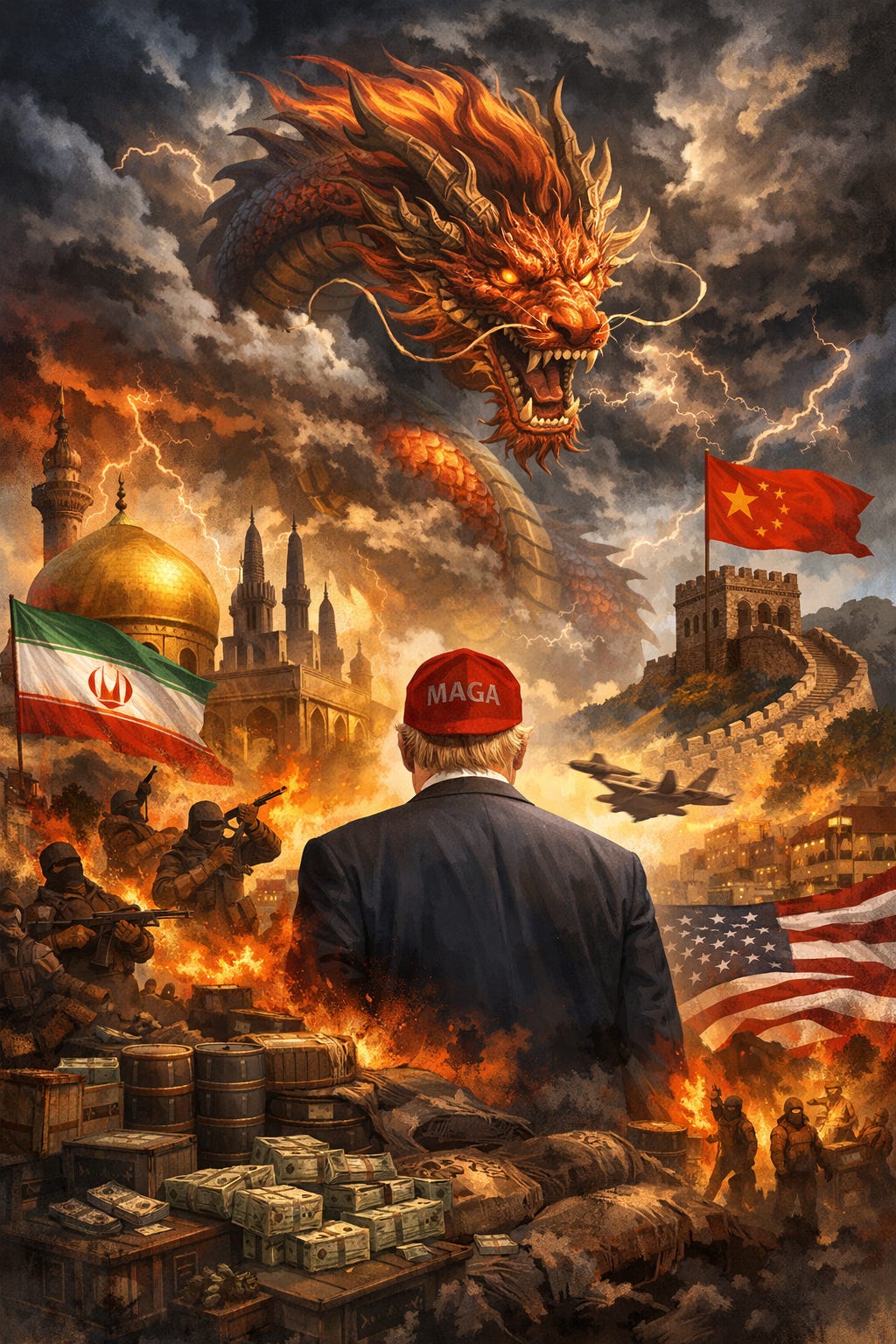
The Dragon and the Ayatollah
Why This Was Always the Inevitable Outcome
There are moments in history that feel sudden.
And then there are moments that, when they arrive, feel like they were already written.
The death of Ali Khamenei falls into the second category.
If you understood the archetype that was elected, this outcome was not shocking.
It was structural.
When Donald Trump was elected again under a “peace” banner with JD Vance, many assumed peace meant restraint. Diplomacy. De-escalation. Fewer wars.
But peace, in turbulent eras, does not always mean softness.
Sometimes peace is enforced.
Sometimes peace requires a storm.
And in Chinese mythology, storms belong to dragons. 🐉
The Dragon Is Not a Villain
Western culture paints dragons as monsters to be slain.
In the European imagination, the dragon hoards gold, terrorizes villages, and must be killed by a knight to restore moral order. The dragon is the embodiment of greed or chaos.
Chinese civilization does the opposite.
In Chinese history and cosmology, the dragon is not the enemy of order.
It is order’s most dangerous instrument.
The dragon governs rain, floods, wind, rivers, harvest cycles. It lives in water and sky. It does not represent chaos for its own sake.
It represents sovereign force.
In an agrarian civilization dependent on the Yellow River and monsoon cycles, rain was survival. Floods were devastation. The dragon, as controller of water, symbolized the power that could either destroy a people or sustain them.
It was not “good” in a sentimental sense.
It was necessary.
During the Qin dynasty, Qin Shi Huang unified China after centuries of brutal warfare. His rule was severe. Books were burned. Dissent was crushed.
Yet in Chinese historical memory, he is not merely a tyrant.
He is the force that ended fragmentation and created centralized order.
Later, during the collapse of the Han dynasty, Cao Cao rose in a period of chaos. He is remembered in folklore as ruthless, even villainous in romantic retellings.
But in historical analysis, he was a stabilizer in a collapsing state. He imposed discipline where corruption and paralysis hollowed out the court.
Dragon energy again.
Not moral purity.
Controlled force.
The emperor wore the dragon not as decoration, but as declaration. The five-clawed dragon on imperial robes was reserved for the Son of Heaven alone.
It signified command over forces too powerful for ordinary men.
To wear the dragon was to accept responsibility for storms.
The dragon is not polite.
It does not operate within the gentle boundaries of consensus politics. It is invoked when the realm is unstable, when foreign forces press in, when internal rot weakens the spine of the state.
And this is where the internal fracture becomes the most revealing part of the story.
When voices like Tucker Carlson publicly criticize the strike, it is not just disagreement over foreign policy.
It is a philosophical split over what “peace” means.
Carlson represents a strain of populist nationalism rooted in restraint.
Fortress America.
Avoid entanglement.
Protect domestic cohesion first.
His criticism flows from a consistent worldview: America should not become the global enforcer.
But here is the tension.
The same electorate that elevated restraint also elevated force.
Trump’s popularity has never rested on diplomatic nuance. It rests on perceived political courage. A willingness to confront elites. Institutions. Foreign adversaries.
The dragon coalition was always internally unstable.
• One wing wants insulation.
• One wing wants dominance.
• One wing wants peace through withdrawal.
• The other wants peace through deterrent force.
That contradiction did not begin with this strike. It was embedded in the campaign itself.
Peace was the banner.
Strength was the subtext.
Carlson is articulating what many inside the coalition may quietly feel:
If peace was the promise, why fire first?
But to those who interpret peace as the absence of ongoing threat rather than the absence of conflict, the strike is consistent.
This is the dividing line.
Is peace maintained by avoiding storms?
Or by ending the storm’s source?
Chinese mythology would frame this not as a morality play, but as a test of balance.
A dragon that never breathes fire loses credibility.
A dragon that breathes fire too often loses the Mandate.
And that consequence is where mythology stops and history begins.
Political Courage vs Political Convenience
I have written recently about political courage.
Not performative aggression.
Not social media bravado.
Courage that costs something.
Courage that risks popularity.
Courage that fractures coalitions.
Convenience protects position.
Courage protects principle.
Convenience optimizes for the next election cycle.
Courage optimizes for the next generation.
If you apply that framework here, this strike is not politically convenient.
It risks backlash.
It risks escalation.
It risks division even within his own party.
But it aligns with the core attribute that built his political identity:
Decisiveness under pressure.
The electorate sensed instability.
Iran’s regime represented, for decades, a fixed axis of tension. Sanctions. Proxy networks. Nuclear brinkmanship.
If you elect a dragon, you cannot be surprised when it acts like one.
The Black Market Empire Beneath the Sanctions
In previous pieces, I’ve written about sanctioned economies not as isolated states, but as ecosystems.
When a regime is heavily sanctioned for decades, it does not disappear.
It mutates.
Formal markets shrink.
Shadow markets expand.
What emerges is not simply economic survival, but black-market megacenters.
Iran did not just operate under sanctions.
It mastered them.
Oil moved through ghost fleets.
Money moved through layered intermediaries.
Arms moved through proxy networks.
Currency moved through informal value transfer systems.
Sanctions were meant to constrain.
Instead, they created parallel infrastructure.
Parallel infrastructure rarely serves stability.
Sanctioned economies often become incubators for:
• Smuggling networks
• Terror financing pipelines
• Weapons proliferation
• Ideological export through proxy militias
The black market does not operate with parliamentary oversight.
It does not publish audited statements.
It does not respect borders.
It feeds on opacity.
And once it matures, it becomes self-sustaining.
This is where the dragon thesis reenters.
If you view Iran not merely as a state actor but as the central node of a sanctioned shadow economy with global tentacles, then the calculus changes.
Containment becomes management of a metastasizing system.
Diplomacy becomes negotiation with actors who profit from instability.
Political convenience begins to look like slow decay.
Eliminating the architect of that network is not framed, in this worldview, as escalation.
It is framed as disruption.
Not moral purity.
Structural disruption.
And that disruption carries enormous political risk.
Because dismantling black-market megacenters does not poll well.
It invites retaliation.
It triggers market volatility.
It fractures coalitions.
But if the underlying belief is that these shadow systems are harming the global order, then restraint becomes politically convenient but strategically insufficient.
Convenience would have been incremental pressure.
Convenience would have been statements layered onto sanctions.
Courage, in this framing, is sacrificing short-term political expediency to eliminate what is perceived as a central destabilizing node.
The dragon does not negotiate with floodwaters.
It attempts to change the river’s course.
Remove the node and chaos could scatter outward.
Leave the node and the shadow network continues to expand.
This is the tradeoff.
This is why some see inevitability.
Not because he is universally admired.
But because he is willing to act where others calculate endlessly.
That is not a moral endorsement.
It is an archetypal alignment.
And archetypes, once activated, rarely behave politely.
The Mandate Test
Chinese political philosophy holds that rulers govern under the Mandate of Heaven.
But the mandate is never permanent.
It is conditional.
If the dragon restores balance, legitimacy strengthens.
If the dragon overreaches, floods follow, and Heaven withdraws its favor.
Power is not justified by rhetoric.
It is justified by outcome.
Did the strike weaken a black-market megacenter that financed instability across continents?
Or did it fracture the system into something more volatile?
Did deterrence solidify?
Or did escalation multiply?
This is the test.
History does not measure intentions.
It measures consequences.
The dragon was not summoned accidentally.
It was elected.
And once elected, storms are not anomalies.
They are expressions of mandate.
Storms must end.
Rivers must settle.
Balance must return.
If stability follows, the dragon will be remembered as necessary.
If instability spreads, the Mandate shifts.
Power has always worked this way.
Not through applause.
Through results.
The electorate did not choose a monk.
They chose a dragon.
And dragons are judged not by how loudly they roar…
but by whether the world is calmer after the fire.
🐉


