
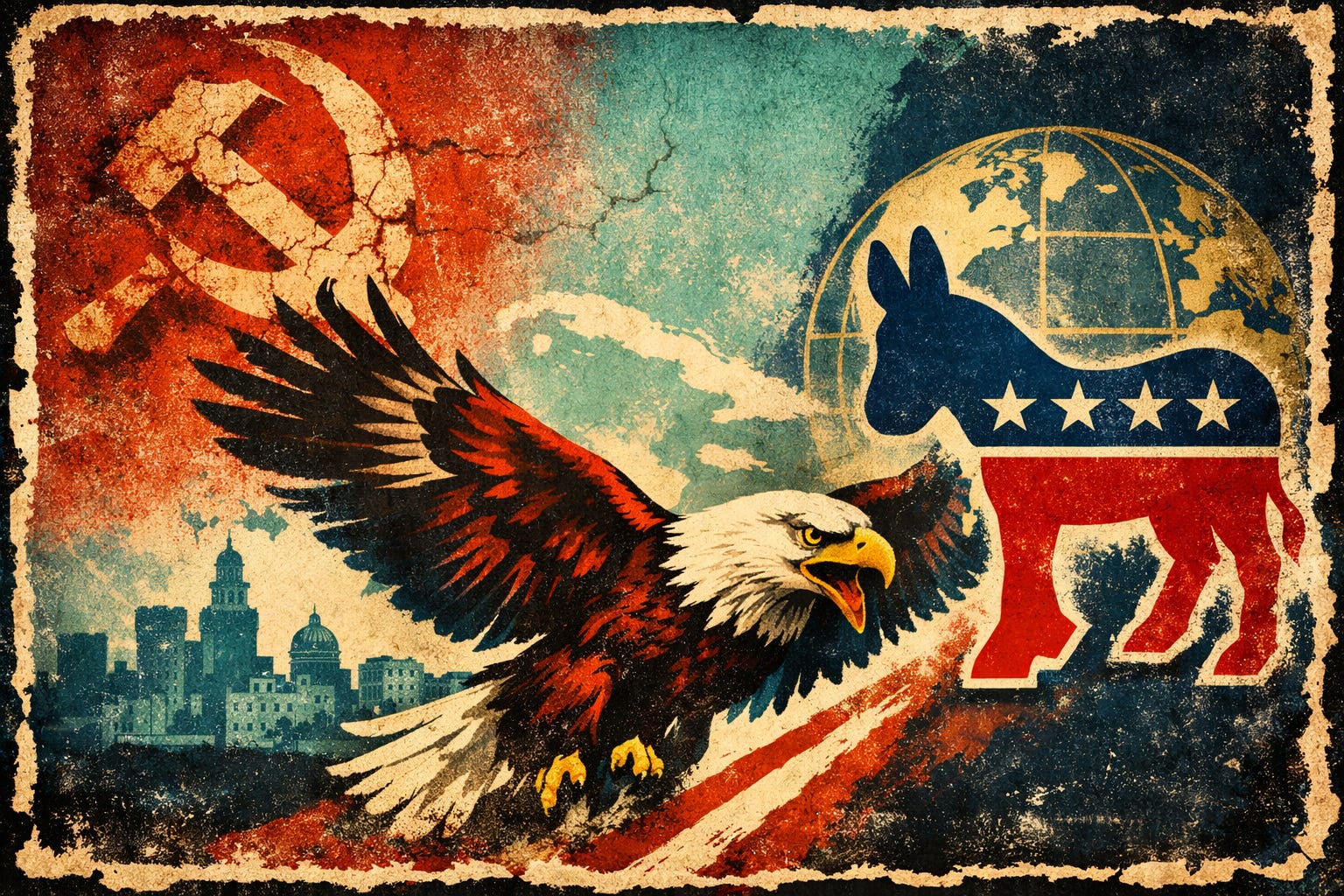
The Democrats Learned to Manage the World — But Forgot How to Fight It
There is a difference between managing a system and defending a nation inside that system.
The Democratic Party of the 1970s was a party of factories, ports, shop floors, and union halls. It was rooted in American labor and domestic production. Its foreign policy instincts were often muscular, but its economic instincts were national. It thought in terms of steel, wages, and bargaining power.
The Democratic Party of the 1990s learned to think differently.
After the Cold War, under Bill Clinton, a new consensus emerged. The Soviet Union had collapsed. The world was unipolar. Capital was mobile. Trade was ascendant. The American system appeared victorious. The question was no longer how to defeat communism. The question was how to manage globalization.
That shift was not conspiratorial. It was strategic.
But it changed everything.
The 1990s Reorientation
Clinton-era Democrats embraced what was then called the “Third Way.” Trade agreements expanded. Financial deregulation accelerated. Russia was pushed through rapid privatization under Boris Yeltsin. Multilateral institutions became central to American statecraft. Sanctions became a normalized foreign policy tool.
The worldview was coherent:
Integrate adversaries into markets.
Build global institutions.
Use capital flows to modernize the world.
Apply sanctions as calibrated pressure.
This was managerial geopolitics.
It required a new coalition inside the party:
International lawyers.
Trade technocrats.
Foundation executives.
Wall Street donors.
NGO diplomats.
The center of gravity moved from the shop floor to the global conference table.
And that mattered.
Shock Therapy and Oligarch Capital
In Russia, privatization was sold as modernization. Instead, it produced oligarch consolidation. State assets were transferred rapidly into private hands. Weak institutions could not regulate the process. Capital fled through offshore channels. Criminal networks fused with political ones.
No one in Washington set out to create oligarchs. But the system they supported accelerated the conditions that allowed oligarch capital to form and then globalize.
That capital did not stay in Moscow.
It moved.
Into London real estate.
Into global commodity markets.
Into aluminum, bauxite, energy, mining.
Into jurisdictions where enforcement was thinner and politics were negotiable.
The 1990s did not just produce Russian oligarchs. It produced mobile, transnational capital comfortable operating in gray zones.
Sanctions and the Caribbean Corridor
At the same time, U.S. policy toward Cuba hardened. The Cuban Democracy Act. Helms-Burton. Sanctions were locked into statute.
Sanctions regimes do one thing reliably:
They create arbitrage.
Scarcity invites smuggling.
Enforcement invites evasion.
Restrictions invite intermediaries.
The Caribbean basin, long a corridor of trade and narcotics routes, became a layered economic chessboard. Fuel moved differently. Remittances rerouted. Shipping networks adjusted. Third-country brokers gained value.
Sanctions are a lever. But they are also a distortion engine.
Now combine:
Mobile oligarch capital seeking resources and influence.
Commodity expansion across South America.
A sanctions-distorted Caribbean trade environment.
Weak anti-money laundering enforcement in the 1990s.
You get an ecosystem.
Not a conspiracy.
An ecosystem.
An ecosystem where state interests, criminal logistics, commodity flows, and political intermediaries coexist in overlapping circles.
Ports matter more than speeches.
Gold and bauxite matter more than press conferences.
And in that environment, hybrid actors thrive.
The Blind Spot
The Democratic Party that emerged from the 1990s was built to manage global systems.
It believed:
Institutions stabilize.
Markets integrate.
Sanctions discipline.
Engagement moderates.
But hybrid economic warfare does not attack institutions directly. It attacks plumbing.
It works through:
Shell companies and nominee directors.
Offshore layering.
Commodity manipulation.
Port access.
Diaspora influence networks.
Lobbying blended with logistics.
Hybrid actors do not announce themselves. They embed.
When a political class is trained in managerial globalism, its instinct is procedural. Technocratic. Multilateral.
Hybrid adversaries are not procedural. They are adaptive.
That is the blind spot.
From Management to Vulnerability
By the 2000s and 2010s, the world changed again.
Putin consolidated power in Russia.
China scaled infrastructure and commodity influence.
Iran mastered sanctions evasion.
Latin America became a contested resource zone.
Meanwhile, the Democratic Party remained culturally anchored in the global governance mindset forged in the 1990s.
The party’s donor base was internationally exposed.
Its staffing pipeline flowed through international institutions.
Its reflex was coordination, not confrontation.
That works in stable systems.
It struggles in hybrid ones.
The Present Political Nightmare
Today’s Democratic instability is not simply about elections. It is about identity.
One wing still believes in system management.
Climate finance. ESG. Multilateral agreements.
Global regulatory frameworks.
Another wing senses something else.
Industrial revival. Anti-oligarch rhetoric. Domestic rebuilding.
The tension is unresolved because the party never fully reconciled its 1990s transformation.
The globalization pivot solved an electoral problem in the post-Reagan era.
But it created a structural vulnerability in the era of hybrid competition.
When voters feel hollowed out, managerial language sounds distant.
When ports are strategic battlefields, process memos are insufficient.
When sanctions create black markets, enforcement must be as adaptive as evasion.
The Democratic Party helped build the architecture of global integration.
It did not fully prepare for the weaponization of that integration.
Political Courage vs. Political Convenience
Here is the deeper question.
Political convenience in the 1990s meant embracing globalization because it appeared inevitable and victorious.
Political courage today would require reassessing whether the tools built for integration are sufficient for defense.
It would require admitting:
Sanctions can distort as much as they deter.
Capital mobility can empower adversaries.
Institutions can be gamed by those who do not share their norms.
It would require moving from management to resilience.
From assumption of good faith to assumption of strategic competition.
The Caribbean as a Mirror
The Caribbean basin is not peripheral. It is diagnostic.
Sanctions regimes.
Commodity flows.
Russian capital.
Chinese infrastructure.
Iranian partnerships.
Port access.
Mining concessions.
If you want to understand hybrid economic warfare, you do not start in Washington. You start at a port.
The Democratic Party helped build a world where capital and sanctions became routine instruments.
The world that followed learned how to weaponize both.
That is not conspiracy.
That is unintended consequence.
And unintended consequence, if not corrected, becomes strategic vulnerability.
The question now is simple:
Can a party built to manage globalization learn to defend against its weaponization?
That is the fault line.
And it runs straight through the 1990s.


