


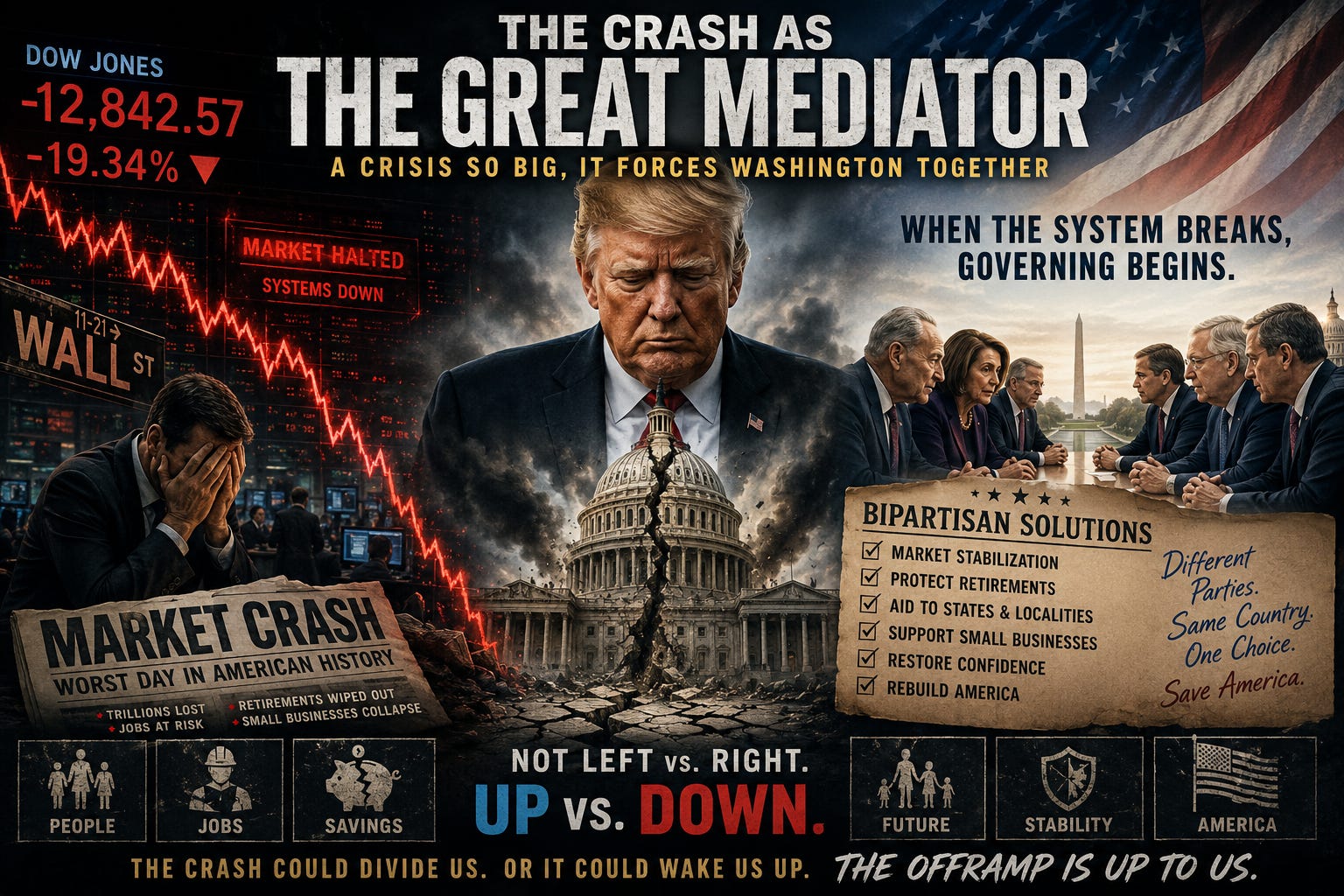
There are moments in American politics when the parties do not come together because they become better.
They come together because reality corners them.
That is the real danger of a stock market crash in the summer of 2026. Not simply that the Dow falls. Not simply that retirement accounts bleed. Not simply that Wall Street begins speaking in its usual coded language of liquidity, contagion, exposure, and systemic risk.
The danger is that a crash large enough to shake the country would not remain an economic event.
It would become a governing event.
It would become a constitutional event.
It would become a spiritual event inside the American political system, because it would force both parties to confront the one thing neither side wants to admit heading into the midterms: neither party is fully prepared to govern through a true national breakdown.
That is why the crash, in this scenario, becomes something stranger than a political disaster.
It becomes the great mediator in Washington, D.C.
Not a mediator with calm hands and a leather folder sitting between two angry sides at a conference table. Not some retired senator brought in to smooth out a budget fight. Not a bipartisan commission designed to produce a report everyone praises and nobody reads.
This would be a mediator made of red numbers, frozen credit, panicked retirees, halted trading, angry voters, collapsing confidence, and governors calling Washington because their state budgets are suddenly built on sand.
The crash would walk into the room like a third party.
Democrats on one side.
Republicans on the other.
And the crash standing between them saying: you can keep performing, or you can keep the country standing.
That is the real story.
A Crash Bigger Than Partisan Blame
The first instinct in Washington would be blame.
That is what the machine knows how to do. It is the native language of modern politics.
Republicans would blame Democratic overspending, regulation, green policy, entitlement math, urban mismanagement, and any Federal Reserve decision they could pin to the opposing side.
Democrats would blame Trump-era economic instability, tariffs, billionaire politics, corporate greed, deregulation, tax cuts, speculation, private equity, crypto, and the long-term decision to build an economy that treats ordinary Americans like passengers on a plane where Wall Street owns the parachutes.
Both sides would have arguments.
Both sides would have evidence.
Both sides would have villains ready for television by noon.
But a market crash of historic size does not obey message discipline.
That is the problem.
A normal downturn can be shaped. A recession can be branded. A bad jobs report can be spun. Gas prices can be blamed on presidents, wars, oil companies, foreign leaders, or environmentalists depending on who needs the talking point.
But a once-in-history stock market crash would move too fast and cut too deeply.
It would not just hit one constituency. It would hit nearly all of them.
It would hit Republican retirees in Florida.
It would hit Democratic public employees in pension systems.
It would hit suburban 401(k) voters who decide elections.
It would hit small business owners who rely on credit.
It would hit young workers who already feel locked out of homeownership.
It would hit tech investors, union households, real estate, state governments, banks, insurance companies, local budgets, and anyone whose future has been quietly stored inside market assumptions they never fully understood.
That is when blame starts to lose value.
Not because people stop being angry.
Because the anger becomes too large to control.
At that point, the political question changes.
It is no longer: who caused this?
It becomes: who can stop the bleeding?
And that is where both parties would begin to face the same brutal reality.
Why the GOP Would Be Hit First
In a 2026 crash scenario, Republicans would likely take the first and hardest political hit because they control the White House in this imagined timeline.
That is not complicated.
The party holding executive power owns the national mood. It owns the emergency podium. It owns the first speech. It owns the face on the screen while the market melts.
If the President is Donald Trump, the political consequences become even sharper because Trump’s brand has always been built around strength, wealth, markets, deals, winning, dominance, and the promise that his instincts can bend reality.
A historic crash would strike directly at that mythology.
It would not simply damage a policy agenda. It would damage the image architecture.
For years, Trump’s supporters have treated him as a kind of political force field against national decline. He is the man who fights. The man who disrupts. The man who makes enemies nervous. The man who says the old system is rigged but insists only he can master it.
But what happens if the system crashes while he is sitting at the center of it?
What happens if the market does not see strength?
What happens if global adversaries celebrate?
What happens if voters who accepted chaos as the price of disruption suddenly realize the bill has arrived?
That would not automatically destroy Trump’s political movement. MAGA has survived events that would have buried older political brands. It has a tribal strength, a media ecosystem, a loyalty structure, and a grievance engine powerful enough to turn setbacks into proof of persecution.
But a crash would create a different kind of stress.
It would not be about one court case, one scandal, one riot, one foreign policy controversy, or one bad week of headlines.
It would be about material loss.
Money gone.
Retirement delayed.
Businesses frozen.
Loans denied.
Homes at risk.
Savings wounded.
That is where political loyalty gets tested in a colder furnace.
The GOP would try to hold the line by blaming the Federal Reserve, Democrats, China, Wall Street, globalists, Iran, Russia, speculators, short sellers, or the administrative state. Some of that might even resonate. But if the crash is large enough, voters would not only want enemies named.
They would want stability restored.
And that is the hardest thing for a party built around disruption to provide in a moment when the country wants the floor to stop moving.
Why Democrats Would Not Escape
Democrats might think a crash under Trump would be their great opening.
At first, it would look that way.
They would say this is what happens when government becomes performance. They would say this is what happens when policy becomes personality. They would say this is what happens when billionaires, tariffs, debt, deregulation, and political chaos are allowed to sit at the controls.
They would have a powerful case.
But they would also face their own trap.
Because in a national crash, the public does not only punish the party in power. It evaluates the entire political class.
Democrats would be asked a simple question: what is your plan?
Not your critique.
Not your speech.
Not your fundraising email.
Not your viral clip.
Your plan.
A crash would expose whether Democrats are a governing party or merely an opposition party waiting for Republicans to collapse.
That distinction matters.
For much of the modern era, Democrats have been strongest when they can present themselves as the adults in the room. The party of competence. The party of institutions. The party that can stabilize the country after Republican recklessness.
But that identity only works if voters believe Democrats are still capable of building a coherent national response.
In 2026, that would not be guaranteed.
A party with too many messages, too many factions, too many donor anxieties, too many activist demands, and too little narrative discipline could find itself standing in the wreckage with a dozen competing rescue plans.
Progressives would demand a crackdown on Wall Street.
Moderates would demand market confidence.
Labor would want job protections.
Younger voters would want debt relief and housing support.
State and local officials would want direct federal aid.
Retirees would want retirement accounts protected.
Governors would want emergency flexibility.
Foreign policy hawks would want to prevent global rivals from exploiting the crisis.
That is a lot of sticks in the fire.
The Democratic danger would be fragmentation.
They could win the blame argument and still lose the confidence argument.
That is the difference between opposition and leadership.
A crash would not ask Democrats whether Trump failed.
It would ask whether they are ready to govern the morning after.
The Crash Would Break the Normal Midterm Frame
Normally, midterms are about punishment.
The party in power gets judged. The opposition gains energy. Voters send a message. Political analysts sort the country into familiar categories: turnout, suburban swing, base intensity, inflation, crime, immigration, candidate quality, presidential approval.
A historic crash would scramble that entire system.
The midterms would no longer be a normal referendum.
They would become a national stress test.
Every race would be filtered through one question: who can help rebuild?
That would create strange politics.
Some incumbents who looked safe could suddenly look useless.
Some outsiders who looked too unconventional could suddenly look necessary.
Some ideological warriors could find their audiences shrinking because voters may enjoy combat during normal times but demand competence when the ship is taking on water.
At the same time, some populists could surge if they successfully frame the crash as proof that the entire system is corrupt.
That is why the crash would not automatically help either party.
It would help candidates who can speak both languages at once: anger and repair.
Voters would want someone who can name the betrayal without sounding unstable, and someone who can promise order without sounding captured by the same people who broke the system.
That is rare political territory.
It is where the country starts looking for builders.
Not performers.
Not influencers.
Not committee-room ghosts.
Builders.
The Forced Bipartisan Moment
This is where the crash becomes the great mediator.
Washington is more polarized than it has been in generations. The parties increasingly operate as separate countries with separate media systems, separate moral vocabularies, separate enemies, and separate memories.
Under normal conditions, there is little incentive to cooperate.
Cooperation looks like betrayal.
Compromise looks like weakness.
A bipartisan bill can be treated as an ideological crime scene.
But a true crash would change the incentive structure.
If banks start freezing credit, if major employers begin emergency layoffs, if pension funds start screaming, if state governments warn of budget collapse, if markets no longer believe the federal government can act, then both parties would be forced into the same room.
Not because they trust each other.
Because failure would be too visible.
The crash would create a new political math:
No party wants to own the collapse alone.
No president wants to stand alone at the podium.
No congressional leader wants history to say they played games while the economy burned.
No governor wants to explain that help never came because Washington chose ideological theater over survival.
That is when bipartisan solutions become possible.
Not beautiful.
Not pure.
Not inspiring in the civics textbook sense.
Necessary.
The first package would likely be ugly. Emergency liquidity. Bank guarantees. Market stabilization. Retirement protections. Aid to states. Maybe temporary restrictions on certain forms of speculation. Maybe hearings into leverage and market concentration. Maybe relief for small businesses and households. Maybe a fight over whether the rescue is aimed at Wall Street, Main Street, or both.
Nobody would like all of it.
That would be the point.
A real rescue package would make both sides angry because both sides would have to give something up.
Republicans would have to accept that markets cannot always self-correct without destroying innocent people.
Democrats would have to accept that stabilizing the system may require saving institutions they despise.
Populists would scream bailout.
Technocrats would scream systemic risk.
Activists would scream betrayal.
Donors would scream into private phones.
But in a crash large enough to threaten national stability, the responsible members of both parties would have to admit the obvious: when the house is on fire, you do not begin by arguing over the wallpaper.
You get people out.
You stop the flames.
Then you investigate who bought the gasoline.
The Return of Governing Gravity
American politics has been floating for years in a strange anti-gravity chamber.
People can say almost anything.
Politicians can perform outrage without delivering results.
Influencers can make a living turning every event into proof of their existing worldview.
Entire campaigns can be built around vibes, resentment, identity, and algorithmic combat.
But a crash would bring back gravity.
Hard gravity.
The kind that pulls language back to Earth.
Suddenly, slogans would sound thin. Memes would not restore pension funds. Viral clips would not reopen credit markets. Cable hits would not calm banks. Hashtags would not keep small businesses alive.
That is why a crash would be politically clarifying.
It would reveal who in Washington actually understands systems.
Who understands finance.
Who understands state budgets.
Who understands emergency powers.
Who understands the Federal Reserve.
Who understands supply chains.
Who understands insurance, pensions, municipal bonds, housing markets, and the invisible wiring that keeps the country lit.
It would also reveal who only knows how to perform.
That may be the most frightening part for the political class.
A crisis of that size would strip away costume.
The loudest people may not look strongest.
The angriest people may not look most useful.
The most ideological people may not look most prepared.
The crash would become a national x-ray.
And Washington would hate what the image shows.
The Moral Meaning of a Market Crash
The stock market is often treated like a scoreboard.
If it is up, presidents brag.
If it is down, opponents attack.
But the market is more than a scoreboard. It is a confidence machine. It is a belief system wearing a financial costume.
It tells people that the future has value.
It tells retirees that time was not wasted.
It tells workers that their sacrifices might compound.
It tells businesses that tomorrow can be financed.
It tells governments that promises made today can be supported by growth tomorrow.
When that belief system crashes, politics becomes raw.
People begin asking deeper questions.
Who was protected?
Who was exposed?
Who knew?
Who profited?
Who lied?
Who gets rescued?
Who gets sacrificed?
That is where the crash becomes more than economic damage. It becomes a moral interrogation.
A country can survive losing wealth.
It has done that before.
What is harder to survive is the belief that the losses were arranged, tolerated, hidden, or dumped onto ordinary people while the powerful escaped through side doors.
That is why any bipartisan response would have to be more than a bailout.
It would need to become a public covenant.
A national statement that the rescue will not simply protect the architecture of wealth while leaving citizens buried beneath the rubble.
If Washington gets that wrong, the crash would not mediate anything.
It would radicalize everything.
The Offramp
This is why the 2026 crash scenario matters as a political thought experiment.
Not because we should root for disaster.
Not because collapse is entertaining.
Not because dark predictions make good headlines.
It matters because it forces the question Washington avoids during normal times:
What would it take for the parties to govern together again?
Maybe it would take fear.
Maybe it would take markets falling so hard that ideology cannot catch them.
Maybe it would take both parties realizing that their own survival depends on stabilizing the country before the country decides neither of them deserves to survive.
That is the strange possibility inside the nightmare.
A crash could become the great mediator.
A brutal one.
A merciless one.
A mediator with no patience for talking points.
It would not ask Democrats and Republicans to like each other. It would not ask them to become friends. It would not ask them to erase their differences or pretend their visions for America are the same.
It would ask them to choose.
Perform collapse.
Or prevent it.
And for the first time in generations, Washington might discover that bipartisanship does not return through goodwill.
It returns when reality grabs both parties by the collar and drags them to the same table.
That is the warning.
That is the opportunity.
That is the Offramp.
The crash would not care who wins the argument.
It would only care who is willing to rebuild.