


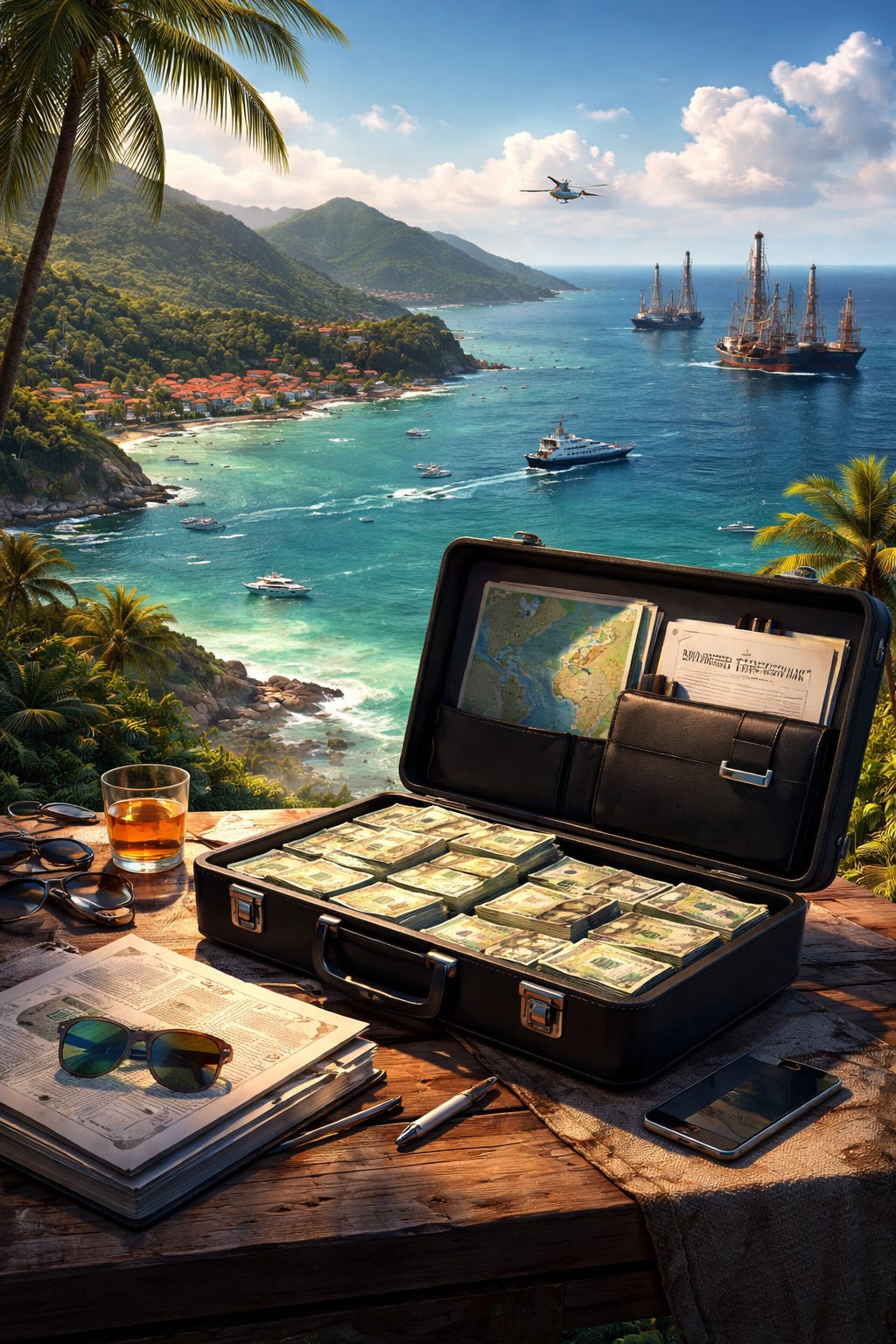
There is a quiet transformation happening in the Caribbean basin.
Most people haven’t noticed it yet.
But if you step back from the daily news cycle and look at the map, something remarkable is unfolding.
Guyana has become one of the fastest growing oil producers on Earth. Venezuela, after years of sanctions and isolation, is slowly re-entering global energy markets. The region’s political balance is shifting. Cuba’s economic model is collapsing while new energy corridors are emerging just a few hundred miles off the South American coast.
Suddenly, a region long defined by tourism and shipping lanes is becoming something else entirely.
An energy frontier.
And with frontiers come fortune seekers.
Energy companies. Logistics firms. political consultants. lobbyists. infrastructure developers. security contractors. private investors. Everyone sees the same thing: opportunity.
Which raises a question almost nobody is asking.
Who is watching the Americans?
Not the governments of the Caribbean.
The Americans.
Because history tells us that when new resource frontiers open, the first wave of problems rarely comes from the host country.
It comes from the people rushing in.
We’ve Seen This Movie Before
The United States actually confronted this exact problem once before.
In the 1970s, Congress discovered that American corporations were quietly bribing officials all over the world.
The scandal exploded after investigations led by Senator Frank Church uncovered secret corporate slush funds used to influence foreign governments.
Companies like Lockheed, Northrop, Gulf Oil, and others had been paying off officials across Europe, Asia, and Latin America.
The sums were staggering for the time.
Congress realized something troubling.
American companies operating overseas had become geopolitical actors, but there was almost no oversight of their behavior once they left U.S. soil.
The result was one of the most consequential anti-corruption laws ever passed.
The Foreign Corrupt Practices Act of 1977.
The law made it illegal for American companies to bribe foreign officials anywhere in the world.
And it created enforcement authority inside the Department of Justice and the Securities and Exchange Commission.
It was a powerful step.
But it solved only one part of the problem.
Bribery.
It didn’t address the broader issue of American influence networks forming around major economic opportunities abroad.
The Caribbean’s New Energy Moment
Now look again at the Caribbean basin.
Guyana’s oil discoveries have already reshaped the economic future of that country.
Production continues to grow rapidly. International companies are moving quickly to secure logistics contracts, energy infrastructure deals, and fuel supply arrangements.
At the same time, Venezuela still sits on the largest proven oil reserves in the world.
If Venezuelan production begins to stabilize and expand again, the Caribbean could become one of the most strategically important energy corridors in the Western Hemisphere.
Which means billions of dollars in contracts.
Which means a rush of political and business intermediaries.
Which means influence networks.
This isn’t speculation. We are already seeing early examples of the tensions that can emerge when American actors compete aggressively for position in emerging markets.
The lawsuits, the lobbying fights, the behind-the-scenes maneuvering.
Anyone who has studied resource booms knows the pattern.
The first phase is excitement.
The second phase is competition.
The third phase is controversy.
A Gap in the System
Here is the problem.
The United States has oversight mechanisms for corruption.
The Foreign Corrupt Practices Act can punish bribery.
Financial regulators can track money laundering.
But there is no system that monitors the broader political and economic conduct of Americans operating in rapidly developing regions.
There is no early warning system.
No oversight entity focused on protecting the integrity of American engagement in strategic economic frontiers.
Which leaves the United States reacting to scandals after they explode rather than preventing them before they start.
A Different Kind of Oversight
What might a better system look like?
Not an authority overseeing Caribbean governments.
That would violate sovereignty and immediately trigger diplomatic backlash.
Instead, something much simpler.
An oversight mechanism focused solely on Americans.
A congressional office or inspector-style body tasked with monitoring American corporate and political activity in strategic regions experiencing rapid economic transformation.
Its mandate would be straightforward:
Track conflicts of interest.
Monitor influence networks forming around major contracts.
Provide early warnings to Congress when American actors begin to destabilize emerging economic systems abroad.
In other words:
Watch the Americans.
Not to block investment.
But to ensure the United States does not accidentally undermine the very economic development it claims to support.
Why This Matters Now
The Caribbean basin may be entering one of the most important economic transitions in its modern history.
Energy wealth is arriving quickly. Political systems will be tested. Foreign investors from around the world will compete for position.
In moments like this, the behavior of outside actors can shape the future of entire regions.
Sometimes for the better.
Sometimes for the worse.
The United States has spent two centuries declaring strategic doctrines about the Western Hemisphere.
The Monroe Doctrine warned outside powers to stay out.
But today the more relevant question may be closer to home.
Who is watching the Americans rushing in?
Because if the Caribbean is about to become the next great energy frontier, the integrity of that frontier may depend as much on the behavior of foreign participants as on the governments hosting them.
And history suggests that when the money starts flowing, oversight rarely arrives too early.
It usually arrives too late.