
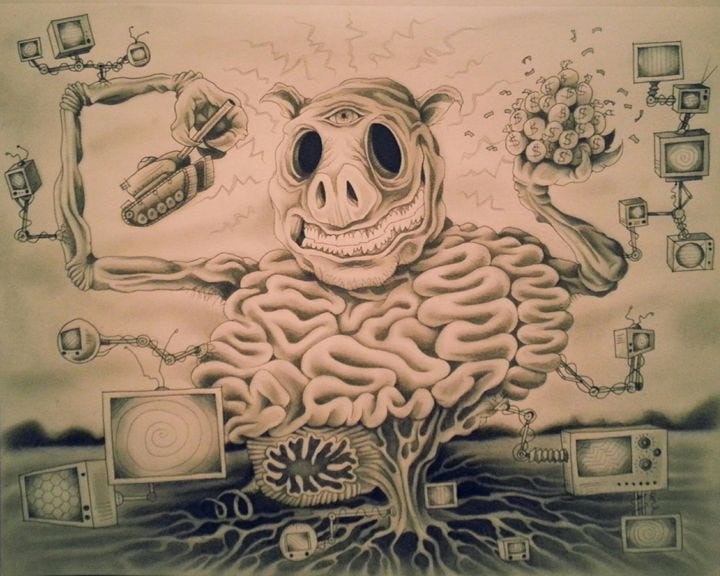
The Anti-War Paradox
How Restraining the Military-Industrial Complex Built a Global Black Market—and Rewired Politics Itself
The Military-Industrial Complex is usually described as a visible machine.
Factories. Defense budgets. Contractors. Lobbyists. Congressional hearings. White papers. All above ground. All legible. All theoretically accountable.
That framing has always been incomplete.
Because wherever industrialized war exists, a secondary system forms beneath it. A black-market network that does not oppose the formal structure, but aligns underneath it. It supplies what cannot be supplied openly. Moves what cannot move legally. Absorbs pressure when the official system is constrained.
This shadow system is not a conspiracy.
It is an outcome.
And here is the uncomfortable truth most discussions avoid: the political pressure applied against the Military-Industrial Complex did not eliminate that underlayer. It strengthened it.
The Success of the Anti-War Movement—and Its Blind Spot
The modern anti-war movement was, by many measures, successful.
Public tolerance for open-ended wars declined. Defense spending became politically sensitive. Overt escalation carried electoral costs. The language of restraint, international law, and humanitarian concern became dominant.
War, at least in its most visible form, became harder to sell.
But power systems do not vanish when constrained. They adapt.
Instead of reducing conflict, pressure displaced it into forms that were:
less visible,
more deniable,
more fragmented,
and far harder to regulate.
The intention was to stop war.
The effect was to change how war is supplied.
Sanctions: The Moral Alternative That Changed Everything
Sanctions regimes emerged as the preferred policy tool of the anti-war consensus.
They were framed as humane. Non-violent. Responsible. A way to punish states without bombing cities.
But sanctions do not eliminate demand.
They eliminate legal supply.
States still need energy. Elites still need revenue. Militaries still need parts. Populations still need goods. When lawful pathways are closed, informal ones open.
Sanctions don’t pause markets.
They redirect them.
Over time, this redirection does something profound: it trains a parallel global economy to operate beyond law, transparency, and institutional control.
By the time sanctions become normalized as statecraft, the black-market infrastructure is no longer temporary. It is permanent.
Black Market Mechanics: How Sanctions Actually Build Shadow Power
This is the part most commentary skips, because it requires abandoning moral abstractions and looking at mechanics.
Sanctions consistently produce the same structural effects:
First, they criminalize ordinary transactions.
Goods that once moved legally now require intermediaries. Every restriction creates a toll booth for brokers who can bypass it.
Second, they reward opacity over scale.
Large, transparent firms retreat. Smaller, agile operators thrive. Networks replace institutions.
Third, they externalize enforcement costs.
Governments declare rules, but markets enforce outcomes. Risk is absorbed by smugglers, shell companies, offshore banks, and proxy states.
Fourth, they normalize deniability.
Once sanctions dominate, everyone understands that outcomes matter more than attribution. This is the oxygen black markets need.
Over time, these mechanics do something dangerous:
they concentrate power not in states, but in intermediary ecosystems.
Those ecosystems:
span borders,
move capital invisibly,
blend licit and illicit activity,
and outlast political cycles.
By the time sanctions are deeply embedded, the black market is no longer parasitic. It is structural.
The Shadow System Comes of Age
This is the missing chapter in most anti-war narratives.
By constraining overt military action while relying heavily on sanctions, the international system unintentionally cultivated a global shadow economy.
Arms brokers learned to outrun regulators.
Shipping networks learned to hide cargo in plain sight.
Financial intermediaries mastered jurisdictional arbitrage.
Proxy forces learned to serve multiple patrons simultaneously.
This wasn’t chaos. It was adaptation.
So when pressure later turned toward the Military-Industrial Complex itself, the terrain had already shifted.
The visible system contracted.
The invisible system expanded.
And crucially, the shadow system became politically relevant.
A New Operating Environment for Politicians
This is where figures like Bob Menendez stop looking like personal aberrations and start looking like environmental artifacts.
Menendez did not operate inside a traditional political environment.
He operated at the interface between:
sanctioned economies,
foreign intermediaries,
black-market logistics,
and deniable state interests.
That is not old-fashioned corruption.
That is hybrid governance.
When sanctions dominate foreign policy and overt military action becomes politically toxic, power doesn’t disappear. It migrates into gray zones where:
legality is flexible,
enforcement is selective,
and access matters more than ideology.
Politicians who step into that environment are no longer maneuvering within clean constitutional lanes. They are navigating a system that rewards brokerage, not statesmanship.
Menendez wasn’t a glitch.
He was a signal.
When the Black Market Challenges the State Above Ground
Here is the paradox now confronting the system:
The anti-war movement was so successful that it helped create a global black-market network powerful enough to challenge the above-ground order itself.
That shadow economy now:
undermines state authority,
corrodes democratic accountability,
and pulls political behavior away from institutions and toward intermediaries.
The irony is severe.
Efforts to restrain war strengthened the mechanisms that make conflict more opaque, more persistent, and harder to resolve.
This does not make the anti-war movement wrong.
It makes the policy toolkit incomplete.
Why Sanctions Now Fuel Political Corrosion
Sanctions don’t just distort markets. They reshape politics.
When access to leverage flows through informal networks, politicians adapt. They begin to:
cultivate brokers instead of alliances,
trade favors instead of policy,
operate through personal channels rather than public ones.
This isn’t ideological rot.
It’s environmental pressure.
Change the operating conditions, and behavior follows.
The longer sanctions dominate statecraft, the more the black market becomes the real arena of power. And the more the formal political system becomes ceremonial.
The Thought No One Wants to Touch
Here is the part that makes everyone uncomfortable.
If sanctions expand black markets,
and black markets erode political legitimacy,
then pulling back on sanctions is not appeasement.
It is containment.
Reducing sanctions:
compresses illicit markets,
weakens intermediary power,
and forces influence back into more legible channels.
Not clean channels.
Not moral channels.
But less adversarial ones.
This is not a call for surrender.
It’s a recognition of where power actually flows.
Rethinking What “Anti-War” Means Now
If war has become decentralized, privatized, and deniable, opposing only the visible military apparatus misses the point.
The real question is no longer:
How do we stop war?
It is:
Where did war move when we made it unpopular?
Ignoring that question doesn’t make the system safer.
It makes it darker.
A System That Outgrew Its Moral Frame
The Military-Industrial Complex is no longer the sole problem.
The global shadow economy that formed beneath it now rivals it in reach and influence. And that shadow economy was not built by warmongers alone. It was shaped by well-intentioned efforts to limit violence without understanding how systems mutate under pressure.
This is not an indictment.
It’s a warning.
When policy tools feel morally clean, they are often structurally dangerous.
And when black markets become the default operating layer, politicians stop behaving like representatives and start behaving like brokers.
If we want fewer Menendezes, we need to stop pretending we’re still operating in a world where pressure only moves in one direction.


