


There’s a moment in American history that doesn’t announce itself.
No parade. No speech that echoes across generations. No cinematic confrontation between rival visions of the country.
Just a quiet decision. A procedural adjustment. A law passed in the rhythm of governance that felt technical at the time.
And yet, it reshaped how power flows through the United States more than most constitutional debates we still argue about today.
That moment sits in 1929.
To understand what happened, you have to go back to the beginning, before the system hardened into what we now accept as normal.
The United States Constitution did something very specific when it designed the House of Representatives. It tied political representation directly to population, but with a ceiling on distance. One representative for every 30,000 people, at minimum.
That wasn’t just arithmetic. It was philosophy.
The House was meant to feel like a living extension of the population. Small districts. Dense representation. A chamber that grew as the country grew, like a living organism adding new cells rather than stretching old ones thinner.
And for a time, that’s exactly what happened.
Through the early republic and into the years surrounding the American Civil War, the House expanded regularly. New states came in, populations surged, and Congress responded by adding seats.
Representation stayed close to the ground.
A representative wasn’t an abstract figure. They were a presence. Someone whose district was small enough that accountability had texture. It wasn’t perfect, but it was proximate.
Power hadn’t yet drifted into abstraction.
Then the country accelerated.
Industrialization, urbanization, immigration. The population didn’t just grow, it multiplied in waves. Congress kept expanding the House, but each expansion became more contested than the last.
More members meant more voices. More voices meant more friction.
By the early 20th century, the system began to strain under its own growth. Not philosophically, but administratively. The chamber was getting crowded. The mechanics of governing a larger body became the concern.
So in 1911, Congress passed the Apportionment Act of 1911, setting the House at 435 members after the next census.
At the time, it was framed as temporary. A pause. A way to stabilize things.
But pauses have a way of becoming permanent when they solve a short-term problem.
The real shift came after the 1920 Census.
For the first time in American history, the country had become more urban than rural. That shift threatened the existing balance of power in Congress. Rural states faced the prospect of losing influence to rapidly growing cities.
Congress deadlocked.
They couldn’t agree on how to reapportion seats. So they did something far more consequential than choosing one formula over another.
They chose not to choose.
For nearly a decade, the House was not reapportioned at all.
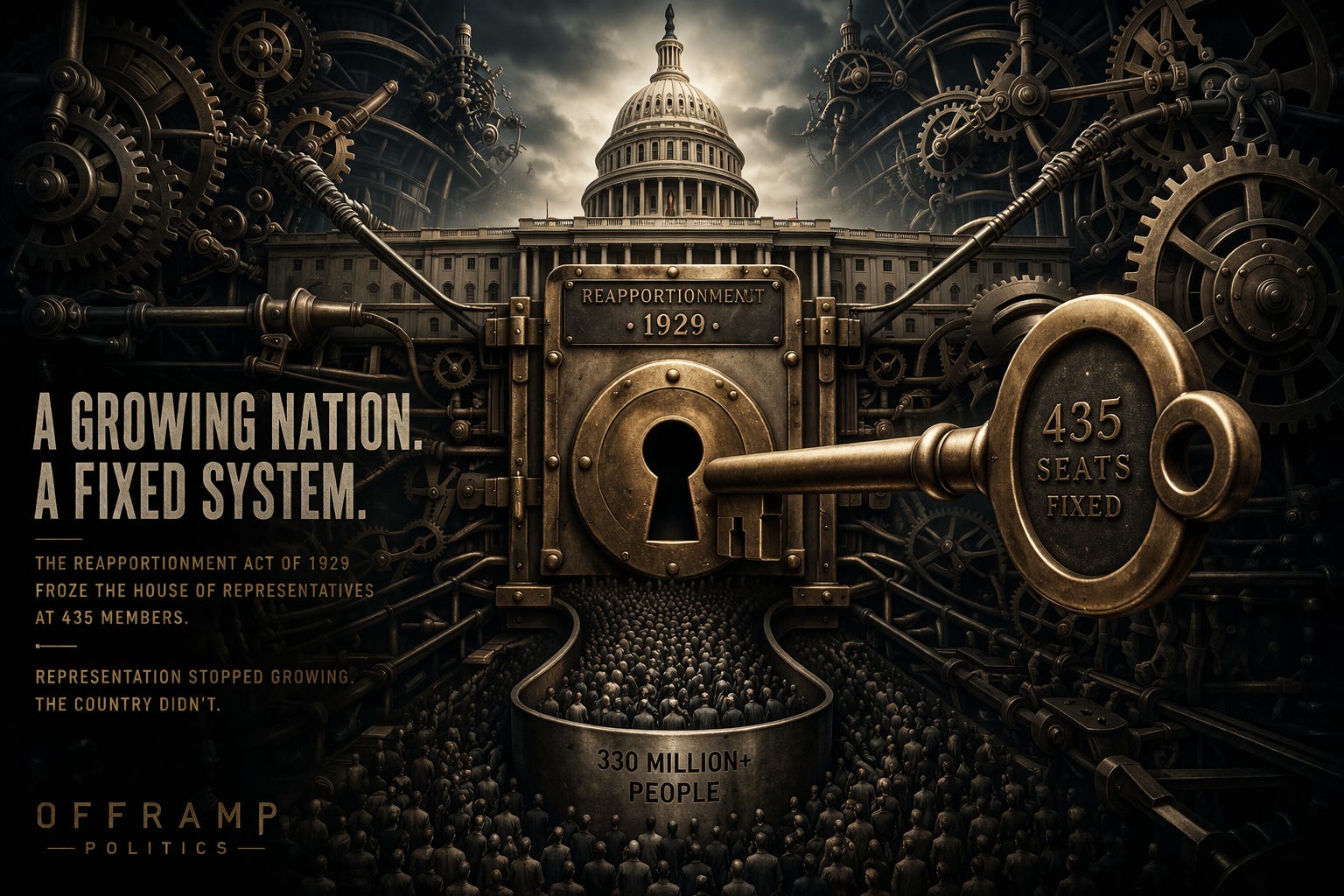
Then, in 1929, Congress passed the Reapportionment Act.
On its surface, it looked like a technical fix. It created an automatic system for reallocating seats after each census. It removed the need for Congress to vote on reapportionment every decade.
But embedded inside that system was a decision that quietly rewired the structure of representation.
The House would remain fixed at 435 members.
Not temporarily.
Indefinitely.
That’s the moment the map stopped growing.
From that point forward, population increases would no longer lead to more representatives. They would only lead to larger districts.
Representation didn’t expand with the people.
It stretched.
At the time, this solved a political problem. It avoided future deadlocks. It stabilized the size of the chamber. It made governance more manageable.
But it introduced something new into the system.
Scarcity.
Today, the United States has a population of over 330 million people.
The House still has 435 members.
Each representative now speaks for roughly 760,000 people.
The ratio that once hovered around tens of thousands has moved into the hundreds of thousands.
The system didn’t announce this shift as a philosophical change.
But that’s exactly what it became.
When representation is dense, political power is distributed across many small units.
When representation is scarce, power compresses.
Every district becomes more valuable. Every seat carries more weight. Every election becomes a higher-stakes contest.
The structure changes the behavior.
This is where the modern conversation about voting rights begins to take on a different shape.
In states like Florida, Virginia, and beyond, battles over district lines, voter access, turnout mechanisms, and election procedures have become defining features of the political landscape.
These fights are often framed as ideological conflicts.
But beneath that layer, there is a structural reality that rarely gets discussed.
When each district represents hundreds of thousands of people, small changes in who votes and how districts are drawn can shift significant amounts of national power.
The stakes are magnified by design.
Imagine a different structure.
One representative for every 100,000 people.
The House would expand to roughly 3,300 members.
The chamber would be larger. More complex. Less streamlined.
But the map would change in a way that’s difficult to ignore.
Districts would shrink.
Representation would become more localized again.
And the impact of any single district would diminish relative to the whole.
This doesn’t eliminate voting rights issues.
Access still matters. Fairness still matters. The integrity of the process still matters.
But the leverage changes.
Distortions don’t disappear.
They get diluted.
Right now, flipping a single district can shift a meaningful portion of power in Congress.
In a larger House, flipping one district becomes one small movement in a much broader field.
The system becomes less sensitive to localized manipulation.
Less brittle.
What we are witnessing today is not just a series of isolated fights over voting rules.
It is the natural outcome of a system where representation has been compressed into a fixed number of seats while the population has expanded beyond what that structure was originally designed to hold.
The pressure has to go somewhere.
It shows up in court battles.
It shows up in legislative fights.
It shows up in the intensity surrounding every election cycle.
In 1929, Congress didn’t set out to redefine American democracy.
It set out to solve a problem of governance.
But in fixing the size of the House, it introduced a new dynamic that continues to shape the political environment nearly a century later.
A system built to grow with the people was quietly turned into one that stretches to accommodate them.
The question now isn’t whether voting rights matter.
They do.
The question is why they matter this much.
Why every rule feels existential.
Why every district feels like a battlefield.
Why every election cycle carries the weight of something larger than the candidates themselves.
If representation were expanded, if the House once again grew alongside the population, the nature of these conflicts would change.
Not because the people changed.
But because the structure did.
We often look at the surface of politics and see conflict.
But beneath that surface, there are design choices.
Sometimes the most consequential ones are the ones that feel the least dramatic at the time.
1929 didn’t feel like a turning point.
It reads like a footnote.
But the system we live in still carries its signature.
And the question that lingers is simple.
Are we arguing over voting rules…
Or are we living inside a structure that makes those rules matter more than they were ever meant to?