
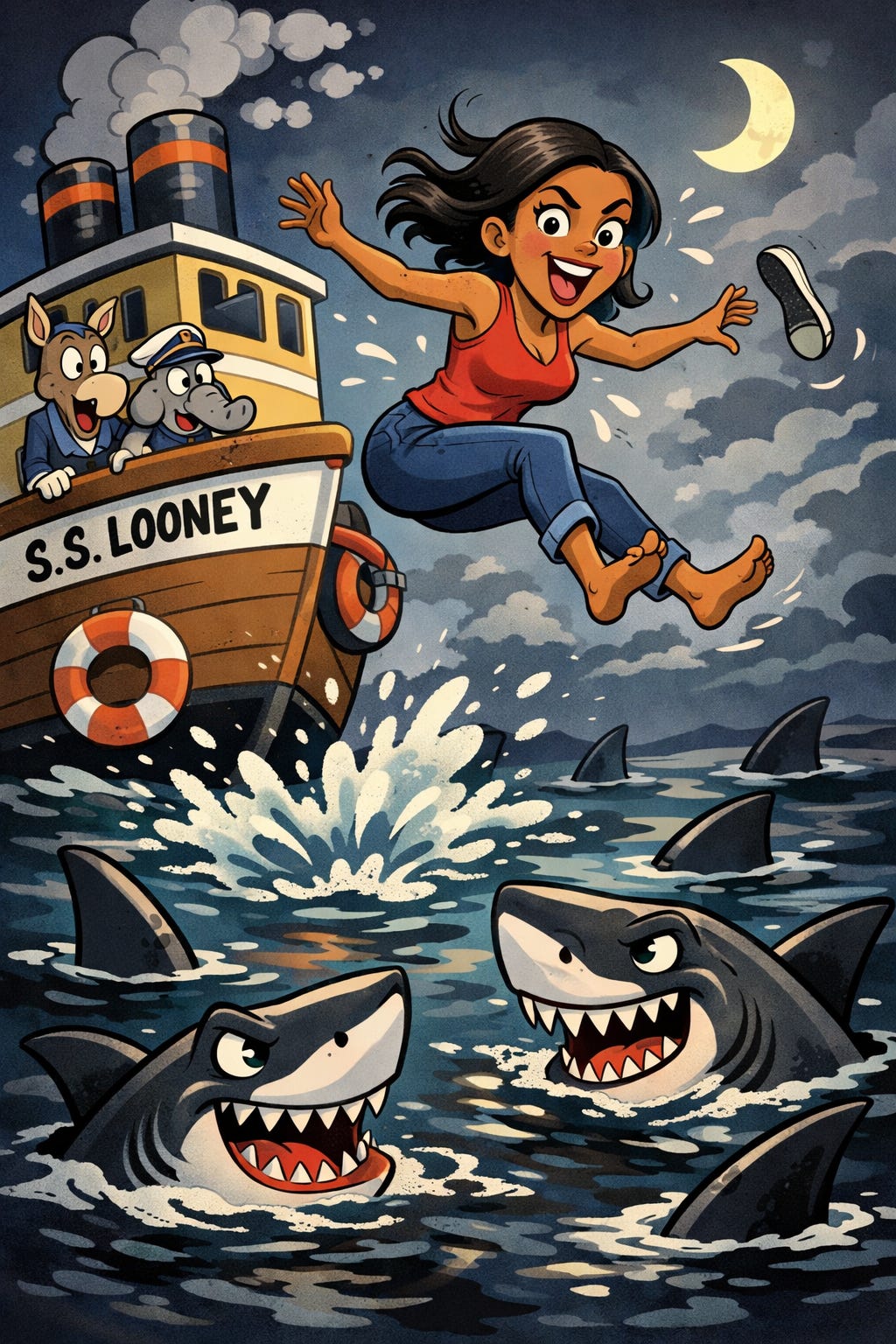
Shark-Infested Waters: Notes From a Region That Doesn’t Blink
I’ve lived in the Caribbean world my entire life. Not the vacation version. Not the Instagram version. The operational version. The one that runs through Miami, Cuba, Colombia, Panama, Guyana, Trinidad, and Venezuela like an underground current. You don’t always see it, but you feel it the moment you stop pretending you’re in control.
I grew up in Liberty City during the Mariel boatlift, poor, the oldest of eight, watching people arrive by sea carrying more history than luggage. I graduated from Miami Central Senior High School. When people ask whether Scarface was exaggerated, I tell them the truth most people don’t want to hear: Scarface played like a documentary to those of us who knew the neighborhood rhythms, the ambitions, the shortcuts, and the inevitable costs.
That upbringing matters. Not as a badge, but as calibration.
Later in life, I worked in the elite sectors of retail as management at Bloomingdale’s, training under one of the Middle East’s largest Persian rug makers. That world teaches you something school never does: power isn’t loud. It’s patient. It notices everything. It remembers who rushes and who waits. Each knot in the rug matters, even the ones no customer will ever see.
Layer that with years of investigative research in Washington, authorship, and deep movement across Caribbean capitals and ports, and you start to recognize the pattern. The same forces wear different clothes in different places, but the posture never really changes.
Which brings me to the phrase that unsettles people.
When I call the Caribbean the land of dictators and drug lords, I’m not being provocative. I’m being literal. This region has always been where empires test ideas before exporting them elsewhere. Sugar, oil, gold, cocaine, lithium, migration routes, money laundering, intelligence pipelines. Each era swaps the commodity but keeps the structure. The Caribbean is where extraction learns efficiency.
And there’s a reason for that.
This isn’t just geography. It’s spiritual terrain.
Water here is not passive. It remembers. It carries. It trades stories the way ports trade cargo. Every ship that crossed these waters brought more than people and goods. It brought gods, ghosts, languages, rituals, bargains, betrayals. Christianity didn’t erase African cosmology. Indigenous memory didn’t disappear. Colonial guilt didn’t evaporate. Everything stacked. Everything stayed.
Down here, myth isn’t fantasy.
It’s memory wearing a mask.
That’s why dictators in this region almost always believe they’re chosen. That’s why drug lords speak in the language of destiny. And that’s why so many of them fall the same way. The Caribbean does not reward arrogance for long. It tolerates it briefly, then collects.
We are now in a part of the timeline where the rest of the world is finally forced to look south and realize this isn’t the periphery. This is the hinge. Energy routes, shipping lanes, elections, coups, spiritual movements, private armies, corporate arbitration. All of it runs through this basin like veins.
And this is where people unfamiliar with the water start to slip.
The news of the day has been revealing, not because it’s shocking, but because it acts like a tide gauge. You don’t need charts. You just watch who loses their footing.
Take Candace Owens. Over the past few years, she’s increasingly positioned herself against the actions and direction of Donald Trump, often loudly, emotionally, and with a tone that suggests surprise rather than understanding. The posture isn’t analytical. It’s aggrieved. As if power betrayed her by behaving like power.
That reaction makes sense if politics is theater to you.
It makes less sense if you understand systems.
My coverage of Trump has never depended on affection or outrage. It’s been measured, document-driven, and frankly unexciting to people who crave spectacle. I’ve treated Trump the same way I treat Caribbean strongmen, intelligence agencies, and corporate actors operating in the region: as forces that must be observed as they are, not as supporters wish them to be.
Down here, you don’t fall in love with the hurricane.
You track it.
This is the difference between shouting at the storm and reading the tide.
Candace’s shock reads like someone discovering salt in the ocean. That tells you she entered the water believing it would adjust to her expectations. The Caribbean never does that. Ignorance isn’t punished loudly here. It’s priced quietly.
And it’s not just political ignorance. It’s spiritual naïveté.
People laugh when Tucker Carlson talks about feeling under spiritual attack after engaging deeply with this hemisphere. They shouldn’t. Not because demons are hiding behind palm trees, but because entering a charged space without preparation has consequences. You don’t need to believe in spirits for spirits to believe in you.
In Caribbean traditions, there’s a difference between those who call forces and those who are called by them. The first group tends to end badly. The second survives by knowing when to speak, when to withdraw, and when silence is the smartest move in the room.
Politics follows the same logic.
This region doesn’t respond well to culture warriors. Volume doesn’t translate to authority here. Certainty isn’t armor. Saltwater eats through that quickly. What survives is discernment.
The elders don’t ask, “Do you support him?”
They ask, “Does he bring balance or chaos?”
Then they prepare.
That’s why my coverage has remained steady while others wobble. I’m not shocked by what’s happening now. I’ve been describing the water for years. Dictators behave like dictators. Strongmen consolidate. Institutions protect themselves. None of this is new if you’ve been paying attention to the region rather than projecting onto it.
This isn’t a warning meant to scare. It’s a field guide.
Come here if you want truth stripped of theater. Come here if you want to see how empires behave when no one is clapping. Come here if you’re willing to listen more than you speak.
But tread lightly.
Don’t cannonball into a sea that has swallowed fleets.
Don’t mistake calm waters for shallow ones.
And don’t confuse confidence with competence.
The Caribbean doesn’t announce when it’s testing you. It just watches how you move. And the water, as always, remembers who entered it unprepared.
For real, for real.


Very well said. Thanks for the insight and keep on tracking these storms!