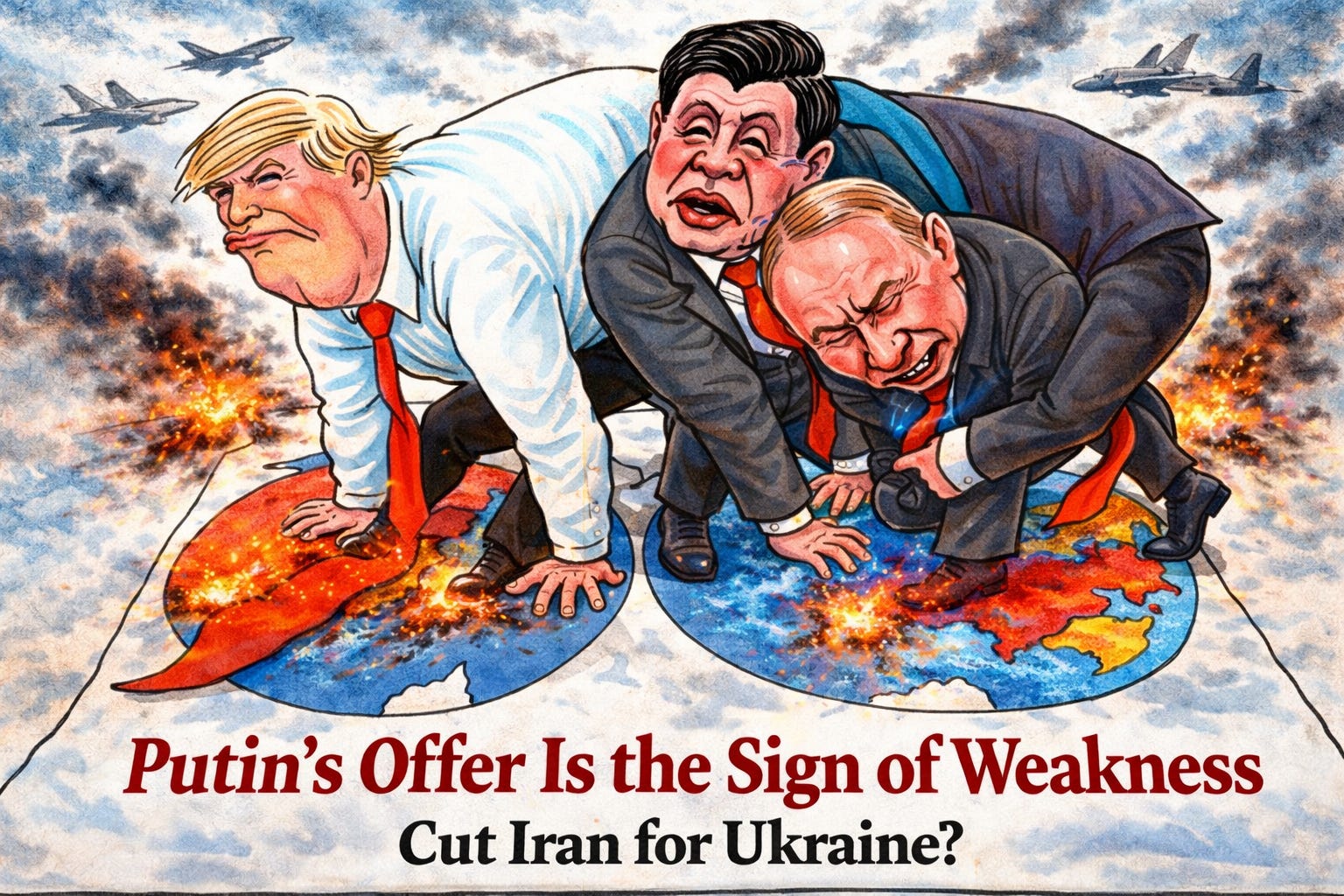
Putin Blinked. Now What?
The Offer to Cut Off Iran Is a Sign of Weakness
There are moments when the world doesn’t change loudly.
It tilts.
A sentence appears where it shouldn’t.
Two things get connected that were never meant to touch.
And suddenly… you’re not looking at events anymore.
You’re looking at alignment.
Putin offers to step back from Iran…
if the United States steps back from Ukraine.
Just like that.
A quiet trade across two separate worlds.
And it lands with that strange feeling…
like hearing a note slightly off-key in a song you know too well.
A Line That Wasn’t There Before
Ukraine is one story.
Iran is another.
Different maps. Different stakes. Different rhythms.
So why draw a line between them now?
Why fold them together?
It doesn’t feel like strategy in the traditional sense.
It feels like something underneath is pressing upward… forcing connections that weren’t necessary before.
What If This Isn’t the End… But the Opening?
Because there’s another way to look at this.
Not as a closing move.
But as the first sign of something about to accelerate.
If Russia is offering trades…
then maybe the pressure point isn’t where we’ve been looking.
Maybe it’s where the response goes next.
The Push That Could Follow
What happens if the United States doesn’t take the offer?
Not just rejects it…
But leans in the opposite direction.
A renewed push into Ukraine.
Sharper. Faster. More coordinated.
Not containment—but momentum.
Not holding the line…
but testing how far it can move.
The Ripple That Doesn’t Stay in Europe
Because pressure like that doesn’t stay contained.
It travels.
And somewhere else on the map… someone is watching.
The Window
If the United States deepens its position in Ukraine…
really commits to it in a visible, undeniable way…
Then for the first time in a long time, something opens.
A window.
Brief. Narrow. Risky.
But real.
Because while one theater tightens…
another one might loosen.
Taiwan, Waiting in the Background
It’s always been there.
Not loudly.
But consistently.
A question that never quite gets answered—only delayed.
So you start to wonder:
If there were ever a moment to act…
wouldn’t it be when attention is split?
When resources are stretched across continents?
When the system is engaged in more than one place at once?
The Comment That Didn’t Sit Still
And then there was that moment.
Sitting next to Japan’s Prime Minister…
Trump makes a remark about “surprises.”
Most people heard history in it.
Pearl Harbor. A look backward.
But what if it wasn’t backward?
What if it was something else entirely?
Because if there’s one nation that understands surprise—not as metaphor, but as memory—it’s Japan.
And if there’s one nation quietly changing its posture in a region where timing is everything…
It’s also Japan.
A Strange Kind of Symmetry
So now the lines start to form:
Russia signals pressure.
The United States has a chance to increase it.
China sees a window—maybe the best one it’s had.
Japan… doesn’t announce anything. It just exists in the equation.
And suddenly it doesn’t feel like separate events anymore.
It feels like a system tightening.
What Happens If the Move Fails
Because here’s the part no one says out loud.
Windows don’t just create opportunity.
They create risk.
If China moves… and it doesn’t go as planned…
If there is resistance that wasn’t fully accounted for…
If that “surprise” doesn’t belong to the attacker…
Then the entire board shifts in a single moment.
Not gradually.
All at once.
Back to the Offer
And this is where it loops back.
Putin’s offer.
That strange connection between Iran and Ukraine.
It starts to feel less like a solution…
and more like a signal that something larger is already in motion.
That pressure is building in ways that aren’t being spoken directly.
Final Thought
Sometimes weakness doesn’t look like collapse.
Sometimes it looks like reaching.
Connecting things that don’t naturally connect.
Trying to reshape the board before the next move is made.
And sometimes…
the most important moment isn’t the offer itself—
It’s what happens right after it’s ignored.