


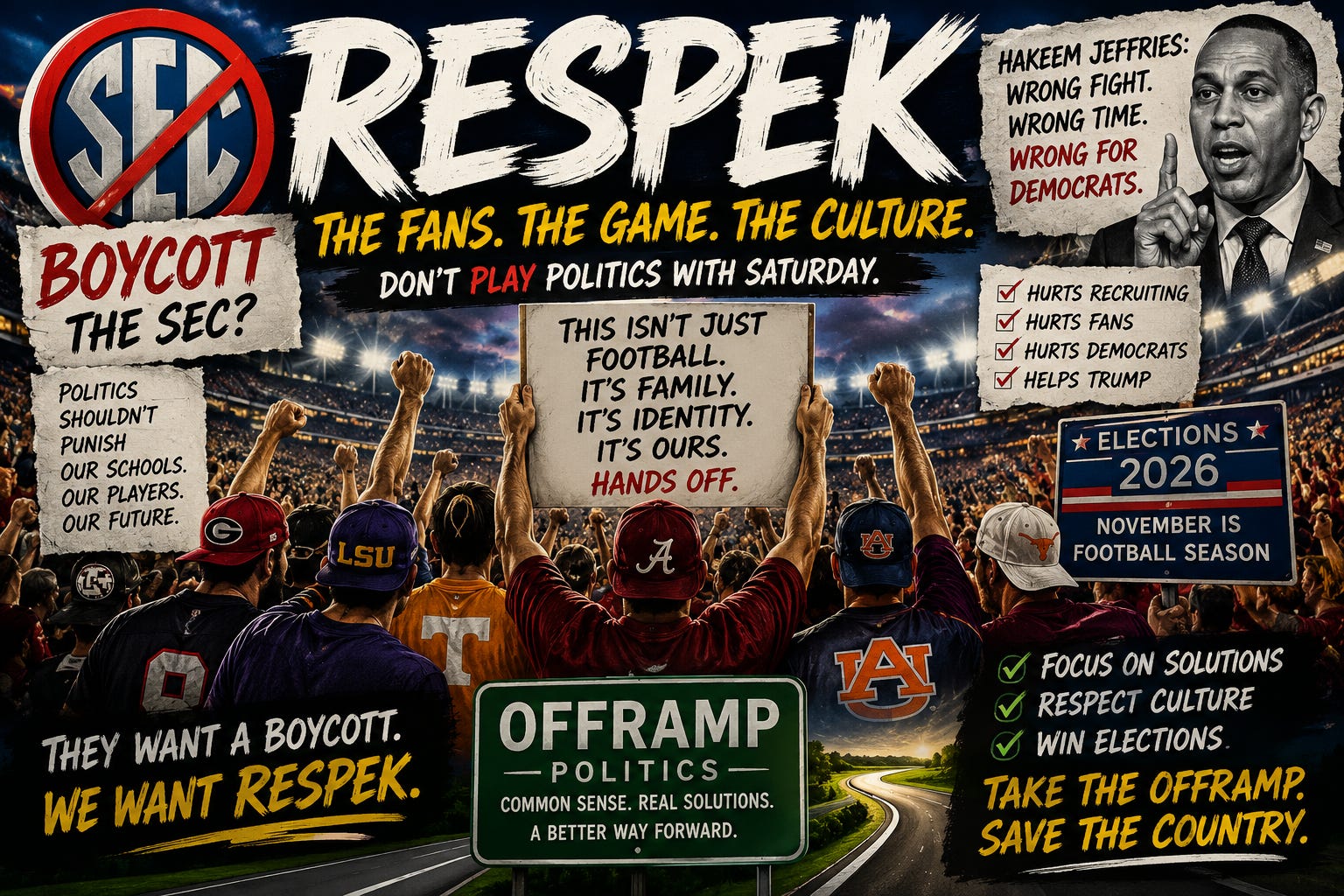
There are certain things in America politicians should approach carefully if they value political survival.
The military.
Churches.
Pickup trucks.
Gas prices.
And SEC football.
Now House Democratic Leader Hakeem Jeffries appears to be drifting directly into the cultural blast radius of college football in the South by involving himself in calls connected to boycotting SEC schools over redistricting fights unfolding after recent Supreme Court rulings tied to Louisiana and Voting Rights Act disputes.
And politically, this may be one of the most self-destructive strategic moves Democrats could make heading into November.
Not because the legal issues surrounding redistricting are unimportant. They are enormously important. Representation matters. District maps matter. Power matters.
But politics is also about understanding emotional ecosystems.
And SEC football is not merely sports.
It is identity.
It is inheritance.
It is economic infrastructure.
It is regional mythology wrapped in shoulder pads and marching bands.
What many Democrats in Washington may not fully understand is that the SEC stopped being “Southern” years ago. The conference became national infrastructure. A traveling cultural republic. An emotional currency system that stretches from Miami to Phoenix, from Las Vegas to Columbus, from Houston suburbs to military bases across the country.
The fan bases of schools like:
Alabama Crimson Tide
Georgia Bulldogs
Texas Longhorns
LSU Tigers
Florida Gators
Tennessee Volunteers
…are spread all over the United States now.
This is what happens when:
millions migrate out of the South,
alumni networks spread nationally,
ESPN builds a 24-hour religion around SEC dominance,
gambling ecosystems explode,
NIL money transforms athletes into quasi-professional stars,
and Saturday football becomes one of the few remaining tribal rituals binding people together.
The SEC became portable America.
And now Democrats are flirting with turning themselves into the enemy of that culture right in the middle of football season.
That is politically dangerous territory.
Because most voters are not constitutional lawyers. They are not studying Voting Rights Act jurisprudence after work while grilling burgers on a Saturday afternoon.
But they absolutely understand:
“They’re attacking our schools.”
And if fans believe this movement hurts recruiting?
That’s when the emotional reactor goes critical.
Because in SEC country, recruiting is not viewed as an administrative process. It is viewed like military readiness. Fans track 17-year-olds with the intensity of intelligence agencies monitoring missile launches. Entire local economies and identities are psychologically attached to whether their team remains nationally dominant.
If people begin to associate Democrats with weakening SEC recruiting pipelines, this could create an enormous backlash far outside the South.
And this is where the political story gets even more interesting.
Because this may not actually be about national Democratic strategy at all.
This increasingly looks like an internal Democratic power struggle.
The Congressional Black Caucus has perhaps the most to lose from aggressive southern redistricting efforts. The very coalition structure that has helped produce influence and leadership opportunities inside the Democratic caucus is under pressure.
And who rose to power through that structure?
Hakeem Jeffries.
So now the question becomes:
Is Jeffries escalating this fight because it helps Democrats nationally?
Or because he needs to preserve the political infrastructure that supports his leadership position inside the caucus?
Those are not necessarily the same thing.
And that distinction matters.
Because if Democrats begin bleeding support among:
working-class sports voters,
culturally moderate independents,
suburban football families,
male swing voters,
Southern transplants living across the Sun Belt,
…all during football season…
…then this could become a devastating self-inflicted wound in November.
Especially because Donald Trump thrives in environments where politics becomes cultural warfare instead of policy discussion.
Trump understands symbolic politics better than almost anyone in modern American history.
He understands grievance.
He understands fandom.
He understands emotional loyalty systems.
And if Democrats allow themselves to become framed as hostile toward SEC football culture, Trump-world media will turn this into a month-long inferno.
You can already see the future headlines forming like storm clouds over a Gulf Coast radar screen:
“Democrats Want to Punish SEC Schools”
“Washington Politicians Coming After Southern Football”
“They Hate Your Team”
Fair or unfair, that is how modern political media ecosystems metabolize issues.
And once that emotional framing sets in, good luck explaining district mapping litigation during halftime of an Alabama-LSU game.
The deeper irony here is that the original argument surrounding these boycotts is itself built around acknowledging the importance of Black athletes to SEC success and financial dominance.
Which is true.
But politically, the move may unintentionally strengthen SEC solidarity instead of weakening it.
Pressure tends to harden tribal identity.
Especially in football culture.
Especially in the South.
Especially during a period where many Americans already feel institutions are trying to shame or politically engineer their cultural spaces.
And that may be the real danger for Democrats here.
Not the legal fight.
Not the boycott itself.
But the feeling among millions of football fans that politicians in Washington are once again trying to interfere with something they love.
That emotional perception may travel far beyond Alabama, Louisiana, Georgia, and Texas.
Because SEC football is no longer regional.
It is national emotional infrastructure.
And if Hakeem Jeffries is tying himself to a movement perceived as threatening it, he may discover something uncomfortable in November:
People who barely vote in midterms will absolutely vote when they feel somebody is coming after their team.