


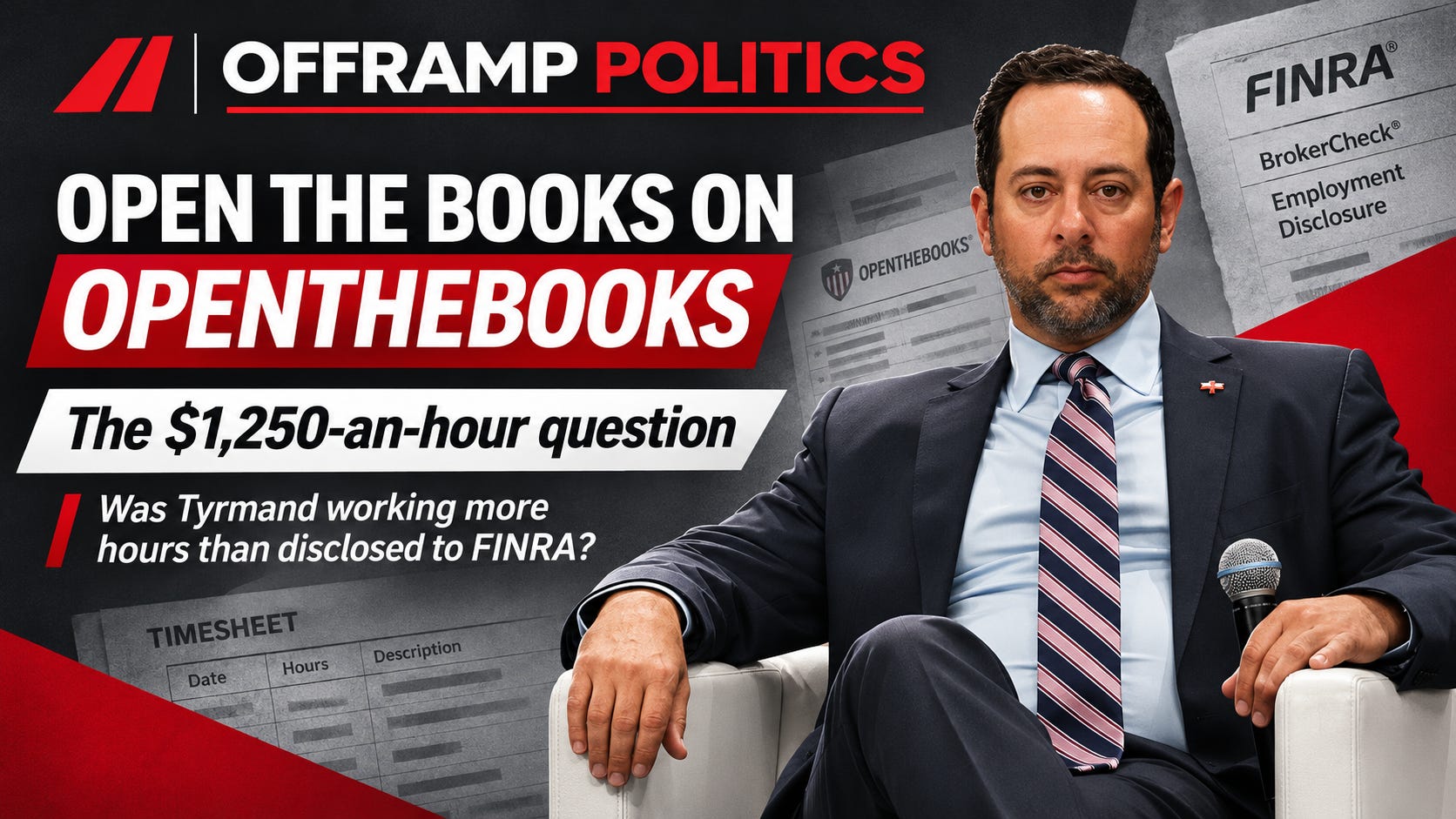
Offramp Politics contacted OpenTheBooks with a series of detailed questions seeking clarification regarding the financial arrangements, consulting payments, and regulatory disclosures examined in this report. As of publication, the organization has not responded to our inquiry.
IRS filings reveal more than $1.2 million in payments to a FINRA-registered broker’s consulting company. The nonprofit called him a deputy director. His current FINRA disclosure says 10 hours per month. Was he working more than reported, or was the charity paying an extraordinary effective rate for his services?
American Transparency, the nonprofit organization behind OpenTheBooks.com, has spent years demanding accountability for how public institutions spend money.
Its mission is straightforward: follow the money, expose questionable expenditures, and give Americans the information necessary to hold powerful institutions accountable.
I support that principle.
In fact, I have spent much of my professional career doing precisely that kind of work.
But transparency is not a principle that can be selectively applied. An organization demanding accountability from others should be prepared to answer the same questions about its own finances and business relationships.
And after examining more than a decade of IRS Form 990 filings, FINRA registration disclosures, and OpenTheBooks’ own annual reports, I have some questions about its financial relationship with Matthew Tyrmand.
Questions that deserve answers.
Not because the public records establish wrongdoing. They do not.
But because the numbers present an unusual financial arrangement, and the organization’s own descriptions of Tyrmand’s responsibilities raise questions that cannot be resolved by its publicly available financial disclosures alone.
Let’s start with the money.
Follow the Money: More Than $1.2 Million
American Transparency’s publicly available IRS Form 990 returns reveal a sustained financial relationship with Matthew Tyrmand LLC, a consulting business identified with Matthew Tyrmand.
The nonprofit reported the following payments in Part VII, Section B, which identifies certain highly compensated independent contractors:
Tax Year
Matthew Tyrmand LLC Payments
2015
$160,000
2016
$150,000
2017
$150,000
2018
$150,000
2019
$150,000
2020
$150,000
2021
$150,000
2022
$150,000
Total
$1,210,000
That’s $1.21 million over eight consecutive years.
The filings generally describe the services as strategy and relations or strategy and relationship management.
The 2016 return copy published by the organization is marked “DO NOT FILE,” so its reported payment should be checked against the return actually accepted by the IRS. The other figures are independently visible in the supplied filings.
For seven of these eight years, the reported payment was exactly $150,000.
That’s $12,500 per month.
Every month.
Year after year.
And these weren’t payments to a publicly traded marketing firm employing hundreds of people. They were reported as payments to Matthew Tyrmand LLC.
The financial relationship becomes particularly interesting when we examine Tyrmand’s disclosures to the Financial Industry Regulatory Authority, better known as FINRA.
The FINRA Disclosure: Ten Hours Per Month
Tyrmand is a FINRA-registered securities representative, CRD #5005228.
According to his publicly available BrokerCheck report, he has been registered with Bradley Woods & Co. Ltd., CRD #13660, since July 14, 2020.
His report identifies several outside business activities.
Among them are Matthew Tyrmand LLC and Leicester Hill Informetrics, both described as non-investment-related business consulting operations.
For Matthew Tyrmand LLC, Tyrmand reports:
10 hours per month devoted to the business.
Five of those hours per month occurring during securities trading hours.
He reports the same monthly time commitment for Leicester Hill Informetrics.
Let’s do some basic arithmetic.
Ten hours per month works out to 120 hours annually.
Now divide the $150,000 that American Transparency repeatedly reported paying Matthew Tyrmand LLC by those 120 hours.
The result?
$1,250 per disclosed annual business hour.
That is not a verified hourly consulting rate. It is gross LLC revenue divided by the owner’s currently disclosed annual time commitment, assuming that time commitment applied throughout a particular contract year.
The distinction matters.
A company can charge a retainer instead of billing by the hour. It can pay subcontractors. Its revenues can cover costs unrelated to the owner’s personal labor.
But the arithmetic raises an obvious question.
Was Tyrmand personally working substantially more than 10 hours a month while performing these services?
Or did American Transparency agree to pay his consulting company an exceptionally high effective rate for a very limited amount of personal work?
There is also a third possibility: the contract purchased services, access, expertise, deliverables, or other value that cannot fairly be reduced to a conventional hourly wage.
That is precisely why the underlying contract matters.
The publicly available documents do not explain which arrangement applied.
FINRA’s current BrokerCheck report also does not establish that Tyrmand reported the same 10-hour monthly figure throughout the years covered by the nonprofit’s tax filings. Historical Form U4 amendments would be necessary to establish that.
Nevertheless, the current disclosure gives us a specific number to examine against the organization’s financial records.
How Does $1,250 Compare with National Nonprofit Compensation?
This is where the comparison becomes revealing.
Rather than simply compare Tyrmand’s consulting revenue to another person’s salary, I examined national nonprofit compensation benchmarks derived from IRS Form 990 filings.
CauseComp’s November 2026 national compensation dataset provides median reported annual compensation across thousands of nonprofits.
Here are several relevant positions, along with their hourly equivalents calculated using a conventional 2,080-hour work year.
Nonprofit Position
National Median Annual Compensation
Hourly Equivalent
President
$90,000
$43.27
CEO / Executive Director
$113,000
$54.33
Director of Marketing
$141,000
$67.79
Director of Communications
$144,000
$69.23
Chief Financial Officer
$172,000
$82.69
Chief Operating Officer
$177,000
$85.10
Chief Strategy Officer
$219,000
$105.29
Source: CauseComp nonprofit compensation data, updated November 2026.
These are national medians, not averages, and they reflect reported compensation from multiple nonprofit sectors and budget sizes. They are not historical consulting-rate surveys.
The figures are nevertheless useful for showing the scale of the discrepancy between ordinary full-time compensation equivalents and an illustrative $1,250-per-hour calculation.
A nonprofit director of marketing has a national median reported compensation equivalent to approximately $68 an hour, assuming a 40-hour workweek.
A chief strategy officer has an equivalent of approximately $105 an hour.
Tyrmand LLC’s calculated revenue per disclosed owner-hour, using the $150,000 annual payment, is about 18 times the marketing director figure and nearly 12 times the chief strategy officer figure.
But here is an important detail.
At $150,000 annually, the company’s total revenue was only about 6% above the national median annual compensation of a nonprofit marketing director.
Therefore, the annual payment alone is not evidence of extraordinary compensation.
The extraordinary-looking figure appears when that payment is combined with the reported 10-hour monthly commitment.
A full-time employee’s salary and a consulting company’s gross revenue are not interchangeable. Nor can compensation benchmarks published in 2026 establish what a comparable consultant should have charged in 2017.
Even with those limitations, the comparison identifies exactly what the organization should explain: what was it purchasing, and how much work was actually being performed?
The CEO Comparison
Now consider American Transparency’s own reported executive compensation.
According to the organization’s 2017 IRS Form 990, founder and then-CEO Adam Andrzejewski reported working approximately 60 hours per week.
His reported compensation was $95,833.
During the same year, Matthew Tyrmand LLC received $150,000.
That means the nonprofit paid Tyrmand’s consulting company approximately 56% more than it reported paying its CEO.
Andrzejewski’s reported compensation works out to approximately $30.72 per hour when divided by a 60-hour workweek over 52 weeks.
Again, the comparison is not between two equivalent categories of earnings. One is an officer’s reported compensation; the other is gross payments to an outside company.
The nonprofit also reported $166,000 in compensation for its COO, Craig Mijares, in 2017, so Tyrmand LLC was not necessarily its highest-compensated source of services.
But the figures still invite a legitimate question.
Why was a consulting arrangement important enough to command $150,000 annually when the organization’s CEO was reporting 60-hour workweeks and receiving less?
Perhaps the consultant provided specialized expertise of extraordinary value.
Perhaps his work produced measurable results that justified the expenditure.
Perhaps the contractual arrangement compensated him for responsibilities extending well beyond what the public might ordinarily understand as marketing.
Any of those explanations could be legitimate.
But the records reviewed do not provide the necessary detail.
And there is another document that makes those questions even more relevant.
The Nonprofit’s Own Annual Reports Describe Tyrmand as a Leader
This may be the most revealing part of the public record.
American Transparency did not merely describe Tyrmand as an outside marketing vendor.
Its own annual reports repeatedly placed him among the organization’s leadership or key personnel.
In its 2015 Annual Report, Tyrmand is identified as Deputy Director.
His name appears with the CEO and chairman in the report’s opening message to supporters.
On page 28, he is profiled in the organization’s key-personnel section. The report explains that he joined Adam Andrzejewski in 2013 to help develop OpenTheBooks into a national transparency organization.
That is a rather substantial description.
The 2019 Annual Report, page 45, identifies him as Deputy Director at Large.
The 2020 Annual Report, page 19, again identifies Tyrmand as Deputy Director at Large and credits him with helping launch OpenTheBooks nationally.
By 2022, page 35, the organization identified him as a Consultant.
This is a meaningful progression.
It demonstrates that OpenTheBooks publicly associated Tyrmand with its development and leadership for a substantial period.
It does not prove that he was a full-time employee, a legal officer, or personally worked more hours than disclosed to FINRA.
But it raises an issue that cannot simply be brushed aside.
What exactly did the Deputy Director at Large do?
Was that a ceremonial title?
Was it an advisory role requiring only occasional consultations?
Or did it involve substantial responsibilities for strategic development, public relations, media outreach, fundraising relationships, organizational planning, or ongoing operations?
And how did those responsibilities relate to the consulting services paid for through Matthew Tyrmand LLC?
A deputy director’s title does not automatically establish full-time work.
But it certainly makes the underlying duties relevant.
There is another detail worth considering.
The nonprofit’s 2020 annual report identifies a separate media associate and graphic designer who was responsible for design and marketing.
Its 2022 report also identifies separate communications and creative-services personnel.
That does not establish duplication of work, because Tyrmand’s contracts were described primarily as strategy and relations, not simply advertising or graphic design.
It does, however, make an itemized description of the consulting arrangement even more useful.
What services were uniquely provided by Tyrmand’s LLC, and what results justified the annual payments?
The Later Payments: Another Company Name Appears
The story does not end in 2022.
American Transparency’s later IRS filings identify payments to businesses bearing the Leicester Hill name.
In its 2024 Form 990, the organization reports paying $112,500 to an independent contractor identified as “Leicester Hill Informic” for strategy and relations.
In its 2025 Form 990, the organization reports paying $180,000 to a contractor whose displayed name begins “Matthew Tyrmand Leicester Hill Informatic L,” described as providing program consulting services.
The contractor names appear abbreviated or truncated on the forms.
Meanwhile, Tyrmand’s FINRA BrokerCheck report lists Leicester Hill Informetrics as an outside consulting activity and Leicester Informatics LLC in his employment history.
Are these different names for the same legal entity?
Are they related businesses operating under different names?
Did American Transparency change consulting vendors, or did the arrangement continue through a different Tyrmand-associated company?
The documents suggest relationships worth checking, but they do not independently establish that all of these names refer to a single legal entity.
The exact identities should be verified using incorporation records, tax identification information, contracts, and invoices.
Nor have I independently verified the corresponding contractor payment amount for 2023, so I have excluded that year from any cumulative calculation.
The confirmed filings from 2015 through 2022 report $1.21 million paid to Matthew Tyrmand LLC. The 2024 and 2025 filings report a further $292,500 to contractors identified by Leicester-related names, including Tyrmand’s name in the 2025 entry.
Those later amounts deserve separate scrutiny rather than being automatically attributed to the original LLC.
The FINRA Connection
There is a reason these business arrangements matter beyond ordinary nonprofit financial oversight.
FINRA requires registered representatives to provide information concerning outside business activities.
Under FINRA Rule 3270, a registered person generally must provide prior written notice to the member firm before engaging in a covered outside business activity.
The member firm has corresponding obligations to evaluate the activity, consider whether it could interfere with the representative’s duties, and document the required review.
Form U4 also requires disclosure of the nature of certain outside business activities and the approximate monthly hours devoted to them.
A person can legitimately have multiple businesses.
A registered representative can legitimately earn significant outside income.
And nothing about a $150,000 annual consulting contract automatically establishes a FINRA violation.
The question is whether the information provided to the brokerage firm and reflected in the registration disclosures accurately described the representative’s activities at the relevant time.
If Tyrmand was actually working substantially more than the hours he reported, that could raise disclosure questions.
If he worked only 10 hours monthly, then the consulting arrangement may have commanded an unusually high effective payment relative to the time involved, although that would not necessarily be improper.
Either possibility warrants a clearer accounting of the work.
Bradley Woods Has Already Been Sanctioned Over Outside Business Activity Supervision
There is another development that makes the regulatory question particularly relevant.
Tyrmand’s brokerage firm, Bradley Woods & Co. Ltd., has previously been disciplined by FINRA over its supervision of outside business activities.
On May 14, 2021, FINRA accepted a Letter of Acceptance, Waiver and Consent involving Bradley Woods and its principal, Daniel S. Ripp.
The enforcement case was numbered 2018056458801.
According to the FINRA disciplinary document, the regulator identified significant deficiencies in the firm’s outside-business supervisory procedures.
FINRA found that Bradley Woods and Ripp failed to document reviews of 14 outside business activities, failed to document eight reviews in a timely manner, and failed to adequately document reasonable reviews of 11 activities.
The firm also failed to timely amend Form U4 filings for five representatives involving eight outside business activities.
Some amendments were delayed by more than a year.
The disciplinary action resulted in a firm censure, $50,000 in combined fines, and a two-month suspension for Ripp from most principal capacities.
Bradley Woods and Ripp accepted the sanctions without admitting or denying FINRA’s findings.
Now, this distinction is important.
The misconduct covered by that case occurred between 2015 and January 2018, before Tyrmand’s current FINRA registration with Bradley Woods became effective in July 2020.
The disciplinary action does not establish that Tyrmand was involved in the earlier violations or that the firm continued the same practices afterward.
The AWC also states that the firm subsequently updated its written supervisory procedures.
Nevertheless, the historical enforcement action establishes that FINRA previously identified shortcomings in precisely the compliance process responsible for evaluating registered representatives’ outside business activities.
That creates a legitimate question about how Bradley Woods subsequently reviewed Tyrmand’s consulting relationships.
Did the firm review the relevant contracts?
Did it know the scope of his responsibilities at American Transparency?
What documentation supported the reported monthly hours?
Were the firm’s supervisory procedures followed?
And if there were material changes to the nature or extent of Tyrmand’s outside business activities, were the necessary disclosures updated?
These questions concern potential compliance issues under FINRA Rules 3270, 3110, 1122, and 2010, as well as applicable Form U4 amendment requirements.
They are questions for examination, not findings of misconduct.
As of the BrokerCheck report reviewed for this investigation, Tyrmand had no disclosed regulatory or other reportable events.
The Transparency Test
Here is what makes this story different.
OpenTheBooks has made transparency its identity.
It publishes government salaries, investigates questionable expenditures, and encourages citizens to examine public institutions.
Its current website states that transparency is fundamental to freedom and emphasizes the importance of following the evidence.
Those are principles worth defending.
But the standard must apply consistently.
A nonprofit that tells the public to question government expenditures should not consider reasonable questions about its own substantial consulting arrangements inappropriate.
The fact that American Transparency publishes its Form 990 filings is a positive act of disclosure.
It is also the reason this investigation was possible.
But a Form 990 tells the public how much money was paid to a contractor. It generally does not reveal the hours worked, detailed contractual terms, or the specific deliverables justifying the payment.
And those missing details are precisely what matter here.
I would like to see clear answers to the following questions:
What specific services did Matthew Tyrmand LLC provide to American Transparency in exchange for the recurring $150,000 annual payments?
How many hours per month did Tyrmand personally devote to those services during the years covered by the contracts?
Did the consultancy use employees, subcontractors, or other providers, and what portion of the payments covered expenses other than Tyrmand’s own work?
What duties were associated with Tyrmand’s titles of Deputy Director and Deputy Director at Large, and were those duties part of the compensated consulting arrangement?
When were the 10-hour monthly outside-business estimates entered on Tyrmand’s Form U4, and were those estimates ever amended?
What is the exact legal relationship among Matthew Tyrmand LLC, Leicester Hill Informetrics, Leicester Informatics LLC, and the Leicester-related contractors named in the nonprofit’s later returns?
What records demonstrate that Bradley Woods conducted the required reviews of Tyrmand’s outside consulting activities?
These questions can be answered through contracts, invoices, corporate records, historical registration filings, and appropriate supervisory documentation.
Not all of those records are necessarily public. Some may need to be reviewed by FINRA or another authorized regulator.
And none of the materials examined establishes that the parties have been asked these particular questions and refused to answer them.
The Choice Is Transparency
I want to be clear about something.
I am not suggesting that nonprofit consultants should be prohibited from earning substantial compensation.
I am not suggesting that organizations are obligated to pay their consultants less than their CEOs.
And I am not claiming that Tyrmand necessarily misrepresented his working hours to FINRA.
The available documents do not prove any of those things.
What they establish is a substantial, sustained financial relationship, a history of publicly described organizational responsibilities, and current regulatory disclosures reporting a relatively limited monthly time commitment.
They also establish that the brokerage firm responsible for reviewing those disclosures has previously been sanctioned for deficiencies involving outside-business supervision.
Those facts justify scrutiny.
And the scrutiny leads to a question that is remarkably simple:
Was Matthew Tyrmand personally working substantially more hours than the figures currently disclosed to FINRA, or was American Transparency paying a premium for a relatively small amount of his time?
Perhaps neither description fully captures the economics of the contract.
Perhaps the organization obtained exceptional strategic value.
Perhaps the services were properly documented and the hours accurately disclosed.
If so, the relevant records should make that explanation straightforward.
A nonprofit dedicated to transparency has an opportunity to demonstrate that its standards extend beyond the institutions it investigates.
Because transparency should not begin and end with someone else’s checkbook.
If the mission is to open the books, then open all the books that can properly be opened.
That includes your own.
Offramp Politics
Primary Documents and Research Sources
FINRA
Matthew Tyrmand BrokerCheck Report, CRD #5005228
Bradley Woods & Co. Ltd. and Daniel Ripp, FINRA AWC No. 2018056458801
FINRA Rule 3270, Outside Business Activities
American Transparency IRS Form 990 Returns
2015 · 2016 · 2017 · 2018 · 2019 · 2020 · 2021 · 2022 · 2023 · 2024 · 2025
OpenTheBooks Annual Reports
National Compensation Data
CauseComp, Nonprofit Salaries by Role, November 2026
Methodology: Payment figures were taken from the nonprofit’s published Form 990 contractor tables. Hourly equivalents are calculations, not reported hourly pay. National compensation data represent employee medians, not contractor fee benchmarks. The current BrokerCheck report does not provide a complete history of amendments to the broker’s outside-business disclosures. No finding of misconduct is made against Tyrmand based on these comparisons.