
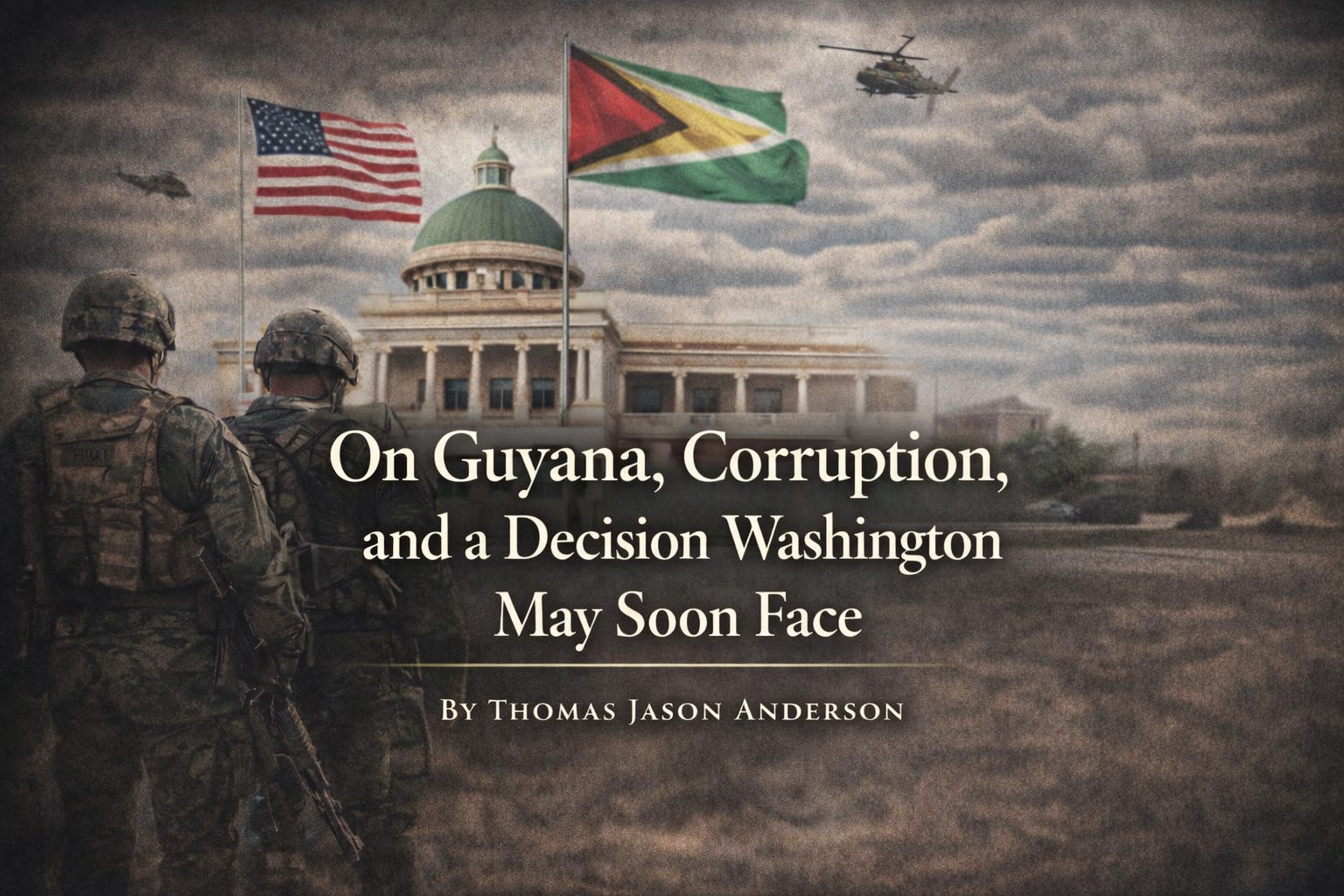
On Guyana, Corruption, and a Decision Washington May Soon Face
There is a category of international problem that almost always arrives disguised as a technical matter.
It does not announce itself as a crisis.
It presents itself as procedure.
A court filing.
An extradition request.
A delayed parliamentary appointment.
A man seeking an office.
These are the kinds of stories that appear small enough to ignore.
And then, months later, policymakers look back and realize that what they were watching was not a legal process at all,
but the early phase of a state-level instability problem.
Guyana may now be in that phase.
Not because of one man.
Because of the intersection of corruption, neglect, regional instability, and timing.
The Assumption That Needs to Be Reexamined
Most discussions of Guyana still begin with an assumption I no longer share.
That Guyana is a functioning democracy temporarily under stress.
I believe Guyana is closer to a failed or failing state, not in the dramatic sense, but in the institutional one.
A state hollowed out by:
Decades of systemic corruption
Chronic neglect by the United States
Weak rule of law
And repeated exploitation by external actors
This did not happen suddenly.
It is the accumulated result of abandonment.
For most of the post–Cold War period, Guyana was:
Too small to matter
Too poor to prioritize
Too peripheral to protect
And in regions like this, neglect is not neutral.
It creates openings.
Not just for domestic corruption.
But for foreign leverage.
The Corruption Environment Washington Rarely Names
Guyana has spent years ranked among the more corruption-prone states in the hemisphere.
That is not a partisan claim.
It is reflected in:
International corruption indices
Donor assessments
U.S. diplomatic reporting
And the country’s own procurement scandals
The People’s Progressive Party, which has governed for much of Guyana’s modern history, has been central to that ecosystem.
Patronage networks.
Politicized institutions.
Weak enforcement.
This is not a stable institutional environment.
It is a fragile system managing sudden strategic wealth.
And that is the most dangerous configuration a state can have.
The Insider Problem That Changes the Frame
Into this environment enters Azruddin Mohamed.
A sanctioned individual.
A potential extradition subject.
And crucially:
A former insider of the ruling party.
This detail matters far more than most public discussions recognize.
Because one of the individuals sanctioned with him in June 2024 was Mae Thomas, a senior PPP official.
That single fact should change how this story is understood.
When insiders fall out with corrupt systems, they do not fall as ordinary defendants.
They fall as repositories of institutional memory.
They know:
How money moved
Who approved what
Which transactions were protected
And where the pressure points are
In corruption politics, the most destabilizing actor is not a reformer.
It is a former insider under legal pressure.
The Timing Problem, Not the Legal Problem
Public debate keeps circling the wrong question.
Does becoming Leader of the Opposition protect someone from extradition?
The answer is no.
That part is legally trivial.
The strategic question is different.
What happens if a sanctioned insider becomes the formal constitutional counterweight to a high-corruption government before he is removed from the system?
Because sequence changes everything.
If damaging corruption disclosures come from a defendant, they are dismissed.
If the same disclosures come from the official Leader of the Opposition, they become:
A national crisis
A diplomatic crisis
And potentially a regional crisis
Same information.
Different platform.
Different consequences.
This is how procedural stories become state-level events.
Not through ideology.
Through timing combined with institutional position.
The Chaos Scenario That Cannot Be Ignored
There is a scenario here that does not require conspiracy to take seriously.
A sanctioned insider becomes Opposition Leader.
He gains formal legitimacy and international visibility.
He releases credible evidence of systemic corruption implicating senior officials.
The government fractures.
Protests follow.
Foreign pressure escalates.
Institutions freeze.
Not because of politics.
Because of disclosure under maximum leverage.
This is how destabilization unfolds in fragile corruption states.
Not through coups.
Through documents.
Why I Do Not See Guyana as a Healthy Democracy Under Stress
Here is where my analysis departs from conventional wisdom.
I do not believe Guyana is a healthy democracy temporarily in trouble.
I believe Guyana is a failed or failing state produced by long-term neglect.
Not by its people.
By abandonment.
By being used as:
A resource corridor
A money corridor
A leverage point
And a strategic afterthought
For decades, the United States did not invest in Guyana’s institutional strength.
Now Guyana sits on:
Major oil reserves
Next to a collapsing Venezuela
Inside a region being actively reshaped
This is not a normal democracy problem.
It is a late-stage neglect problem.
The Regional Reshaping Already Underway
There is another variable rarely discussed openly.
The region is already being reshaped.
The recent agreements to relocate tens of thousands of deported migrants from the United States into parts of the Caribbean and northern South America are not marginal policies.
They are geopolitical interventions.
They are changing:
Demographics
Labor markets
Security burdens
And political stability
Guyana is not insulated from this.
It is inside the restructuring.
And instability in Guyana does not remain local.
It becomes part of a broader regional transformation that the United States is already participating in, whether intentionally or not.
Why Preemption Looks Different in a Failed State
In a healthy democracy, force undermines legitimacy.
In a failed state, legitimacy is already hollow.
What remains is containment and transition management.
The question is no longer:
Will force weaken institutions?
It is:
Which institutions still exist to protect?
If Guyana’s governing system is already structurally corrupt, already penetrated by bad actors, already used as leverage by external powers, then removing a destabilizing insider does not damage a healthy system.
It accelerates an unavoidable restructuring.
Not regime change.
State salvage.
The Strategic Choice Washington Actually Faces
Under this lens, the dilemma looks different.
Waiting for due process does not preserve stability.
It creates a window in which:
Disclosures destabilize the government
External actors exploit the chaos
And a fragile oil-state collapses at the worst possible moment
Removing a destabilizing variable early does not create instability.
It front-loads a transition that is already coming.
It shortens a dangerous phase.
It prevents a corruption crisis from becoming a regional crisis.
It speeds up a reshaping that is already underway.
Final Thought
This is not about punishing one man.
It is about acknowledging a reality the United States rarely names.
Guyana is not a stable democracy temporarily in trouble.
It is a neglected state long taken advantage of,
now sitting on strategic resources,
next to a collapsing neighbor,
inside a region being actively redesigned.
In that world, patience is not neutrality.
It is a decision to allow the most dangerous phase of collapse to unfold publicly.
Removing a destabilizing variable early would not violate a healthy process.
It would simply acknowledge that the process Guyana now needs
is no longer judicial.
It is structural.
And every year the United States delayed taking Guyana seriously
made this moment
not avoidable,
but inevitable.


