


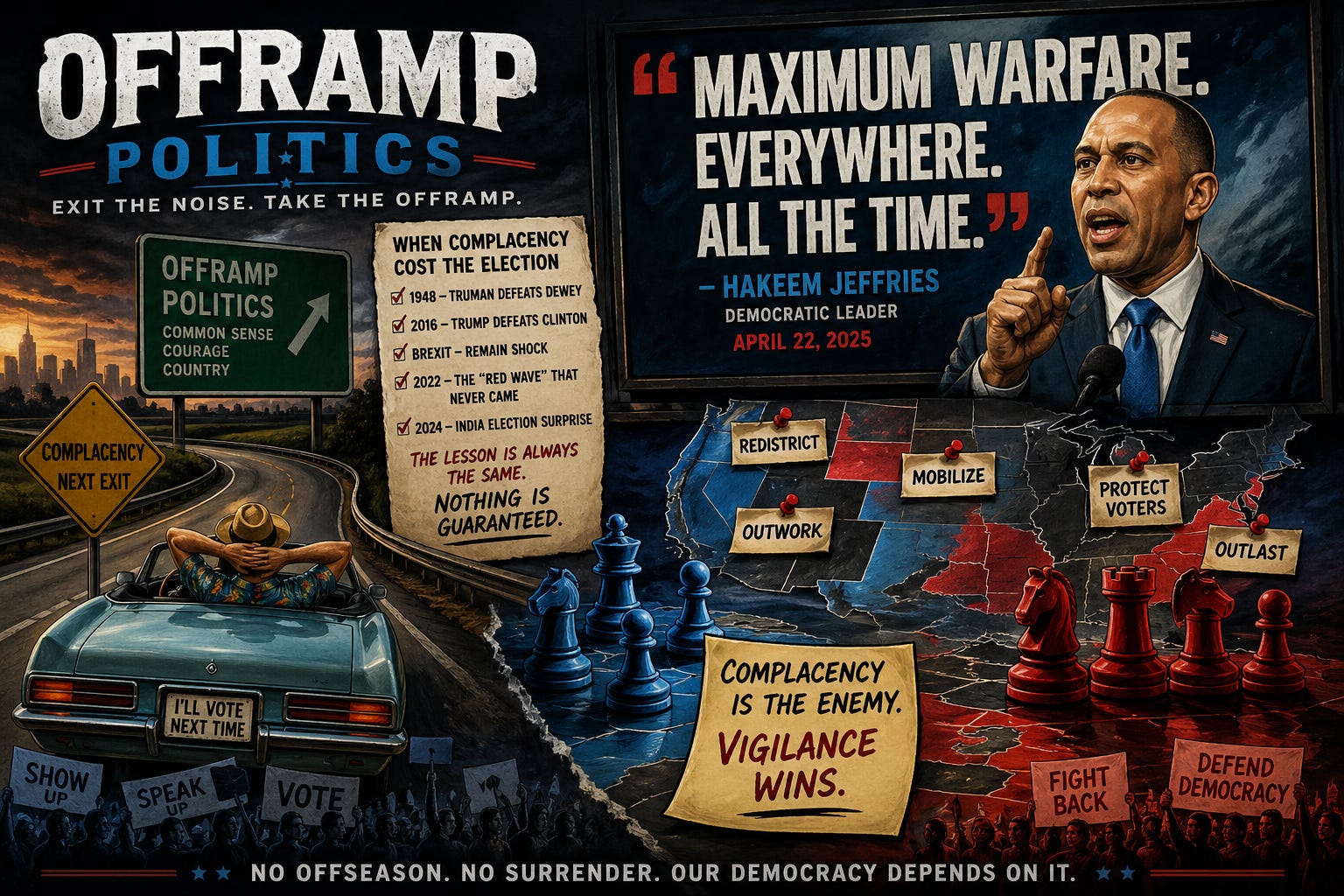
There is an old ghost that haunts American politics.
It walks through campaign headquarters quietly, wearing expensive shoes and carrying favorable polling data under its arm. It sits in donor lounges sipping wine. It appears in television studios when analysts begin speaking in percentages instead of possibilities. It lives inside the phrase:
“Don’t worry. We’ve got this.”
Political complacency has destroyed campaigns, stunned nations, and rewritten history more times than voters probably realize.
In 1948, newspapers practically engraved Thomas Dewey’s name into the presidency before votes were fully counted. Harry Truman was treated like a historical formality. America awoke instead to one of the most famous political photographs ever taken: Truman smiling while holding a newspaper declaring Dewey the victor.
The machine had already emotionally moved on.
Then came 2016.
For months, much of America operated inside a statistical fog machine where Hillary Clinton’s victory was treated less like a contest and more like an approaching weather system. Analysts spoke about “firewalls.” Probability charts became emotional sedatives. Entire sections of the Democratic coalition seemed to psychologically cross the finish line before Election Day arrived.
Donald Trump’s coalition, meanwhile, behaved like political survivalists stocking canned food before a hurricane.
The result shocked the political establishment so violently that it permanently altered how campaigns think about turnout psychology.
The lesson was simple:
A frightened voter is often more reliable than a comfortable voter.
That realization now appears to be hardening into official doctrine inside the modern Democratic Party.
This week, House Democratic Leader Hakeem Jeffries issued a statement that sounded less like a traditional political message and more like a military operations briefing. Referring to the coming battles over redistricting and political control, Jeffries declared Democrats were prepared for:
“Maximum warfare. Everywhere. All the time.”
That sentence matters.
Not because politicians use aggressive language. They always have.
It matters because it signals something deeper happening inside American politics itself.
Jeffries is not merely talking about elections.
He is talking about vigilance.
He is talking about emotional mobilization.
He is talking about preventing the single greatest threat modern political strategists fear:
their own supporters relaxing.
For years, Democrats often approached redistricting through the language of fairness, legal disputes, and institutional process. Republicans, meanwhile, became known for aggressively engineering political maps in states they controlled.
But after the shocks of 2016, the razor-thin House battles of the Trump era, and increasingly nationalized elections, Democrats appear to be evolving into something different.
The Jeffries statement is not the language of a party expecting demographics alone to save it.
It is the language of a party trying to permanently electrify its coalition.
And there is logic behind it.
Modern campaigns increasingly understand that turnout is not simply produced by policy positions. It is produced by atmosphere.
Fear.
Momentum.
Identity.
Conflict.
The emotional temperature of the electorate now matters almost as much as the actual issues themselves.
In many ways, politics has evolved into a form of sustained psychological weather.
Voters are constantly being asked:
Are you under threat?
Is democracy collapsing?
Is your future disappearing?
Is your opposition dangerous?
Because urgency creates motion.
Complacency creates silence.
And silence on Election Day is fatal.
This is why the Jeffries comment should not be viewed as some isolated rhetorical outburst. It appears more like a strategic acknowledgment that Democrats intend to keep their base in a constant state of political readiness moving into the midterms and beyond.
Not sleepy.
Not optimistic.
Not assuming victory.
Ready.
The phrase “maximum warfare” also reveals how dramatically the battlefield itself has changed.
There was once a time when redistricting happened quietly after the census, largely buried inside state legislative procedure. Most Americans barely understood how congressional maps worked.
Today, district maps are treated almost like missile systems.
Both parties now openly discuss redistricting as an existential struggle for national power.
Every district line is viewed as a pressure valve affecting:
fundraising,
media narratives,
committee control,
legislative priorities,
and presidential momentum.
The map itself has become part of the campaign.
And this is where the story becomes especially important for Democrats.
One of the hidden tensions inside the Democratic coalition over the past decade has been balancing demographic optimism with electoral reality.
Many Democrats genuinely believed long-term demographic shifts would naturally secure future victories.
You could hear it constantly after Obama’s victories.
The phrase “demographics are destiny” floated through political conversations like gospel.
But 2016 shattered that illusion.
Demographics are not destiny if turnout collapses.
Demographics are not destiny if enthusiasm evaporates.
Demographics are not destiny if voters assume someone else will carry the burden.
That realization changed both parties.
Republicans became more turnout obsessed.
Democrats became more urgency obsessed.
The result is a political system now running at an almost permanent emergency frequency.
And donors are part of this equation too.
Large political donors do not simply invest in policies. They invest in perceived momentum.
The donor class watches emotional energy carefully.
When donors sense:
confidence,
clarity,
and combativeness,
money flows.
When they sense fatigue, drift, or inevitability, fundraising can soften.
Jeffries’ language appears carefully calibrated for that reality.
“Maximum warfare” tells donors:
The fight is active.
The battlefield is expanding.
The opposition is dangerous.
Resources are urgently needed.
It transforms political engagement from optional participation into defensive mobilization.
And that may be exactly the point.
Because one of the greatest dangers for Democrats entering future cycles is not necessarily Republican strength.
It may be Democratic exhaustion.
After years of nonstop political intensity:
Trump investigations,
impeachments,
COVID,
January 6,
legal battles,
inflation fights,
foreign wars,
and nonstop digital political warfare,
many voters are psychologically exhausted.
A tired electorate becomes unpredictable.
Jeffries seems to understand this.
His statement acts almost like a defibrillator paddle pressed against the chest of a coalition drifting toward fatigue.
Shock the system.
Raise the pulse.
Keep people emotionally engaged.
Because modern political campaigns increasingly believe that once voters emotionally disengage, they rarely return with the same intensity.
This raises a deeper question.
What happens to a democracy when both major parties begin operating under permanent wartime psychology?
Because Republicans are doing versions of this too.
Both parties now speak as if every election represents civilization’s final exam.
Every district becomes sacred territory.
Every map becomes a weapon.
Every election becomes existential.
And perhaps that is the real story hidden inside the Jeffries statement.
Not merely Democratic strategy.
But the transformation of American politics itself.
The old politics of persuasion appears to be fading.
In its place emerges something more intense:
politics as perpetual mobilization.
Politics as emotional maintenance.
Politics as atmospheric management.
The goal is no longer simply to win arguments.
The goal is to prevent your side from emotionally falling asleep.
Because history has shown repeatedly that the moment voters believe victory is guaranteed is often the exact moment danger enters through the side door.
Harry Truman understood that.
Donald Trump’s 2016 campaign understood that.
And judging from Hakeem Jeffries’ latest remarks, Democrats appear determined to make sure their voters never forget it again.