Ignition
Timing, stress, and the illusion of control
Wood can sit in air for years without burning.
Oxygen is all around it.
The chemistry is already favorable.
The fuel is present.
The oxidizer is present.
And still, nothing happens.
Not because combustion is impossible.
Because the system has not yet crossed the activation threshold.
In basic chemistry, this is one of the first lessons. A reaction can be favorable and still never occur. Molecules collide, bounce, separate, and return to equilibrium. Everything required for fire is present, and the wood remains unchanged.
Until one small thing happens.
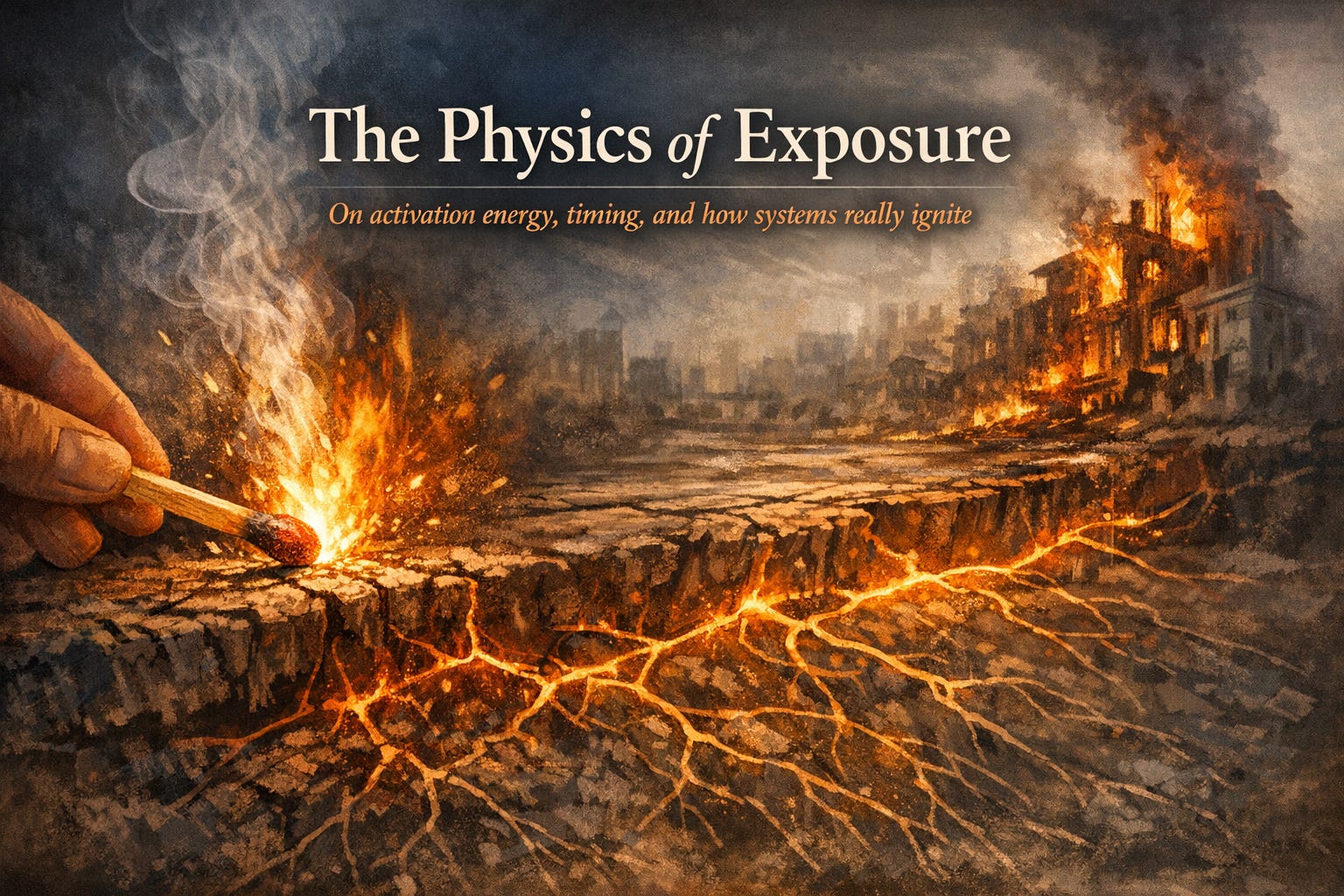
A match delivers a tiny burst of energy into a microscopic region of the surface. A few bonds break. Pyrolysis begins. Flammable gases are released. Oxygen stops bouncing and starts binding.
At that point, the match is no longer doing the work.
The system is.
Over time, I’ve learned that power systems behave the same way.
Why Most Truth Does Nothing
One of the hardest lessons in investigative work is this:
Most true things change nothing.
Documents can be authentic.
Facts can be correct.
Patterns can be real.
And still, no consequence follows.
Not because people are blind.
Because the system is still elastic.
The oxygen is there.
The fuel is there.
But the collisions are not energetic enough.
The molecules bounce off each other and move on.
This is why so much serious work disappears without a trace.
Not because it was wrong.
Because the environment was not yet reactive.
For a long time, I believed influence worked like a sniper shot.
Find the right piece.
Wait for the right moment.
Expose the decisive fact.
Trigger collapse.
It’s a clean theory.
It’s also mostly wrong.
Complex systems almost never fall because of one perfect revelation.
They fall because of accumulation and timing.
And timing has very little to do with your calendar.
Activation Energy and Power
In chemistry, the key variable is not whether a reaction is possible.
It is whether it has crossed the activation barrier.
That barrier is not moral.
It is not about truth.
It is about energy.
Until enough local energy exists to break initial bonds, nothing propagates.
Information works the same way.
You can release accurate material into a system that is not yet stressed, and it will vanish.
You can release trivial material into a system already overheated, and it can trigger a cascade.
The difference is not the size of the spark.
It is the state of the wood.
This is why timing matters more than content.
Not timing as in “the right historical moment.”
Timing as in:
Is there latent legal exposure?
Is there institutional anxiety?
Is there political transition?
Is there internal fragmentation?
Is there competition looking for leverage?
When those conditions exist, the system is dry.
At that point, any spark will do.
The First Sign of Ignition Is Rarely Flame
One of the most reliable indicators that a system is near failure is something counterintuitive.
You don’t look for response where you touched it.
You look for displaced response.
In physics, when materials approach fracture, stress redistributes. Microcracks appear far from the load. Heat spikes show up in unexpected regions.
Power systems do the same thing.
You publish a small piece.
And the reaction appears somewhere else.
Not from the subject.
From a different institution.
A different department.
A different actor.
Legal threats over footnotes.
Denials about things you didn’t write.
Silence followed by sudden motion elsewhere.
Attacks on your credibility instead of your facts.
That displacement is diagnostic.
It means the system could not absorb the energy locally.
Which means:
Stress is already redistributed internally.
Hidden couplings exist.
Load-bearing members are under strain.
You are no longer probing the surface.
You’ve touched a fault line.
Why I No Longer Wait for the Perfect Piece
For a long time, I waited.
I waited for the right document.
The right moment.
The right exposure.
I assumed collapse required precision.
I no longer think that’s true.
Collapse requires something simpler:
Presence.
When a system is near criticality, the specific spark matters less than the fact that a spark appears at all.
This is why I no longer wait for the decisive revelation.
Any small, accurate fragment will do, once the system is dry.
Because at that point, I am not supplying energy.
I am only testing whether oxygen is ready to bind.
If nothing happens, that tells me something.
If something happens somewhere else, that tells me much more.
And if a feedback loop begins to form, then the system crossed its threshold long before I arrived.
What This Is Not
This is not about warning institutions.
Institutions do not change behavior because a writer warns them.
They change because:
Internal audits begin.
Legal risk increases.
Political incentives shift.
Regulatory attention rises.
Independent investigations converge.
Writers do not manage cascades.
They contribute fragments.
The rest is emergent.
That boundary matters.
Because the moment a person believes they control collapses, they stop being an observer and start being a self-appointed regulator.
History is not kind to people in that role.
I do not collapse systems.
I do not manage outcomes.
I do not threaten or coerce.
I publish accurate pieces when the environment is already unstable.
After that, the system does whatever it was already going to do.
The Ethical Line
There is a simple moral rule here.
Introducing activation energy is not the same as causing destruction.
If a system collapses because a small disclosure ignites it, that collapse was not created by the spark.
It was created by everything stored inside the structure long before.
Fire is not created by matches.
Fire is created by systems that have accumulated too much unreleased energy for too long.
The match only tells you when the waiting is over.
That distinction keeps you honest.
It keeps you from confusing:
Diagnosis
with
Power.
And it keeps you from mistaking timing for authorship.
Why Most Work Remains Invisible
Most serious work never ignites anything.
Not because it failed.
Because the system was not yet flammable.
In stable environments, information dissipates.
In unstable environments, information binds.
The difference is not courage.
It is not cleverness.
It is not even truth.
It is state.
Learning to read state matters more than learning to find secrets.
Closing
Wood does not burn because you strike it.
It burns because it has already crossed a threshold where:
Heat produced by reaction
exceeds heat lost to the environment.
At that point, the reaction sustains itself.
The match becomes irrelevant.
Power systems behave the same way.
Most collapses are not triggered.
They are revealed.
Not by the biggest disclosure.
By the smallest one that happens to arrive
when oxygen is finally ready to bind.
That is the only physics of exposure that has ever mattered.


