
I Said This Would Happen to Trump
Gen Z Just Proved It.
When I wrote about the “comply-or-die paradigm,” I wasn’t describing a moment.
I was describing a structural fault line.
When I wrote about War Plan Red and Minnesota as contested sovereignty space, I wasn’t forecasting invasion.
I was pointing to something more subtle:
When centralized authority overextends into a population that does not psychologically consent to its framing of reality, legitimacy erodes.
Now the data is here.
And it is not ambiguous.
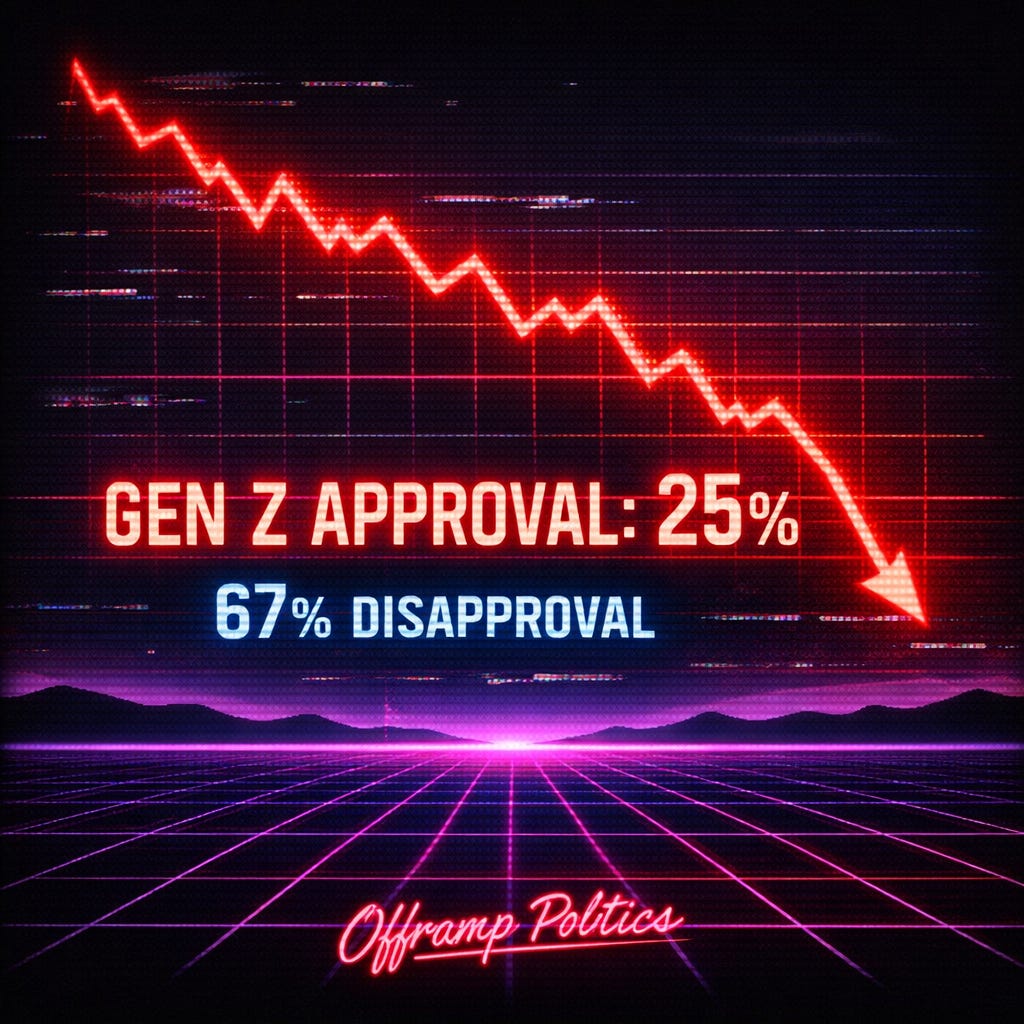
According to polling reported by Newsweek this week, President Trump’s approval rating among Gen Z has collapsed to approximately 25 percent approval with 67 percent disapproval.
Let that ratio settle.
Two-thirds disapproval.
One-quarter approval.
That is not drift.
That is rupture.
It also represents an eight-point drop in a single week.
Political approval does not move eight points in a week unless something structural has shifted in perception.
Now zoom out.
In 2024, Trump overperformed with younger voters compared to prior Republican benchmarks. Exit polling showed meaningful gains among young men under 30. The assumption that Gen Z was permanently aligned with Democrats cracked.
I wrote at the time that this was conditional support, not ideological conversion.
Gen Z did not “join” anything.
They tested.
Now they are recalibrating.
And they are recalibrating hard.
Let’s layer this with additional data.
Recent national polling averages place Trump’s overall approval in the low 40s. Among independents, net approval has slipped significantly negative. But Gen Z is where the collapse is sharpest.
25 percent approval.
67 percent disapproval.
If that demographic sustains a two-to-one rejection ratio, midterm math changes.
But this isn’t just electoral arithmetic.
This is narrative legitimacy.
When Operation Metro Surge flooded Minneapolis with federal immigration officers, the administration framed it as restoring order.
Law and order.
Border enforcement.
Federal authority.
I warned that this would not play the way strategists expected.
Why?
Because Gen Z does not instinctively equate force projection with legitimacy.
They equate transparency and proportionality with legitimacy.
Minnesota became a live demonstration of that divide.
Roughly 700 federal immigration officers were deployed into a state whose leadership publicly resisted the operation. Two fatal shootings involving federal agents ignited sustained protests. Lawsuits followed. National coverage intensified.
Then the administration announced a drawdown.
Officially: success achieved.
Politically: pressure absorbed.
The sequence matters.
Deploy.
Escalate.
Backlash.
Withdraw.
That pattern is not interpreted by Gen Z as strength.
It is interpreted as reactive correction.
Now add economic stress.
While headline inflation has cooled from 2022 peaks, consumer sentiment among younger Americans remains weak. According to recent surveys, Gen Z reports disproportionate anxiety over housing affordability, job security, and cost of living. Housing prices remain elevated relative to median income. Rent burdens among young urban voters are historically high.
When economic stress combines with visible enforcement escalation, the legitimacy equation shifts.
And Gen Z is uniquely wired for this moment.
They are the first fully algorithm-native voting bloc.
They grew up watching:
• body camera footage
• livestreamed protests
• leaked court documents
• viral breakdown threads
• cross-referenced narratives
They do not process governance through single-source messaging.
They audit.
When I wrote about the comply-or-die paradigm, I argued that the deeper danger is not enforcement itself.
It is the assumption that the state’s interpretation of reality must override lived experience in moments of conflict.
Compliance is framed as rational.
Resistance is framed as deviance.
But what happens when a generation does not accept that framing?
Approval collapses.
The Minnesota drawdown reinforces this point.
If Operation Metro Surge had been widely perceived as stabilizing and legitimate, approval among young voters would not be imploding simultaneously.
Instead, we see a rapid decline.
Eight points in a week.
That suggests the enforcement optics were not neutral in the political energy field.
Now widen the aperture.
Gen Z is not a minor constituency.
They are now the largest emerging voting cohort in the United States.
By 2026, millions of additional Gen Z voters will be eligible.
If two-thirds of them disapprove of the administration, that is not noise.
That is demographic gravity.
And this is where War Plan Red becomes metaphorically relevant.
Historical contingency planning teaches one lesson: sovereignty holds when legitimacy holds.
When legitimacy fractures, pressure accumulates.
Minnesota illustrated a federal-state sovereignty collision.
Gen Z polling illustrates a narrative-sovereignty collision.
The center attempted to assert authority.
The periphery evaluated the assertion.
The periphery is not impressed.
This is not about left or right.
This is about generational psychology.
Older voters often equate firmness with authority.
Younger voters equate fairness and transparency with authority.
Those are not interchangeable currencies.
If the administration misreads that distinction, erosion accelerates.
Let’s examine turnout implications.
In 2022 midterms, Gen Z turnout surged relative to expectations, driven largely by issue salience and mobilization intensity.
When energy is high, they vote.
Right now, energy is high — but trending negative toward the White House.
If that persists into 2026, congressional control dynamics become volatile.
And volatility is contagious.
Political donors react.
Strategists reposition.
Opposition messaging sharpens.
This is how narrative momentum shifts.
Not through one headline.
Through sustained perception drift across demographics that will dominate the next decade.
There is another layer here that is uncomfortable but necessary to state.
Gen Z is less tolerant of perceived coercive governance.
Survey data consistently shows younger Americans prioritize civil liberties, systemic fairness, and institutional accountability at higher rates than older cohorts.
When enforcement optics appear heavy-handed, even if legally defensible, the moral interpretation shifts from lawfulness to harm.
That shift is deadly for approval.
You cannot command moral authority.
You can only accumulate it.
And once narrative trust fractures, rebuilding it is exponentially harder than maintaining it.
This is why I wrote that comply-or-die governance models are brittle.
They appear strong in moments of deployment.
They weaken in moments of audit.
Gen Z lives in audit mode.
The Minnesota moment was audited.
The polling reflects that audit.
Now ask the harder question:
Is this cyclical frustration, or structural realignment?
If cyclical, approval rebounds when economic sentiment stabilizes.
If structural, we are witnessing early generational decoupling from centralized authority models that rely on coercive optics.
If it is structural, it will not self-correct through messaging tweaks.
It will require recalibration of tone, proportionality, and narrative alignment.
Because here is the truth:
You cannot govern through narrative imposition in 2026.
You must govern through narrative resonance.
Minnesota was a stress test.
Gen Z delivered the scorecard.
25 percent approval.
67 percent disapproval.
Eight-point weekly collapse.
That is not just a bad poll.
That is a warning.
I said this dynamic would emerge.
It just did.
The question now is whether anyone in power recognizes what the numbers actually mean.


