
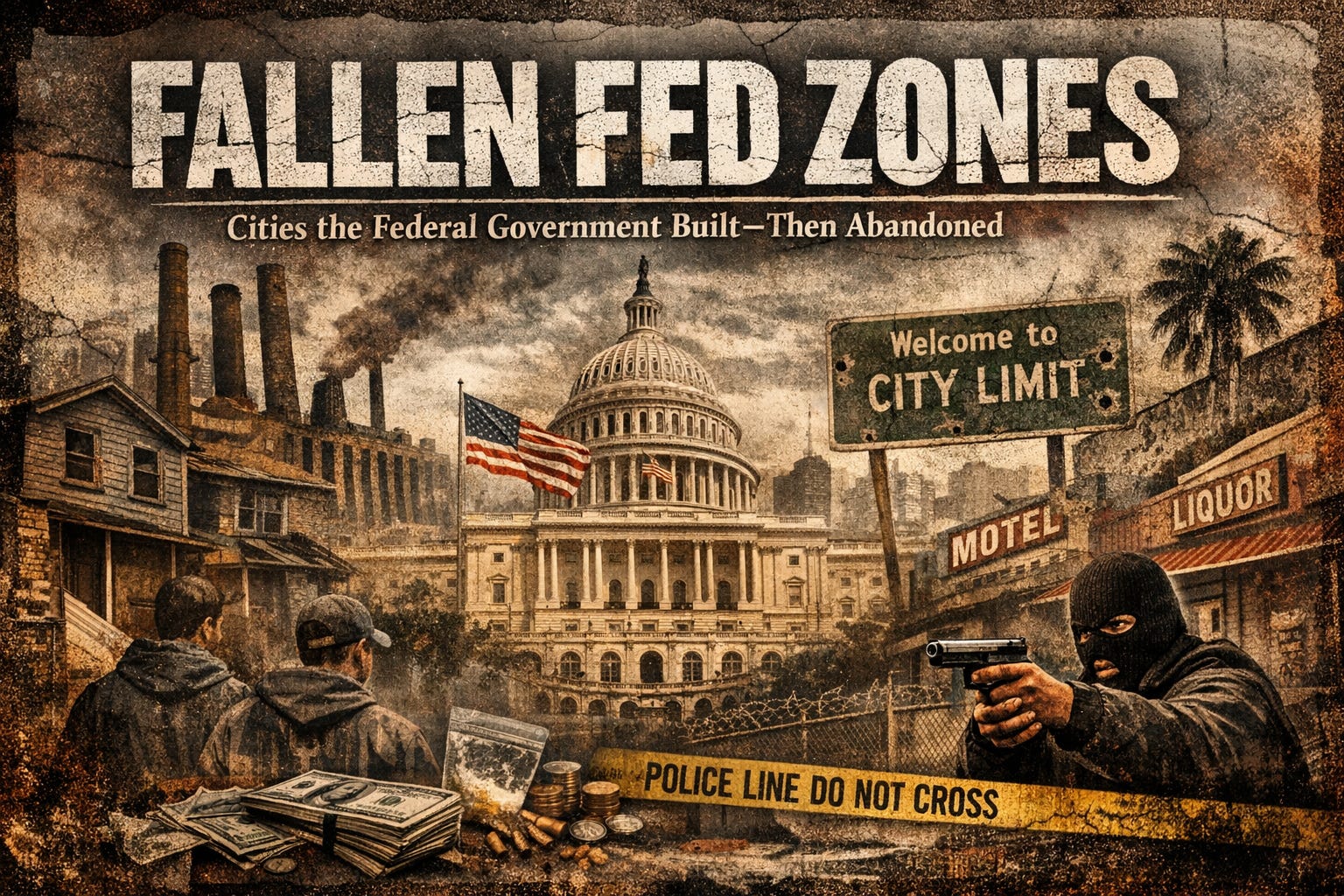
Fallen Fed Zones: The Cities the Federal Government Built — and Then Abandoned
We talk about crime as if it appears out of nowhere.
We talk about gangs as if they are the cause, not the consequence.
We talk about cities like Baton Rouge, Watts, Miami, Baltimore, Union City as if they simply failed themselves.
But what if that entire framing is wrong?
What if some American cities were not merely misgoverned — but designed for federal missions that later disappeared?
And what if the violence, instability, and fragmentation we see today are not the product of moral collapse, but the long shadow of a withdrawn federal state?
This is the idea I want to explore: the existence of what I now call Fallen Fed Zones.
Not failed states.
Not cartel cities.
But places where a federal mission once organized civic life — and then vanished.
The Concept: What Is a Fallen Fed Zone?
A Fallen Fed Zone is not a failed state.
It is not a gang-ruled territory.
It is something more precise.
A Fallen Fed Zone is:
A city or district that was once structured around a federal mission,
where that mission ended,
and no stable civic or economic replacement was ever built.
These places share five traits:
Heavy federal investment and purpose in a peak era
Sudden or gradual withdrawal of that federal mission
Collapse of the economy tied to that mission
Local institutions too weak to replace federal structure
Long-term disorder managed primarily by policing and prisons
But there is another feature that appears again and again — and it is rarely named.
When federal missions withdraw and no civic institution replaces them, a new social order forms.
Not ruled by cartels.
Not ruled by mafias.
Not ruled by national gangs.
But organized around what I would call a criminal spine.
The Criminal Spine
In most cities, crime is a layer.
In Fallen Fed Zones, crime becomes a structural axis.
Not because criminals are especially powerful —
But because no other organizing institution remains.
When:
Factories vanish
Federal agencies withdraw
Unions collapse
Schools fail
Political machines fall
The only durable hierarchy left is:
Street → Prison → Street
This produces a strange kind of stability:
Leadership flows through incarceration
Status is earned through survival
Order is enforced through fear
Memory is preserved through crews
These are not criminal empires.
They are replacement institutions.
And the clearest signal of this condition is something counterintuitive:
The absence of national syndicates.
In true criminal cities, outside organizations arrive.
In Fallen Fed Zones, they usually do not.
Because there is no hierarchy to capture — only vacuum to endure.
Watts: The First Prototype
Watts is not just a symbol of racial unrest.
It is one of the earliest post-war federal mission zones in America.
During World War II and the Cold War, South Central Los Angeles was:
A defense manufacturing hub
A war-labor colony
A federally engineered migration zone
Black workers were recruited from the South to build planes, ships, engines, and weapons.
Federal contracts built the economy.
Federal housing policy built the neighborhoods.
Federal highways boxed them in.
Then the mission ended.
Defense plants automated or left.
Union ladders disappeared.
Federal investment withdrew.
What remained was:
Dense housing
No jobs
No replacement mission
The 1965 Watts uprising was not random.
It was the first mass revolt in a post-federal mission city.
After that, the federal state did not rebuild.
It policed.
Baton Rouge: Violence Without Syndicates
Baton Rouge followed a different path, but the same arc.
For most of the twentieth century, Baton Rouge was:
A refinery hub
A war-production node
A Mississippi River logistics center
The federal government embedded itself through:
Army Corps of Engineers
Bureau of Mines
War Production Board
Petroleum administration
This was not a local economy.
It was a federally governed industrial city.
Then the war state withdrew.
Refineries automated.
Unions collapsed.
Federal oversight thinned.
What makes Baton Rouge strange is not its violence.
It is the absence of outside criminal hierarchy.
Despite decades of:
Drug markets
Homicide
Mass incarceration
There was:
No durable Bloods or Crips empire
No Chicago gang franchise
No cartel capture
Instead:
Violence without hierarchy.
Crime without syndicates.
A spine without a brain.
Here, the criminal element did not become an enterprise.
It became a social ordering system.
Miami: Money Without Gangs
Miami is stranger still.
In the 1980s, Miami was one of the largest drug trafficking hubs on Earth.
It had:
Cartel money
International smuggling
Global banking
And yet, socially, Miami never developed:
A national gang culture
Durable Blood or Crip structures
Chicago-style prison hierarchies
Instead, Miami evolved into:
A city where money replaced gangs as the organizing force.
Power flowed through:
Real estate
Finance
Immigration networks
Transnational capital
Not through street syndicates.
Miami became a post-strategic Fallen Fed Zone —
A city where federal purpose vanished,
And capital replaced governance.
Union City: Crime After the Machine
Union City, New Jersey represents a different and crucial variant.
Its federal mission was not industrial or military.
It was political and immigration-based.
For much of the twentieth century, Union City functioned as:
An immigrant intake city
A Cold War exile processing zone
A state-sanctioned political machine
Here, the federal state did not govern directly.
It outsourced governance to local political machines.
Patronage networks controlled:
Jobs
Housing
Zoning
Police
Courts
Votes
This created a corruption-stabilized social order.
Not criminal.
Political.
Then that machine collapsed.
Federal prosecutions dismantled patronage.
Immigration flows changed.
The informal order vanished.
What replaced it was not civic governance.
It was:
A criminal–political hybrid order
built from the ruins of machine power.
Union City shows that:
In Fallen Fed Zones, crime does not replace industry.
It replaces collapsed governance.
What Replaces Federal Missions?
In every Fallen Fed Zone, the pattern converges.
When federal purpose withdraws, one of three things replaces it:
Policing and prisons
Informal economies
Fragmented violence
Not syndicates.
Not empires.
Just:
Governance by containment.
These are not criminal cities.
They are abandoned mission cities.
Why This Frame Matters
If this is right, then most of our crime debates are misdiagnosed.
We argue about:
Policing
Sentencing
Culture
Morality
But we almost never ask:
What was this city originally built to do?
And:
What replaced that purpose when it ended?
In many cases, the answer is:
Nothing.
Which means:
We punish people for living in post-mission ruins
We police territories we never rebuilt
We treat abandonment as pathology
The Final Question
There may be a dozen Fallen Fed Zones in America:
Watts
Baton Rouge
Miami
Union City
Baltimore
New Orleans
Oakland
Places built for:
War
Industry
Intelligence
Immigration
Political patronage
Then left behind.
So the real question is not:
Why are these places violent?
The real question is:
What responsibility does a federal state have
to cities it built for missions
it later abandoned?
And what happens when a country never answers that question?
Thomas Jason Anderson writes on power, governance, and the long memory of institutions at Offramp Politics.


