


The Democratic Party has a messaging problem.
Not because Democrats lack issues. They have plenty of them. Maybe too many.
Affordability. Health care. Corruption. Reproductive freedom. Democracy. Redistricting. Tariffs. Political violence. Trump’s chaos. Republican extremism. Medicaid. Prescription drugs. Housing. Groceries. The courts. The maps. The donors. The scandals.
All of these things matter.
But elections are not won by proving that twenty different things matter. Elections are won by making millions of voters understand why one thing matters most.
That is where the Democratic Party appears stuck heading into November 2026. They have arguments. They have policy lanes. They have real vulnerabilities to exploit against Republicans. They have a president in Donald Trump who is unpopular with large portions of the country and entering the back stretch of his second term. They have a Republican Congress tied to every price increase, every health care cut, every ethical scandal, and every moment of national exhaustion.
Yet what they do not seem to have is one simple national sentence.
That matters.
Because MAGA does.
The Republican Party does not appear to be confused about what it is selling. It is selling Trump. Again. Still. Completely.
That may sound too simple, but that is the point. MAGA’s advantage is not complexity. MAGA’s advantage is singularity.
Trump is the message. Trump is the brand. Trump is the organizing principle. Trump is the loyalty test. Trump is the shortcut voters use to understand which candidate belongs to the movement and which candidate does not.
That was made clear in Kentucky, where Trump-backed Ed Gallrein defeated Rep. Thomas Massie in the Republican primary. Massie was not just some anonymous backbencher. He was a known political figure with a libertarian streak, a national profile, and a long record of independence from party leadership. But independence is no longer the currency inside the GOP. Trump’s endorsement was.
Then came Texas, where Ken Paxton defeated John Cornyn. Cornyn had seniority, institutional weight, and the old Republican résumé. Paxton had MAGA energy, Trump’s backing, and the ability to run as the candidate who represented the real base of the party.
That should tell Democrats something.
MAGA is still strong.
Not theoretically. Not emotionally. Not nostalgically.
Operationally.
Trump is still the central force in Republican politics. His endorsement still moves votes. His approval still defines Republican primaries. His ability to punish dissenters and reward loyalists is still shaping the party heading into November.
Democrats can laugh at this if they want. They can say Trump-backed candidates may be weaker in general elections. They can say the GOP is nominating candidates with baggage. They can say corruption, extremism, and chaos will damage Republicans in November.
Maybe.
But none of that changes the fact that Republicans are entering this cycle with one dominant message and Democrats are entering it with several scattered arguments.
That is dangerous.
Politics is not a policy filing cabinet. It is a battle over public memory.
And right now, MAGA knows exactly what memory it wants to activate.
Trump was wronged. Trump returned. Trump is fighting. Trump’s enemies must be defeated. Every Republican primary is another loyalty trial. Every win is another ritual of confirmation.
The Democratic Party cannot answer that with a PowerPoint presentation.
It needs a theme.
What Democrats did when they won
The irony is that Democrats should know this already. Their last three major successes each had a clearer emotional center than what they appear to be building now.
In 2018, Democrats won by making the midterms a referendum on Trump and Republican threats to health care. The message was not perfect, but it was simple enough: protect health care and put a check on Trump.
That worked because voters understood the stakes. Republicans had spent years trying to repeal the Affordable Care Act. Pre-existing condition protections were easy to explain. Health care was personal. The Democratic House campaign had a center of gravity.
In 2020, Joe Biden won by promising stability after chaos. That campaign was not powered by some grand ideological revolution. It was powered by national exhaustion. Trump had turned the presidency into a constant emergency broadcast. COVID had exposed the cost of chaos. Biden’s message was essentially this: let the fever break.
Again, simple.
Voters did not need a white paper. They needed a permission slip to choose normalcy.
In 2022, Democrats overperformed because Republicans gave them a new center of gravity: abortion rights and extremism after the fall of Roe. Democracy was also on the ballot after January 6, and candidate quality mattered in key races. But the emotional center was clear enough: Republicans had gone too far.
That message worked because it was not only about policy. It was about boundaries. Voters may disagree on tax rates or spending levels, but many understand when a political movement crosses a line.
So look at the pattern.
2018: protect health care and check Trump.
2020: end the chaos.
2022: stop extremism and protect rights.
Each victory had a usable spine.
Now compare that to 2026.
The Democratic Party appears to be saying: affordability, health care, corruption, democracy, reproductive freedom, redistricting, Trump, tariffs, courts, billionaires, Project 2025, Medicaid, groceries, housing, and congressional oversight.
That is not a message.
That is a drawer full of cables.
Useful cables, yes. But still tangled.
The party does not need fewer issues. It needs one theme that can carry all of them.
Why affordability alone is not enough
Democrats seem to understand that affordability has to be central in 2026. That is smart. Voters are still feeling squeezed. Groceries are too expensive. Housing is too expensive. Insurance is too expensive. Health care is too expensive. The basic cost of living has turned into a daily referendum on whether government is working.
But affordability by itself is not enough.
Why?
Because Republicans can talk about affordability too. Trump can stand in front of a flag and say he wants lower prices. Republican candidates can blame Democrats, migrants, regulations, foreign countries, the Federal Reserve, corporations, or Joe Biden’s ghost wandering the cereal aisle.
If Democrats make the election only about prices, they are fighting on a battlefield where both sides can shout numbers.
They need to answer a deeper question.
Why are costs high?
Who benefits from the chaos?
Why does government seem unable to protect ordinary families?
That is where corruption comes in.
That is where health care comes in.
That is where democracy comes in.
That is where Trump comes in.
The strongest Democratic argument is not simply that life is expensive. The strongest argument is that life is expensive because Republican power has been organized around insiders, donors, loyalists, and political survival instead of the public good.
That is the bridge.
Affordability is the symptom. Corruption is the disease. Trump’s Republican Party is the governing machine that spreads it.
But even that needs to be made simple.
The missing frame: Turn the page
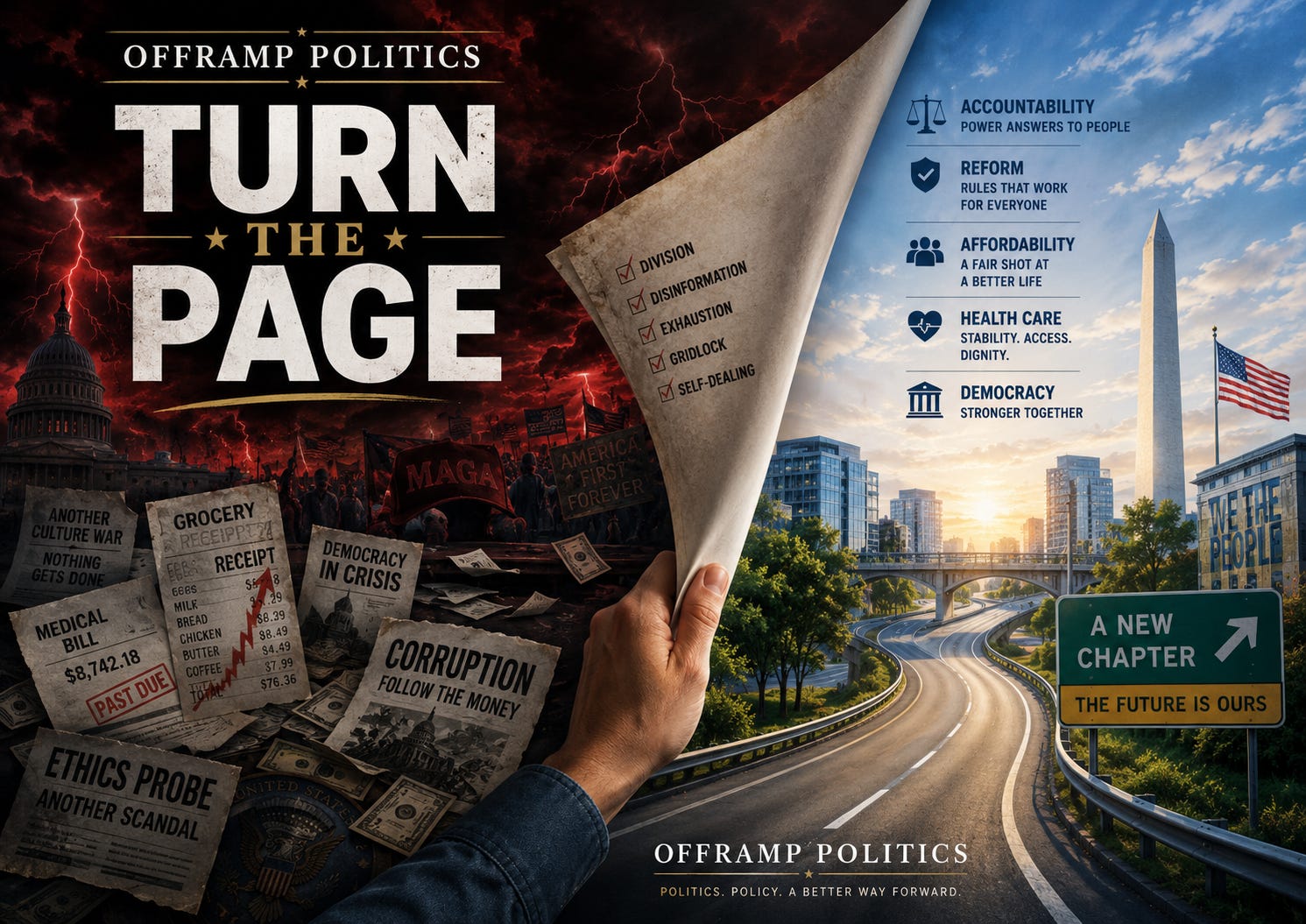
The Democrats should make 2026 the “Turn the Page” election.
Not just turn the page on Trump.
Turn the page on Trump’s Republican Party.
That distinction matters. If Democrats make the election only about Trump personally, Republicans will argue that he is already heading into his lame-duck phase. They will say the country can wait until 2028. They will say Democrats are obsessed with yesterday’s fight.
The Democratic answer should be direct:
America cannot wait until 2028.
That is the key.
America cannot wait until 2028 to lower costs.
America cannot wait until 2028 to protect health care.
America cannot wait until 2028 to clean up corruption.
America cannot wait until 2028 to restore oversight.
America cannot wait until 2028 while Republicans redraw maps, weaken voting rights, and lock in power.
America cannot wait until 2028 while Trump’s lame-duck Republican Party uses the next two years to reward loyalists, punish enemies, and drain the government for insiders.
The change has to start now.
That is the message.
Not because it sounds pretty. Because it solves the structural problem.
“Turn the Page” allows every Democrat to run the same national campaign while localizing the details.
A Democrat in a district worried about hospitals can say: turn the page to protect health care.
A Democrat in a district worried about grocery prices can say: turn the page to lower costs.
A Democrat in a district worried about corruption can say: turn the page to restore accountability.
A Democrat in a district facing redistricting abuse can say: turn the page to protect your vote.
A Democrat speaking to younger voters can say: turn the page on old fights and broken systems.
A Democrat speaking to independents can say: turn the page on chaos.
A Democrat speaking to anti-Trump Republicans can say: turn the page on a party that no longer allows independence.
This is how a national theme should work. It should be broad enough to hold the coalition, but sharp enough to cut.
“Turn the Page” does that.
It carries exhaustion without sounding defeated. It carries urgency without sounding hysterical. It carries optimism without pretending everything is fine. It tells voters that they do not have to live inside Trump’s political weather system forever.
More importantly, it turns the 2026 midterms into the first step of a national transition.
That is crucial.
Most voters do not wake up excited about midterms. Presidential elections feel like the main event. Midterms can feel like paperwork.
Democrats have to break that.
They have to tell voters that 2026 is not a pause before 2028. It is the first door out.
The lame-duck danger
Trump entering the lame-duck phase of his presidency should not make Democrats less urgent. It should make them more urgent.
A president who cannot run again still has power. A president with a loyal Congress has even more. A president surrounded by lawmakers who owe their careers to his endorsement has something close to a political enforcement squad.
That is what the Kentucky and Texas primaries show.
They show that many Republicans are not preparing for a post-Trump party. They are doubling down on Trump’s party.
So Democrats should stop acting as if time itself will solve the problem.
Time does not govern. People do.
If Democrats wait until 2028, they are giving Trump’s Republican Party two more years to shape the courts, the budget, the agencies, the maps, the investigations, the contracts, and the rules of the next election.
That is the urgency.
Not panic.
Urgency.
There is a difference.
Panic says the sky is falling. Urgency says the house is on fire and the hose is right there.
The message Democrats should use
Here is the frame:
America needs a change.
The country cannot wait until 2028.
Prices are too high. Health care is too fragile. Corruption is too obvious. The maps are being manipulated. The government is being used for insiders while ordinary families are told to be patient.
Trump may be entering his lame-duck years, but Trump’s Republican Party still controls decisions affecting your life right now.
So the change has to start in 2026.
It is time to turn the page.
That should be the whole campaign.
Every ad should fit under it.
Every candidate should be able to say it.
Every voter should understand it in ten seconds.
This is what Republicans have understood better than Democrats for years. A movement needs a chant, not just a spreadsheet. A campaign needs a door people can walk through, not a maze they have to study.
“Turn the Page” is that door.
And it forces the right comparison.
The election is not just Democrats versus Republicans.
It is movement versus stagnation.
Future versus rerun.
Accountability versus corruption.
Change now versus waiting until more damage is done.
The Democratic Party does not need to abandon affordability, health care, democracy, corruption, or reproductive freedom. It needs to stop presenting them as separate islands.
They are all part of the same mainland.
The country is tired.
The government feels captured.
The bills are too high.
The politics are too loud.
The corruption is too open.
The Republican Party has wrapped itself around Trump again, and the latest primary results show the grip has not loosened.
So Democrats have a choice.
They can keep walking into November with a fractured message and hope voters assemble the puzzle themselves.
Or they can give voters one clean sentence:
America cannot wait until 2028.
Turn the page in 2026.
That is the election Democrats should be running.
And if they are serious about winning, they should start saying it now.