
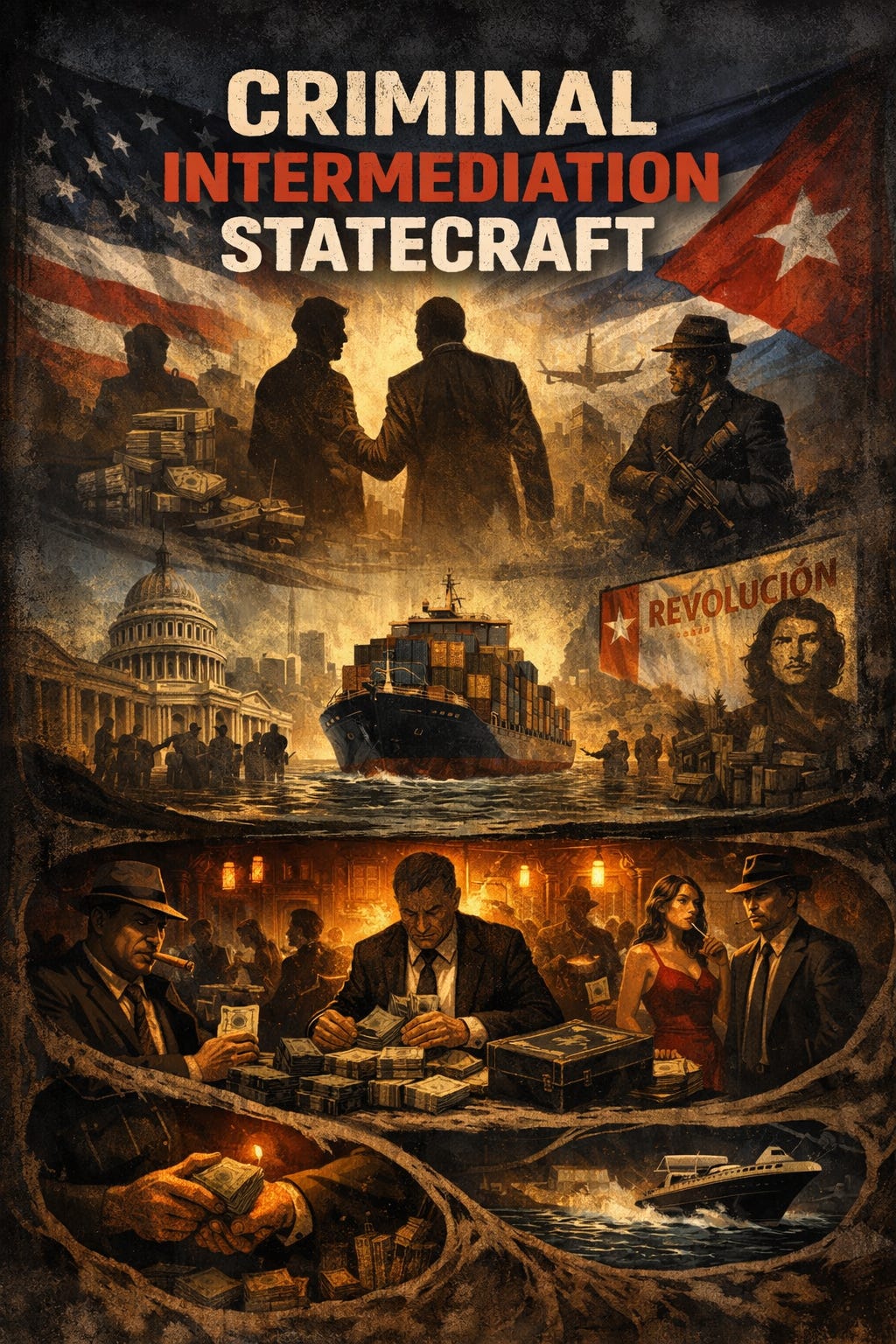
Criminal Intermediation Statecraft
How economic war turns corruption into diplomacy
There is a moment in every prolonged geopolitical conflict when something quiet happens beneath the noise.
The slogans stay loud.
The flags remain in place.
The speeches continue to sound absolute.
But the work of survival moves elsewhere.
This is easiest to see when nations enter conflict without kinetic war. When sanctions, embargoes, and financial pressure replace bombs and troops, ideology does not disappear. It changes jobs. It becomes a covering layer, a narrative membrane stretched over a far more practical system underneath.
Economic war does not eliminate interaction between adversaries. It re-routes it.
And what emerges, almost inevitably, is a parallel infrastructure that does not belong fully to either state. A black market, yes—but more precisely, a shadow logistics network capable of moving goods, money, favors, and assurances across borders that officially do not exist.
This is not chaos.
It is order without paperwork.
When ideology becomes a veil
Take the U.S.–Cuba conflict as a starting point, not because it is unique, but because it is legible.
Once direct confrontation gave way to economic pressure, ideology shifted function. It no longer served primarily to guide policy. It served to manage populations under strain. Scarcity had to be explained. Hardship had to be moralized. Endurance had to be framed as virtue.
Beneath that ideological surface, Cuba survived not on slogans, but on systems. Informal supply chains. Trusted intermediaries. Currency workarounds. External conduits.
The ideology spoke inward.
The black market spoke outward.
This is the first key inversion: once sanctions harden, the real economy becomes external-facing and unofficial, while the official narrative becomes internal-facing and symbolic.
And once that shadow economy stabilizes, it does not remain marginal. It becomes the spine.
The interface problem
Here is where most analyses stop too early.
Once a sanctioned state’s survival depends on shadow networks, those networks must interface with the global economy somewhere. And when formal diplomacy, customs regimes, and corporate compliance walls are sealed shut, the interface does not vanish.
It changes character.
Organized crime is not an accident in this phase. It is an answer to a systems problem.
Criminal organizations already know how to:
move goods through ports quietly
enforce trust without courts
launder money through legitimate structures
operate across jurisdictions without recognition
They are, functionally, pre-built diplomats for economies that are not allowed to speak.
At this stage, interaction between hostile nations becomes oddly intimate. Not friendly. Not moral. But reliable. Predictable flows matter more than ideological purity. Stability becomes more valuable than victory.
And once this shadow interface exists, a new role emerges inside the formal state.
The corrupt official as infrastructure
This is the point where corruption stops being incidental and becomes functional.
Certain public officials are uniquely positioned to operate as stabilizers between worlds. They can speak the language of ideology on the surface while quietly ensuring continuity underneath. They can reassure law enforcement without triggering enforcement. They can calm criminal intermediaries without acknowledging them. They can signal to foreign actors without leaving fingerprints.
These officials are not freelancers. They are load-bearing beams.
Removing them abruptly does not end the system. It destabilizes it.
This is why corruption at this level is so often tolerated, deferred, or reframed as complexity. The official is no longer seen merely as compromised. They are seen as useful. As someone who “understands the terrain.” As a person who keeps things from getting worse.
This is diplomacy without treaties.
Peace without acknowledgment.
Conflict management by deniability.
Naming the process
This is the moment where clarity matters.
What we are describing is not rogue behavior. It is not an aberration. It is a repeatable statecraft pattern that emerges under economic warfare.
The correct name for it is:
Criminal Intermediation Statecraft
A process by which:
economic sanctions replace kinetic war
black markets replace formal trade
organized crime replaces official interfaces
and corrupt public officials replace diplomats
All while ideology continues to perform legitimacy for domestic audiences.
This is not a conspiracy theory. It is a structural outcome. You can trace it in documents, prosecutions, trade anomalies, selective enforcement patterns, and jurisdictional hesitations.
Bob Menendez as vessel, not exception
Seen through this lens, Bob Menendez is not an outlier. He is an example of the role.
Publicly, Menendez occupied the familiar terrain of anti-Castro exile politics. The rhetoric was clear. The posture was uncompromising. The ideological line was sharp enough to reassure constituencies.
Privately, as documented over years of investigative work, he became a vessel. An interface point through which Cuban-linked organized crime interests, U.S. political power, and international economic flows could coexist without collapsing the narrative.
This does not require secret meetings in dark rooms. It requires something far subtler: consistency. Predictability. An understanding of which doors must remain half-open and which investigations must never quite reach full speed.
The louder the ideological hostility on the surface, the safer the shadow equilibrium underneath.
This is the dance most observers miss. The ideology is not false. It is misdirected. It performs belief while logistics perform reality.
Why exposure never ends the system
This is the part that frustrates reformers.
When figures like Menendez are finally exposed or removed, there is often an expectation of catharsis. Justice will cleanse the system. Accountability will restore order.
Instead, what happens is turbulence.
Because Criminal Intermediation Statecraft does not belong to individuals. Individuals occupy roles. When one vessel breaks, the pressure does not disappear. It seeks a new container.
Ports still need predictability.
Networks still need protection.
States still prefer shadow stability to open rupture.
So the system regenerates.
This is why corruption scandals at this level often feel unsatisfying. They reveal conduct but obscure function. They punish actors without naming architecture.
The uncomfortable truth about American diplomacy
Here is the hardest sentence to write, but it must be written:
Criminal Intermediation Statecraft is not anti-American. It is a function of American power under constraint.
When the United States chooses economic warfare over kinetic war, it creates environments where unofficial systems must absorb the friction. When it demands absolute compliance while tolerating strategic exceptions, it incentivizes intermediaries who can manage contradiction.
This is not unique to Cuba. The pattern appears in Panama, Colombia, Iran, Venezuela, and beyond. Wherever sanctions persist long enough, shadow diplomacy grows roots.
The question is not whether this exists.
The question is whether we are honest enough to name it.
Why naming matters
Giving this process a name does not excuse it. It clarifies it.
Without a name, corruption is framed as moral failure. With a name, it can be analyzed as policy outcome. Without a name, each scandal feels isolated. With a name, patterns emerge.
Criminal Intermediation Statecraft explains:
why ideology often intensifies as material conditions worsen
why organized crime flourishes at geopolitical fault lines
why certain corrupt officials are protected longer than logic suggests
and why reform without structural change rarely sticks
This is not an argument for cynicism. It is an argument for precision.
If we want cleaner diplomacy, we must first admit how dirty stability actually is.
And if we want to understand figures like Menendez honestly, we have to stop asking only what did he do and start asking what role was he playing.
Because roles, once created, do not disappear when the actor exits the stage.
They wait.


very interesting
As a New Jerseyan, I disagreed with Sen. Menéndez on just about everything (environment, women’s rights, and health were areas where we sometimes agreed). Reading your article, I’m now thinking of his actions in alignment with the book “Confessions of an Economic Hitman”. I’m not ready to draw conclusions yet, but reconsidering. . . .nothing positive, for sure.