

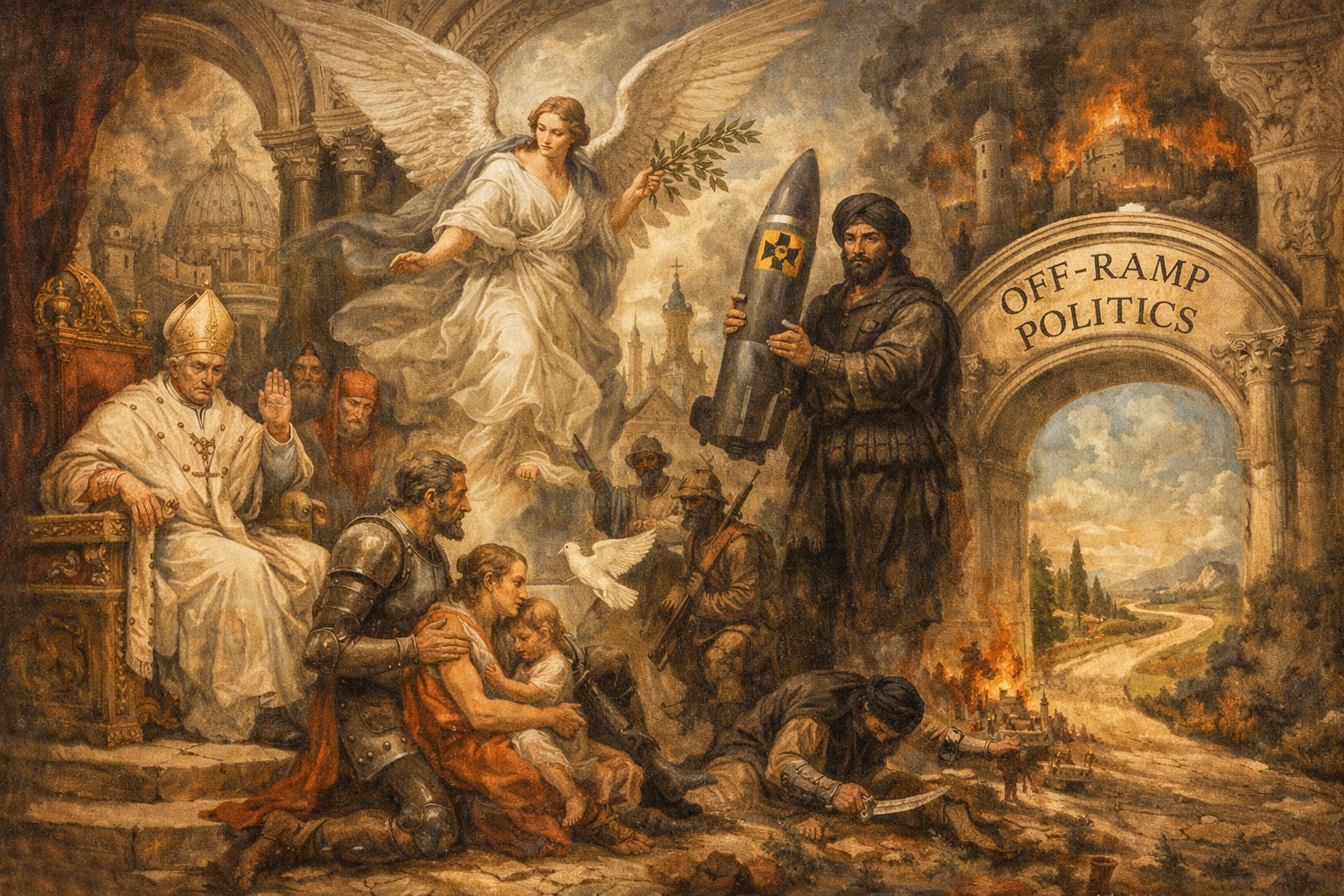
There is a certain gravity that comes with the voice of the Pope.
It is not the gravity of armies or markets. It does not move oil prices or redirect fleets. But it moves something just as powerful in a different dimension: moral perception. It shapes how millions interpret right and wrong, restraint and aggression, justice and excess.
That is why, when the Pope speaks on a geopolitical conflict, the words do not float. They land. And where they land matters.
In recent days, the Vatican’s posture toward Iran has followed a familiar pattern. Calls for restraint. Appeals for peace. Opposition to escalation. A defense of civilian life and a rejection of language that leans toward total destruction.
On its face, it is consistent. It aligns with centuries of Catholic teaching on war, dignity, and moral restraint.
But consistency is not the same as wisdom.
And that is where the question begins.
What Is Actually Being Supported?
The Vatican would argue that it is not supporting Iran.
It is supporting:
Peace over war
Dialogue over destruction
Humanity over annihilation
That is the official frame.
But in practice, global conflicts are not judged by intention alone. They are shaped by outcomes, by timing, and by the distribution of pressure.
When a powerful moral voice publicly calls for restraint against force, it does not exist in a vacuum. It changes the balance of pressure between actors.
And in this case, the actor at the center of the discussion is not a neutral state.
Iran is not simply another nation seeking stability. It is a regime that:
Has pursued nuclear capabilities for decades
Maintains relationships with proxy groups across multiple regions
Has been repeatedly tied to acts of destabilization and violence
This is not speculation. It is pattern.
So the question is not whether peace is desirable. It is.
The question is whether publicly advocating restraint, in this specific context, shifts pressure in a way that allows a known pattern to continue.
The Problem of Predictability
There is a difference between uncertainty and predictability.
If an outcome is unclear, caution makes sense. Dialogue makes sense. Holding space for change makes sense.
But when behavior follows a long, observable pattern, the moral equation changes.
At that point, the question becomes:
If you reduce pressure on a system that predictably uses that space to expand its capabilities, what role do you play in what comes next?
This is where the Vatican’s position begins to feel incomplete.
Not because it is morally wrong in isolation, but because it may be morally insufficient in context.
Moral Authority vs. Strategic Reality
The Vatican operates from a place of moral clarity.
It is designed to stand above conflict, to remind the world of principles that transcend power struggles. It is meant to be a voice that does not bend to political necessity.
But the modern world does not separate morality from consequence so cleanly.
Today, every major voice is part of a system:
Words influence policy
Policy influences action
Action shapes outcomes
When the Pope calls for restraint, it is not just a theological statement. It becomes a signal within a geopolitical system.
And that system is not guided by ideals alone.
It is guided by leverage.
A Different Path: Strategic Neutrality
There may be another option. One that preserves moral authority without unintentionally altering the balance of power.
The Vatican could say:
We support peace.
We support the preservation of life.
But we will not intervene in the strategic decisions of nations navigating complex threats.
This is not silence. It is discipline.
It acknowledges that:
The Vatican does not possess full intelligence on military threats
It is not responsible for managing global security
Its role is not to shape geopolitical outcomes, but to guide moral reflection
In this posture, the Pope becomes:
A witness to principle
Not a participant in pressure
The Burden of Influence
The deeper issue is not Iran.
It is the burden carried by the papal voice.
When the Pope speaks, especially on matters of conflict, he is not speaking into a quiet room. He is speaking into a system where:
Governments listen
Media amplifies
Narratives shift
That creates a responsibility that goes beyond intention.
It requires foresight.
Not prophetic foresight in the spiritual sense, but practical foresight in how words function in a world of competing interests.
And that is where tension emerges.
Because the Vatican is built to provide moral clarity, not strategic prediction.
The Question That Remains
This is not a question of faith.
It is a question of alignment between role and reality.
Should a figure whose authority is rooted in moral teaching:
Act as a voice within geopolitical conflict?
Or remain above it, offering principle without altering pressure?
And more directly:
When dealing with regimes that operate on long, consistent patterns of expansion and destabilization, does advocating restraint serve peace… or delay confrontation?
There is no easy answer.
But there is a cost to getting it wrong.
Closing Thought
The Vatican’s instinct toward peace is not the problem.
It is one of the last institutions willing to speak against destruction without calculating gain.
But in a world where power moves quickly and patterns repeat, the question is no longer just about what is right in the moment.
It is about what unfolds next.
And whether moral authority, when applied without strategic awareness, can unintentionally shape the very outcomes it seeks to prevent.
That is the quiet gamble.
And it is one worth examining closely.