


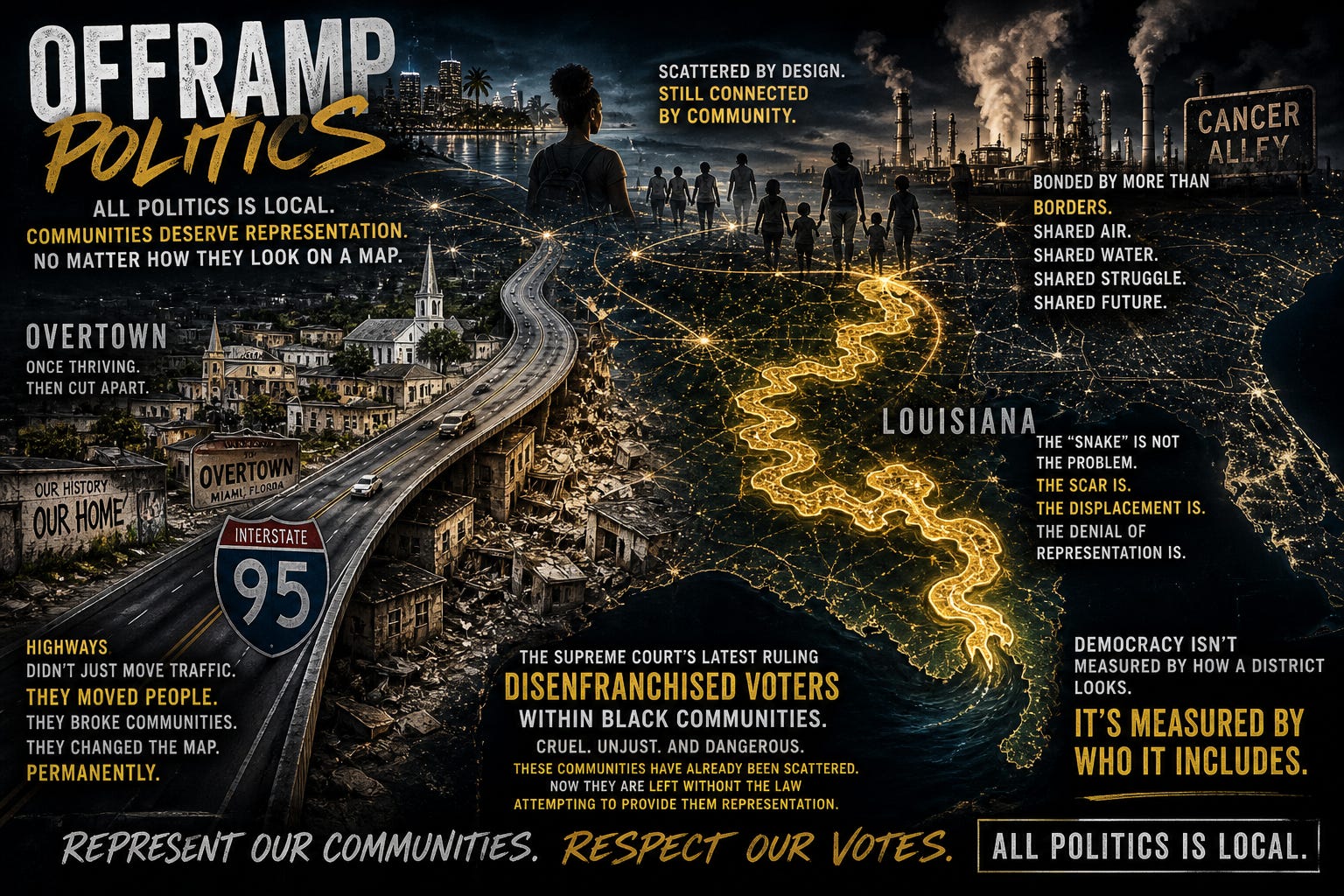
Let’s not ease into this.
Let’s say it plain.
All politics is local.
Not theoretical.
Not geometric.
Not aesthetic.
Local.
Built from neighborhoods, shared experiences, common struggles, and the quiet, daily reality of people living side by side.
And when those communities are denied representation—whether by design or by decision—democracy doesn’t weaken.
It fractures.
That’s exactly what just happened.
With its latest ruling, the U.S. Supreme Court didn’t just weigh in on maps in Louisiana.
It disenfranchised voters within Black communities.
Not abstractly.
Not symbolically.
Functionally.
And there’s no way to understand that without understanding what came before.
Communities Don’t Live on Paper
There’s a dangerous idea floating through legal arguments and media coverage right now:
That fairness can be measured by how a district looks.
That a clean shape equals a clean process.
But communities are not shapes.
They are living networks—bound by:
History
Economics
Culture
Survival
And sometimes, by shared harm.
When those communities are scattered, stretched, or broken apart, representation doesn’t become simpler.
It becomes harder—and more necessary.
The First Fracture Was Concrete
To understand Louisiana, you have to understand what happened in places like Overtown.
This wasn’t just a neighborhood. It was a thriving Black economic center in Miami.
Then came the highways.
I-95 didn’t just pass through.
It cut through.
Homes were taken. Businesses erased. Families displaced.
A concentrated, functioning community was turned into fragments—spread across Miami, Broward, and beyond.
And once that happened, the rules changed.
Because now, the question became:
How do you represent a community that’s been physically broken apart?
The Snake Is the Evidence
You don’t draw a neat box.
You draw a line that follows the people.
That line bends. It stretches. It connects pieces that were never meant to be separated.
And suddenly, critics point at that map and say:
“This looks wrong.”
But what they’re really seeing is the aftermath of something deeper.
The district looks fractured because the community was fractured first.
Louisiana’s Reality
In Louisiana, particularly in regions like the industrial corridor known as Cancer Alley, communities are bound together not by proximity alone, but by shared exposure, shared risk, and shared neglect.
They are connected through:
Environmental conditions
Health outcomes
Generational impact
These are real-world ties.
Stronger than any straight line on a map.
Yet the argument being advanced—and now reinforced by the Court—is that these communities do not deserve representation if that representation requires a map that looks “unnatural.”
Cruelty in Legal Form
Let’s call it what it is.
This ruling is cruel.
Because it ignores history.
It ignores displacement.
It ignores the very forces—many of them government-driven—that created these scattered populations in the first place.
And now, after those communities have already been:
Broken apart
Relocated
Politically diluted
They are being told:
You do not qualify for meaningful representation.
Not because you don’t exist.
But because you don’t exist in a shape that’s convenient.
The Voting Rights Act Was Supposed to Catch This
The Voting Rights Act of 1965 was built for moments like this.
It recognized that discrimination doesn’t always announce itself.
Sometimes it hides in systems.
In processes.
In decisions that appear neutral but carry very real consequences.
And one of its core protections was simple:
Communities must have a fair chance to elect representatives who reflect their lived reality.
Not their geometry.
Their reality.
What the Court Just Did
By prioritizing form over function, appearance over substance, the Court has effectively said:
Representation must conform to the map
The map does not need to conform to the people
That reversal is everything.
Because once you accept that premise, any dispersed community becomes vulnerable.
And in America, there is no group more historically dispersed by force than Black communities.
Overtown to Louisiana—A Continuous Line
This isn’t two separate stories.
It’s one.
From the highways that cut through Overtown…
To the industrial corridors of Louisiana…
To the courtroom decisions being handed down today…
There is a continuous line.
A line of disruption.
A line of displacement.
And now, a line of denied representation.
The Offramp
If there’s a way out of this, it starts with rejecting the premise entirely.
Maps are not the foundation of democracy.
Communities are.
And communities deserve representation:
Whether they are compact
Whether they are scattered
Whether they are convenient to draw
Or difficult to acknowledge
Because the moment representation becomes dependent on visual simplicity, democracy stops being local.
And when politics stops being local—
It stops being accountable.
Final Question
If a community is broken apart by policy…
And then denied representation because it is no longer whole…
Is that fairness?
Or is that the completion of the fracture?