


There’s a type of presidential campaign that doesn’t begin with a launch.
It begins with an event.
Not a scheduled one. Not a policy rollout. Not a donor dinner in a ballroom somewhere in Manhattan or Palm Beach.
An event that reorganizes reality.
A shock to the system that forces the country to ask a simple question:
Who understands what just happened?
History shows us that these moments don’t just produce winners. They produce interpreters.
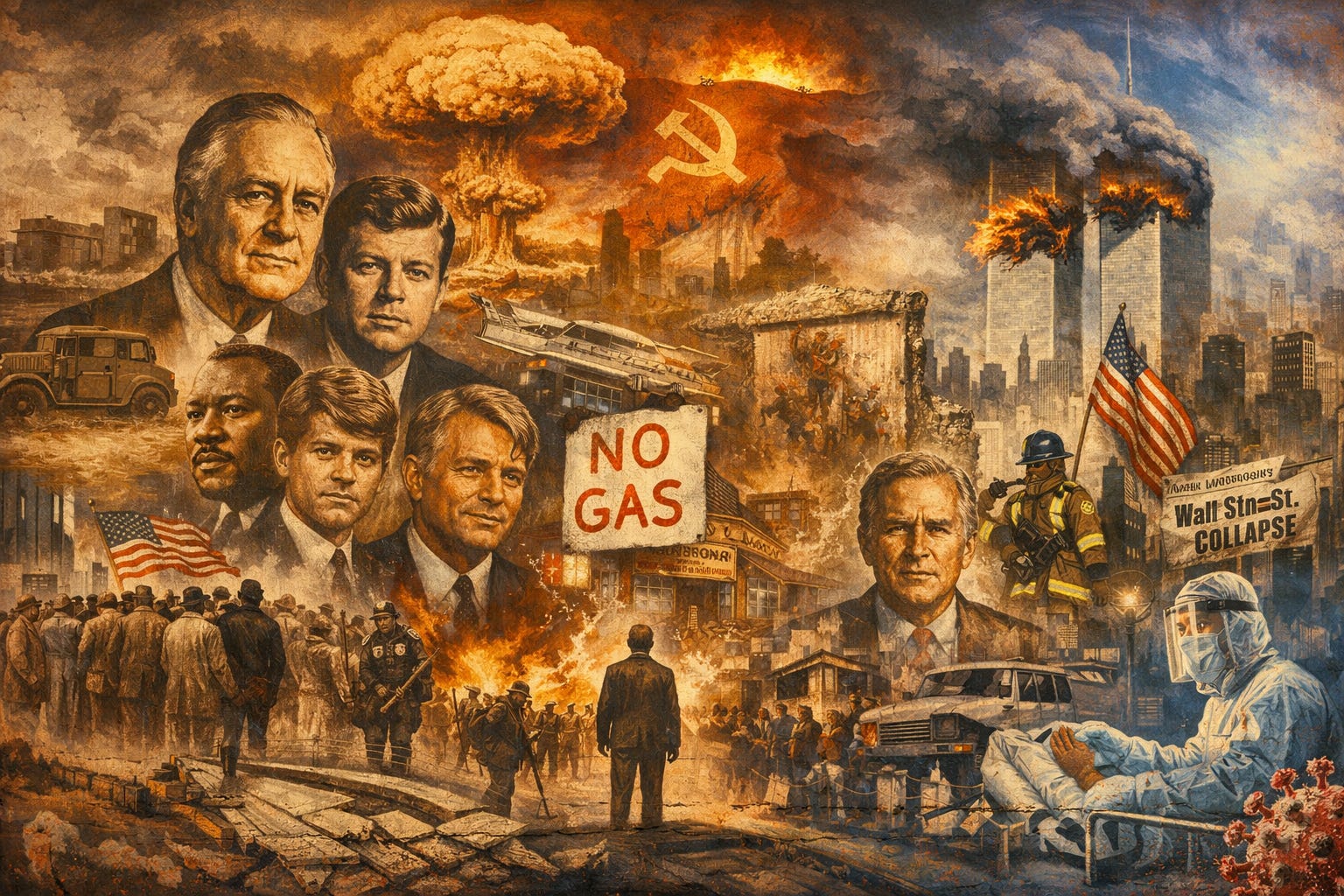
Franklin Roosevelt didn’t just run for president in 1932. He stepped into the vacuum created by economic collapse and offered a new definition of government. Ronald Reagan didn’t simply campaign in 1980. He translated the frustration of inflation, energy scarcity, and national stagnation into a story about American revival. George W. Bush’s reelection in 2004 wasn’t built on domestic policy alone. It was anchored in the emotional and strategic aftershock of September 11.
These campaigns don’t feel like traditional campaigns.
They feel inevitable.
And when you look at the current landscape—carefully, without forcing conclusions—you start to see something unusual forming.
Not a candidacy.
A position.
The Pattern Before the Event
There is always a period before the event where certain individuals begin to align themselves, consciously or not, with the conditions that an event would activate.
They are not necessarily predicting the event.
But they are speaking in a language that only becomes fully legible after something happens.
Right now, Tucker Carlson is operating in that space.
Not as a declared candidate. Not even as a traditional political actor. But as something more subtle:
A carrier of a framework.
Over the past several years, his positions have moved in a consistent direction. Not randomly. Not reactively. Structurally.
Opposition to foreign intervention, particularly in the Middle East
Increasing skepticism, and now open criticism, of the U.S.–Israel relationship
A reframing of adversaries like Russia and Iran as actors within a broader system rather than singular threats
A rejection of the idea that the United States can or should function as the uncontested global authority
An openness to a multipolar world, where power is negotiated rather than imposed
Taken individually, these positions can be debated, criticized, or dismissed.
But taken together, they form something more important:
A doctrine waiting for a trigger.
The Absence of a Defining Event—For Now
What makes this moment different from past cycles is that we are not yet anchored to a single defining event.
There is no Great Depression-level collapse.
No 9/11-style attack.
No singular geopolitical shock that dominates everything else.
Instead, we are in a phase of accumulation.
Rising geopolitical tension involving Iran
Energy instability tied to global conflict and supply constraints
A visible shift toward multipolar power dynamics involving China and Russia
Domestic economic pressure—cost of living, housing, wage stagnation
The early-stage disruption of labor and infrastructure tied to artificial intelligence
None of these, on their own, are sufficient to reorganize the political system.
But together, they create a kind of pressure.
A system under strain, waiting for a point of release.
And historically, that release tends to come not gradually—but all at once.
Why Tucker Fits the Event Model
If a significant event were to occur—particularly one tied to foreign policy, energy disruption, or a broader geopolitical realignment—the country would enter a familiar phase:
Confusion followed by interpretation.
This is where Tucker Carlson becomes relevant.
Because his current positioning is not optimized for a standard election cycle.
It is optimized for a moment of rupture.
He is not building a traditional campaign platform centered on tax rates, healthcare plans, or incremental policy adjustments.
He is building a narrative that answers a different question:
What if the system itself is wrong?
That distinction matters.
In a normal cycle, voters are choosing between competing management styles.
In an event-driven cycle, voters are choosing between competing explanations of reality.
And Tucker’s explanation is already in place.
The United States has overextended itself globally
Foreign conflicts are often misrepresented or driven by interests not aligned with the American public
The post-Cold War unipolar model is no longer sustainable
The future will require negotiation with rival powers rather than domination
These ideas, in a vacuum, can feel abstract.
But in the context of a major event, they become immediately actionable.
The “Magical Alignment” Problem
From a purely analytical standpoint, there is something almost unusual about how cleanly Tucker’s current framework aligns with the type of event that could reshape a presidential race.
Not because he caused anything.
Not because he predicted anything with certainty.
But because he has positioned himself in such a way that, if a specific type of event occurs, his message does not need to be built.
It only needs to be activated.
That is rare.
Most candidates spend months or years trying to retrofit their messaging to fit new conditions.
In this case, the messaging already exists.
It is simply waiting for conditions that make it feel obvious rather than controversial.
The Insurgency Pathway
If such an event were to occur, Tucker would not need to enter the race in a conventional way.
There would be no need for a slow rollout.
No need for immediate policy white papers or coalition-building exercises.
The pathway would look different:
Continued commentary reframing the event
Increased alignment with a segment of the electorate that feels misled or exhausted
Growing pressure on existing candidates to respond to his framing
A shift from commentator to participant, once the ground has already moved
In that sense, the campaign would not start with him.
It would start with the event.
And he would step into it as someone who appears to have already been speaking about it before it happened.
The Limitation
All of this comes with a clear constraint.
Event-driven candidates succeed when they can translate their interpretation into something tangible for voters.
Economic stability.
Security.
Order.
If Tucker remains primarily in the realm of geopolitical theory or civilizational critique, the ceiling becomes visible.
But if that framework is translated into:
Lower costs through reduced foreign entanglements
Energy expansion tied to national independence
A redefinition of sovereignty that includes economic and technological domains
Then the platform begins to move from abstract to actionable.
And that is where viability expands.
What This Actually Means
The key point here is not that Tucker Carlson is running for president.
It’s that he is positioned in a way that makes a run plausible under a specific set of conditions.
Conditions that historically have produced some of the most consequential presidential campaigns in American history.
Campaigns that did not begin with a slogan.
But with a moment.
If no such event occurs, his current positioning may remain influential but incomplete.
If an event does occur—particularly one that reinforces the themes he has been consistently advancing—then what looks today like commentary could very quickly become candidacy.
Final Thought
Every election cycle has candidates.
But only some cycles produce something else:
An event candidate.
Not built through the normal machinery.
But revealed by circumstances.
When you step back and look at the structure—not the noise, not the personalities, but the structure—Tucker Carlson appears to be aligned with that possibility.
Not guaranteed.
Not inevitable.
But positioned.
And in politics, positioning ahead of an event is often the difference between reacting to history…
…and stepping into it.